Seoulstart Korea Weekly
The KOSPI crashed twice, then staged the biggest rally in its history
The Korea Composite Stock Price Index (KOSPI) fell into a second circuit-breaker day on July 29, then rose 17.91% on July 31, the largest single-day gain in its history, as Samsung Electronics and SK hynix posted record quarterly profits. Also: Yoon Suk-yeol's new election-law conviction, Hyundai and Kia's diverging strike paths, Homeplus's targeted reopening, and Korea crossing the UN's super-aged threshold the same week Seoul jeonse hit ₩700 million.
The KOSPI crashed twice, then staged the biggest rally in its history
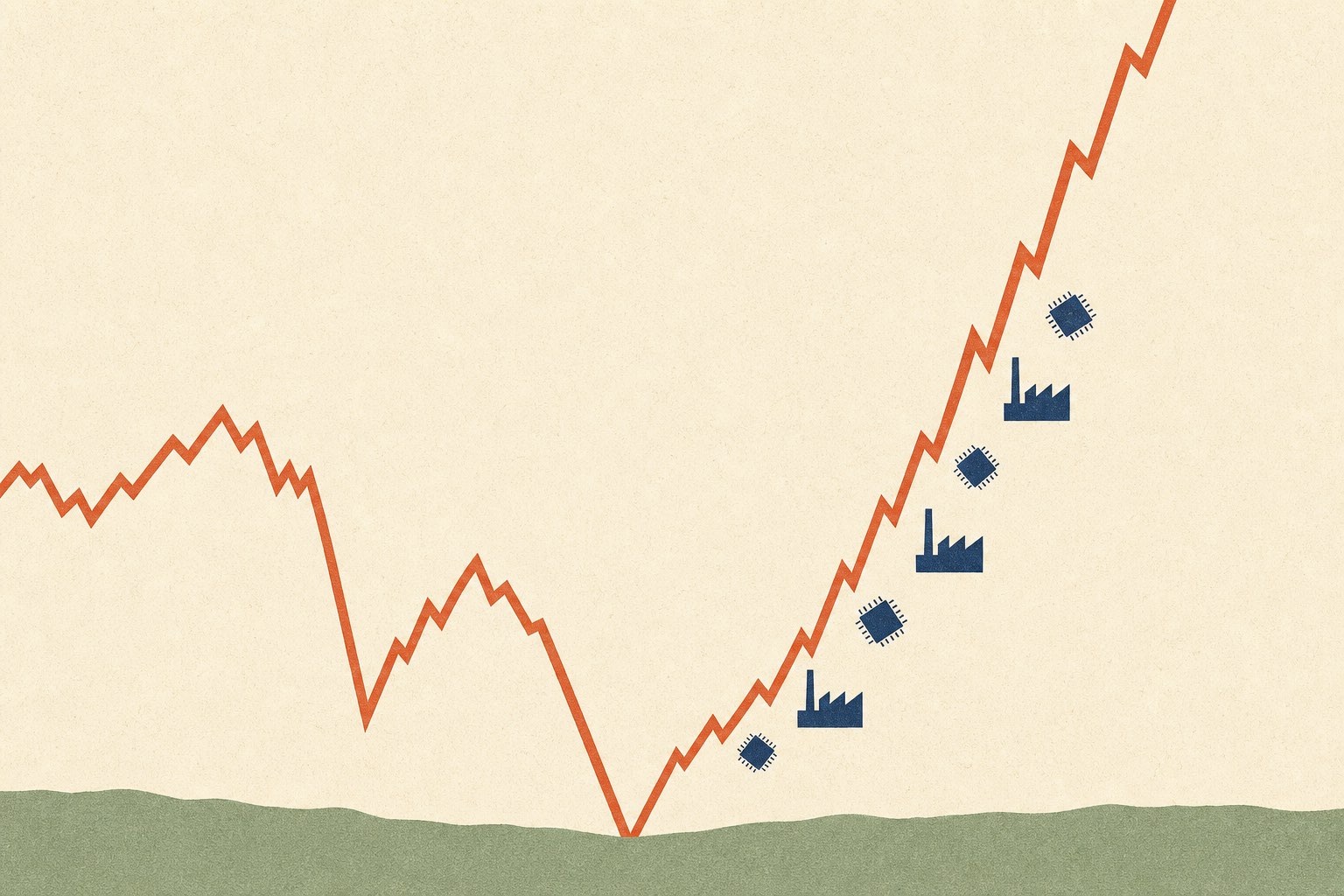
The Korea Composite Stock Price Index (KOSPI) hit a second circuit-breaker day July 29, then rose 17.91% on July 31, the largest single-day gain in its history.
Why this matters. The reversal wasn't just a market story. It came alongside record profits at Samsung Electronics and SK hynix, the two companies that make up roughly a third of the index, so the panic and relief among millions of retail investors traced back almost entirely to two earnings reports.
What changed. The KOSPI fell below 5,300 on July 29, then closed July 31 at 6,595.45, up 1,001.89 points on the day, a 17.91% rebound, per Financial News and Newsis.
The numbers.
- Samsung Electronics posted Q2 operating profit of 89.4924 trillion won, up 1,813.8% year on year, on record revenue of 171.4995 trillion won, per Hankyung; the stock closed up 26.81% on July 31, per Financial News, with market cap back above $1 trillion, per Financial News
- SK hynix posted Q2 operating profit of 60.5426 trillion won, a 76% margin, per Herald Corp; first-half cumulative revenue reached 131.895 trillion won, crossing 100 trillion for the first time, per A News and MBC; the stock hit its daily up-limit (상한가) for the first time in 17 years, closing up 29.95%, per Financial News
- Foreign investors net-bought a record 7.22 trillion won on July 31; individual investors net-sold a record 8.25 trillion won, per Money Today
- The Financial Services Commission (FSC) moved up a leverage-ETF deposit rule to July 31: leveraged Samsung and SK hynix ETF trades now need a 30-million-won cash-only deposit, up from 10 million won, settled T+2, per Newspim
- The US Federal Reserve held rates at 3.50 to 3.75% for a fifth straight meeting, per YTN
What this means for you. If you trade Korean leveraged single-stock ETFs, the new rule already applies: cash only, no last-minute top-ups from same-day stock sales.
The last time. Before July 31, the KOSPI's record one-day gain was 11.95%, set October 30, 2008, when the Bank of Korea and the US Federal Reserve announced a $30 billion currency swap during the Lehman Brothers collapse, per Economy Talk. Both moves reversed weeks of building panic with one external, confidence-restoring shock: a central-bank swap line in 2008, two chipmakers' earnings this time. The parallel is in the shape of the reversal, not a claim the two crises match in scale.
What's next. The Bank of Korea's next rate-setting meeting is August 27, and this week's volatility will shape that decision. More AI-capital-spending disclosures from US tech firms are still coming in August, the next test of whether the July 31 relief holds.
Korea This Week
Yoon picks up a new conviction, and Kim Keon Hee's next case gets a sentencing date
A Seoul court convicted former president Yoon Suk-yeol on election-law charges July 27, and the appeals of both Yoon and his wife, former first lady Kim Keon Hee, opened at the Seoul High Court July 29.
What changed. The Seoul Central District Court convicted Yoon of a Public Official Election Act violation, over a false public statement denying he introduced Kim Keon Hee to Jeon Seong-bae, a religious figure known as "Geonjin beopsa" (건진법사), a Buddhist-style title meaning roughly "Dharma master Geonjin"; the court described Jeon as a figure with shamanistic characteristics. The court sentenced Yoon to one year six months, suspended for three years, a separate case from his already-final martial-law conviction, per MBC and YTN. His appeal in the Pyongyang drone-infiltration case opened at the Seoul High Court the same week, closed to the public for national-security reasons, per Money Today. Kim Keon Hee's separate "position-selling" appeal also opened, per Newsis and Financial News; the court set closing arguments for September 9 and sentencing for September 22, per the Korea Times US edition.
What's next. Closing arguments in Kim Keon Hee's position-selling appeal are set for September 9, with sentencing September 22.
Hyundai's third strike round overlaps a factory shutdown; Kia chooses talks over a walkout
Hyundai Motor's union ran its third round of partial strikes July 29 to 31, while Kia's union secured a legal strike mandate but chose to keep negotiating.
What changed. Hyundai's third round ran four hours per shift across day and night crews, bringing cumulative strike hours this month to 60, per Money Today Network; the first two rounds alone caused about 673 billion won in production losses, roughly 15,800 vehicles, and industry projections made before the third round put the potential cumulative toll past 1 trillion won, per Money Today. Kia's Central Labor Relations Commission mediation failed July 27, granting the union a legal strike right, but on July 30 its strike committee voted to keep negotiating instead, delegating authority to refuse August overtime shifts as leverage, per EDaily and Ajunews.
What's next. Hyundai's union goes on summer vacation August 3 to 7 and may escalate afterward. Kia's production-line vacation runs through August 9, with intensive talks expected once both resume.
Homeplus targets reopening its 67 stores the second week of August
Homeplus and its labor union agreed to prioritize restocking and reopening stores as early as August 7 to 10, starting in the Seoul metro area.
What changed. 200 billion won in emergency debtor-in-possession financing is expected to land between July 31 and August 3. Reopening is phased, starting with Seoul metro stores and expanding through all 67 locations; supply-chain restoration and unresolved unpaid supplier claims are the key risk, per Herald Corp, ZDNet Korea, and Newspim.
What this means for you. If a Homeplus location near you closed, it may reopen within about a week. Worth checking before a special trip.
What's next. The target reopening window is August 7 to 10.
Korea crossed the "super-aged" threshold the same week Seoul's jeonse hit a record 700 million won
Korea's 65-and-older population reached 20.7% of the total for the first time, government data released July 28 showed.
The numbers.
- The 65-and-older population reached 10.723 million, 20.7% of Korea's 51.817 million total, crossing the UN's "super-aged society" threshold for the first time since Korea's census-taking began in 1925, per Kyunghyang Shinmun and Segye Ilbo
- Korea's working-age population, ages 15 to 64, fell below 70% of the total for the first time in 35 years, at 69.2% (35.87 million), per YTN
- Seoul's average apartment jeonse (전세) deposit crossed 700 million won for the first time on the KB index, at 704.58 million won, per Herald Corp; for a standard 84-square-meter apartment, the average real-transaction deposit reached 733.42 million won, up 7.2% in a year, per Segye Ilbo
An aging population, a shrinking working-age base, and rising rents on that same base all landed in the same week's data releases.
In Conversation
Korean financial media coined "roller coaster plus KOSPI (롤러코스피)" this week: the panic matched the numbers, not just the mood.
Worth knowing. 2026's average daily KOSPI move, 2.86%, has now exceeded the volatility benchmarks from both of Korea's defining financial crises: the 1998 Asian crisis averaged 2.46% daily moves, and the 2008 crisis averaged 1.67%, per Hankyung. That is why regulators tightened leverage-ETF rules twice inside two weeks despite public pushback, and why a week that read as "stocks went up" in English-language wire coverage landed very differently inside Korea, after weeks of genuine panic.
Retail investors who averaged down (물타기) into leveraged single-stock ETFs saw one widely cited position grow from 30 million won to 70 million won in additional buys; collective unrealized losses among retail SK hynix buyers hit roughly 8.3 trillion won mid-week before the July 31 rebound erased much of it, per Financial News. Retail investors split between calling July 31 "money-photocopying day (돈 복사의 날)" and others posting that they were "leaving the casino" for good, per Financial News.
Good Reads
- Bloomberg. "South Korea Stock Boom: Why Kospi Is World's Most Volatile Benchmark Stock Index." People have been asking why Korean stocks swing harder than almost anywhere else long before this week's crash-then-rally. This piece walks through why: heavy retail trading, an index leaning hard on a couple of chip giants, thin institutional buffers underneath. (link) (subscriber)
- Seoulstart. "Government Apps in Korea: What Foreign Residents Can Actually Do (2026)." Tax filing, ID verification, most government errands in Korea now run through an app, and the English support varies a lot from one to the next. This guide goes through them one by one so you know what to expect before you're stuck at a login screen.
- Seoul Economic Daily. "Bloomberg Warns Korea's Militant Labor Movement Poses Investment Risk." Global investors are watching Korea's strike calendar closely, and this explains why, down to Hyundai's new demand for job-security guarantees against AI and robots, a request that goes well past pay. (link)
- NK News. "Beyond the photo ops: What lies behind North Korea and China's diplomatic surge." North Korea and China have been meeting a lot lately, and this piece looks past the handshake photos to what Pyongyang actually wants out of the relationship right now. (link) (subscriber)
- The Korea Herald. "[Editorial] Demographic threshold." Korea just crossed the UN's super-aged threshold, and this editorial makes the case for why that should force faster movement on pension and labor reform. It's the paper's own opinion, not a news report, but a sharp one. (link)
New on Seoulstart this week
- Digital Korea: a new pillar guide on why Korean apps accept some people and reject others. Almost every service gates on four keys, an Alien Registration Card (외국인등록증), a phone number in your own name, a Korean payment method, and identity verification (본인인증). The guide maps which app needs what, in the order you can actually get them.
- The guides the pillar anchors: KakaoTalk setup, transit apps, T-money, emergency alerts, intercity travel booking, Kakao T, Naver Map, and government apps.
- Google Sign-in (site-wide): signing up now takes one tap with a Google account, no new password to create.
- Jobs board: the Saved-jobs tab merged into My Jobs, one place to track applications and saved listings.
That's Seoulstart Korea Weekly for this week. See you next week.
Sources cited in this issue · 21 publishers, 36 links
ajunews.com
biz.heraldcorp.com
bloomberg.com
economytalk.kr
edaily.co.kr
fnnews.com
hankyung.com
Korea Herald
koreatimes.com
m.anewsa.com
MBC News
mt.co.kr
news.mtn.co.kr
Newsis
newspim.com
nknews.org
segye.com
Seoul Economic Daily (English)
v.daum.net
ytn.co.kr
zdnet.co.kr
Seoulstart curates and interprets; original reporting belongs to the outlets above.