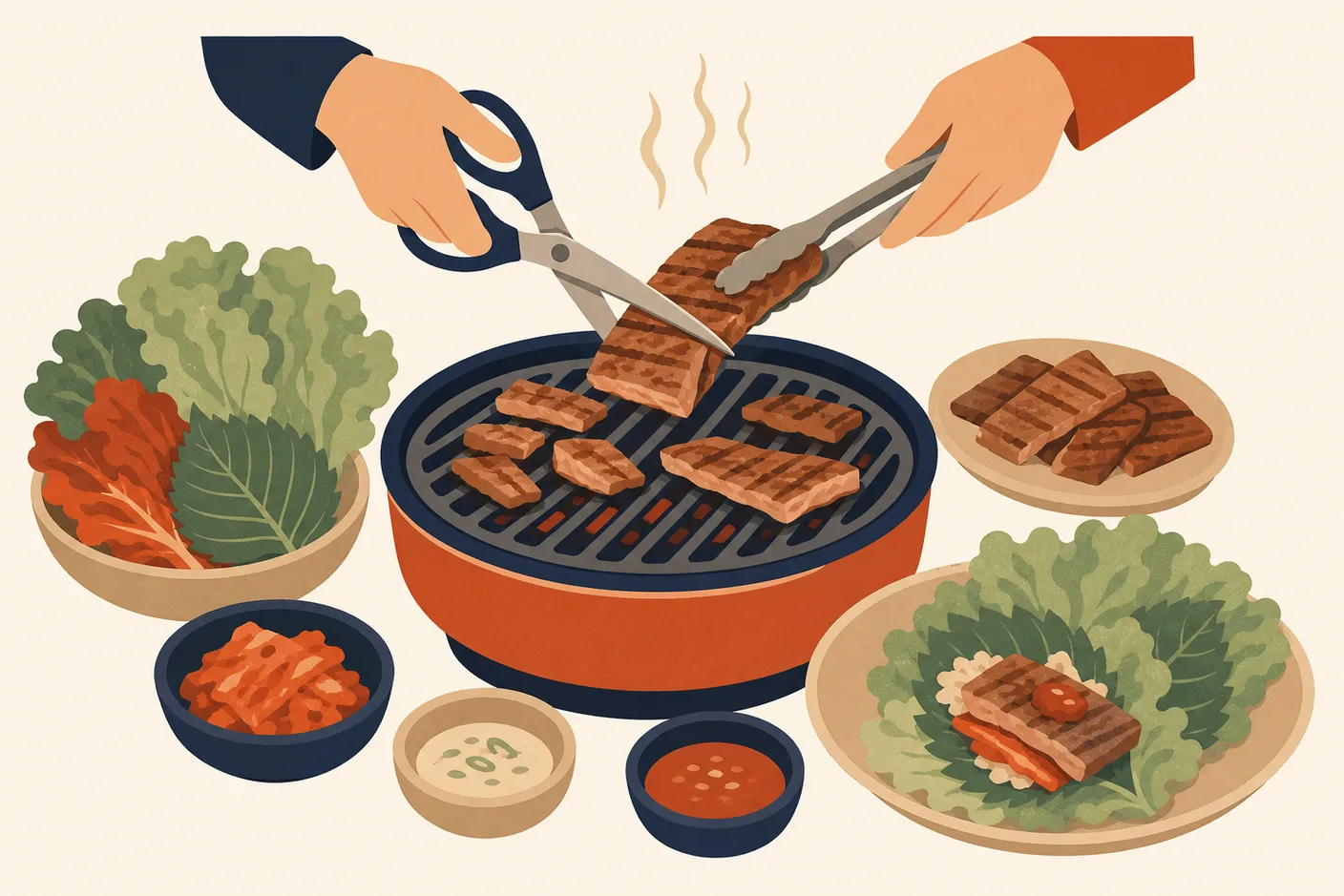
The menu is in Korean and the cuts don't map to anything a Western butcher would recognise. Here is what you need to know before you sit down.
How a Korean BBQ meal works
You order by the portion, and most restaurants require a minimum of two portions (2인분, i-inbun) per table. That applies even if you are eating alone. Solo-friendly BBQ restaurants exist but are a minority, mostly in larger cities. If you want to eat solo, call ahead or look for signs saying 1인 가능 (solo dining allowed).
When you sit down, the table already has a built-in gas or charcoal grill in the centre. Staff will light it. A set of small side dishes called banchan (반찬) arrives with your order at no extra cost: typically kimchi, pickled radish, bean sprouts, and a few others. The staple sides are refillable. Say "이거 더 주세요" (igeo deo juseyo, "more of this please") or "리필 가능해요?" (ripil ganeungheyo?, "can I get a refill?"). Specialty sides may cost extra.
At a neighbourhood restaurant, you grill your own meat. By informal custom, the youngest person at the table manages the tongs and watches the grill. Mid-range and premium restaurants often have staff who cook for you, or who at least get things started. If you are unsure of the protocol, watch the next table.
Wrapping the meat: ssam (쌈)
Most tables come with a plate of lettuce (상추, sangchu) and perilla leaves (깻잎, kkaennip). Put a piece of grilled meat on a leaf, add a small amount of ssamjang (쌈장, a thick paste of fermented soybean and chili), a slice of garlic, and some scallion salad (파절이, pajeorim). Fold it into a parcel and eat in one bite. This is ssam (쌈).
Changing the grill plate
When the grill plate (불판, bulpan) gets heavily charred, or when you switch from unmarinated to marinated meat, ask for a replacement. Say "불판 갈아주세요" (bulpan garajuseyo). The reason to change before marinated meat: the sugar in marinades burns quickly on a plate coated in old residue.
Finishing the meal
After the main meat, many restaurants offer one of three options to close out the meal: fried rice (볶음밥, bokkeumbap) cooked on the still-hot grill, cold buckwheat noodles (냉면, naengmyeon), or a fermented soybean stew (doenjang jjigae, 된장찌개). These are common but not universal. Check the menu or ask.
Tipping and drink etiquette
There is no tipping in Korea. Do not leave money on the table.
Soju (소주) and draft beer (생맥주, saengmaekju) are common drink pairings, though neither is required. If someone older pours a drink for you, receive the glass with two hands. By custom, you do not pour your own drink before attending to others at the table.
The cuts: what to order
Most menus focus on pork, with beef options at a higher price point. The table below covers the cuts you will encounter most often.
| English name | Korean | What it is |
|---|---|---|
| Pork belly | 삼겹살 (samgyeopsal) | Thick layered belly, the default order at any Korean BBQ restaurant. Cooked unmarinated on the grill. |
| Pork shoulder / neck | 목살 (moksal) | Leaner than pork belly, often a little cheaper. |
| Pork jowl | 항정살 (hangjeongsal) | A small-yield premium cut with a distinct chewy texture. Found at specialist pork restaurants. |
| Marinated pork ribs | 돼지갈비 (dwaeji-galbi) | Usually marinated in soy sauce or chili paste before grilling. |
| Beef short ribs | 소갈비 / 갈비 (so-galbi / galbi) | Premium bone-in ribs, typically marinated. Often cut LA-style across the bone. |
| Shaved brisket | 차돌박이 (chadolbaegi) | Paper-thin slices that cook in seconds. Dip in sesame oil and salt rather than ssamjang. |
| Sirloin / marbled sirloin | 등심 / 꽃등심 (deungsim / kkotdeungsim) | "꽃" means flower and refers to the marbling pattern. A premium beef cut. |
| Small intestine | 곱창 (gopchang) | Pork or beef small intestine. Common at offal-specialist restaurants. |
| Large intestine | 대창 (daechang) | Beef large intestine. Richer and fattier than gopchang. |
| Beef abomasum | 막창 (makchang) | The fourth stomach chamber of a cow, not intestine. Has a chewy texture and a distinct flavour. Common in Daegu-style BBQ. |
Reading the hanwoo grade label
Hanwoo (한우) is Korean domestic beef. Restaurants are required by law to label whether the beef is hanwoo or imported (수입산, suipssan). If you are at a premium beef restaurant and want to know the grade before ordering, ask: "몇 등급이에요?" (myeot deunggeub-ieyo?, "what grade is it?").
The grading authority is the Korea Institute for Animal Products Quality Evaluation (KAPE, 축산물품질평가원). The primary grading factor is the Beef Marbling Score (BMS), which runs from 1 (least marbled) to 9 (most marbled). The final grade is the lowest score across four criteria: marbling, meat color, texture, and maturity.
The BMS-to-grade mapping below reflects the revised criteria that took effect in December 2019:
| Grade | BMS range | What it means in practice |
|---|---|---|
| 1++ | BMS 7, 8, or 9 | Highest marbling. The top tier at premium hanwoo restaurants. |
| 1+ | BMS 6 | High marbling. Still premium; less expensive than 1++. |
| 1 | BMS 4 or 5 | Good marbling. The quality level at most mid-range hanwoo restaurants. |
| 2 | BMS 2 or 3 | Light marbling. |
| 3 | BMS 1 | Minimal marbling. |
The December 2019 revision added BMS 7 to the 1++ band. Before the revision, 1++ required BMS 8 or 9. Industry figures cited by KAPE suggest the change raised the share of cattle graded 1++ from roughly 12 to 15% to around 25.6%, so the 1++ label is more common now than it was before 2019. As of June 2026, the December 2019 criteria remain in effect based on publicly available KAPE materials; check the KAPE grade table directly if you need to verify this for a purchasing or sourcing decision.
The two-portion minimum and solo dining
The two-portion minimum (2인분) is a house policy, not a legal requirement. Most restaurants apply it because the table grill setup and the cost of banchan and gas make a single portion uneconomical to serve. Some restaurants post a sign near the entrance or on the menu; others only raise it when you order.
If you want to eat Korean BBQ alone, look for restaurants that advertise 1인 가능 or 혼밥 OK. These are more common in areas with large numbers of office workers eating lunch solo. In the evening, a single counter seat at a neighbourhood moksal or samgyeopsal specialist is the easiest route.
Price tiers
Prices vary by cut, restaurant type, and neighbourhood. The figures below are directional ranges as of mid-2026 and reflect typical Seoul pricing; verify current prices at the restaurant before ordering.
Neighbourhood pork (삼겹살 / 목살)
Korea Consumer Agency ChamPrice listed Seoul's average samgyeopsal restaurant price at ₩21,321 per converted 200g portion for April 2026. Expect roughly ₩20,000 to ₩22,000 per 200g portion at a typical Seoul restaurant. Neighbourhoods away from tourist areas and major commercial strips tend to run ₩2,000 to ₩4,000 cheaper.
Mid-range beef (차돌박이, 목심, 등심)
₩20,000 to ₩45,000 per portion. These cuts appear on menus at both pork-focused restaurants and dedicated beef specialists.
Premium hanwoo (소갈비, 꽃등심, 1++ grade)
₩40,000 to ₩80,000 or more per 100 to 150g at a dedicated hanwoo restaurant. Grade 1++ commands the highest prices. Some restaurants price by the 100g and some by the portion; confirm the unit before ordering.
All-you-can-eat (무한리필, muhanripil)
₩17,900 to ₩29,900 per person. Usually limited to a set time, typically 90 minutes to two hours. Meat quality is lower than at a la carte restaurants, but it is a practical option for a large group on a budget.
FAQ
Do I have to order a minimum amount at a Korean BBQ restaurant?
Most restaurants require a minimum of two portions (2인분) per table. This is a house norm, not a law, but nearly every pork-belly and beef restaurant enforces it. Solo-dining BBQ restaurants do exist but are the minority, mostly in larger cities. If you are eating alone, check before you sit down.
What is the difference between hanwoo and imported beef at a Korean BBQ restaurant?
Hanwoo (한우) is Korean domestic beef, graded by KAPE and required by law to be labeled at the point of sale. Imported beef is labeled 수입산 (suipssan). Hanwoo costs significantly more and is prized for marbling. To ask the grade, say "몇 등급이에요?" (myeot deunggeub-ieyo?).
Who is supposed to grill the meat?
At most neighbourhood restaurants you grill your own. By informal custom, the youngest person at the table manages the tongs. Mid-range and premium restaurants often have staff who start the fire and rotate the meat. If you are unsure, watch what the next table does or let staff take the lead.
What do the hanwoo grades 1++, 1+, 1, 2, and 3 actually mean?
The grade is based primarily on a Beef Marbling Score (BMS) from 1 to 9, where 9 is the most marbled. Under the grading criteria revised in December 2019: 1++ equals BMS 7, 8, or 9; 1+ equals BMS 6; 1 equals BMS 4 or 5; 2 equals BMS 2 or 3; 3 equals BMS 1. The final grade also accounts for meat color, texture, and maturity, so the lowest of those sub-scores determines the overall grade.
How much does Korean BBQ cost?
Pork belly (삼겹살) averages around ₩21,000 per 200g in Seoul as of early 2026, with neighbourhood spots typically ₩2,000 to ₩4,000 cheaper than tourist-area restaurants. Mid-range beef cuts run ₩20,000 to ₩45,000 per portion. Premium hanwoo restaurants charge ₩40,000 to ₩80,000 or more per 100 to 150g. All-you-can-eat options run ₩17,900 to ₩29,900 per person, usually with a time limit.
Can I ask for the grill plate to be changed?
Yes. Say "불판 갈아주세요" (bulpan garajuseyo) and staff will swap in a clean grill plate. Do this when the plate is heavily charred or before switching from unmarinated to marinated meat, since the sugar in marinades burns fast on a used plate.