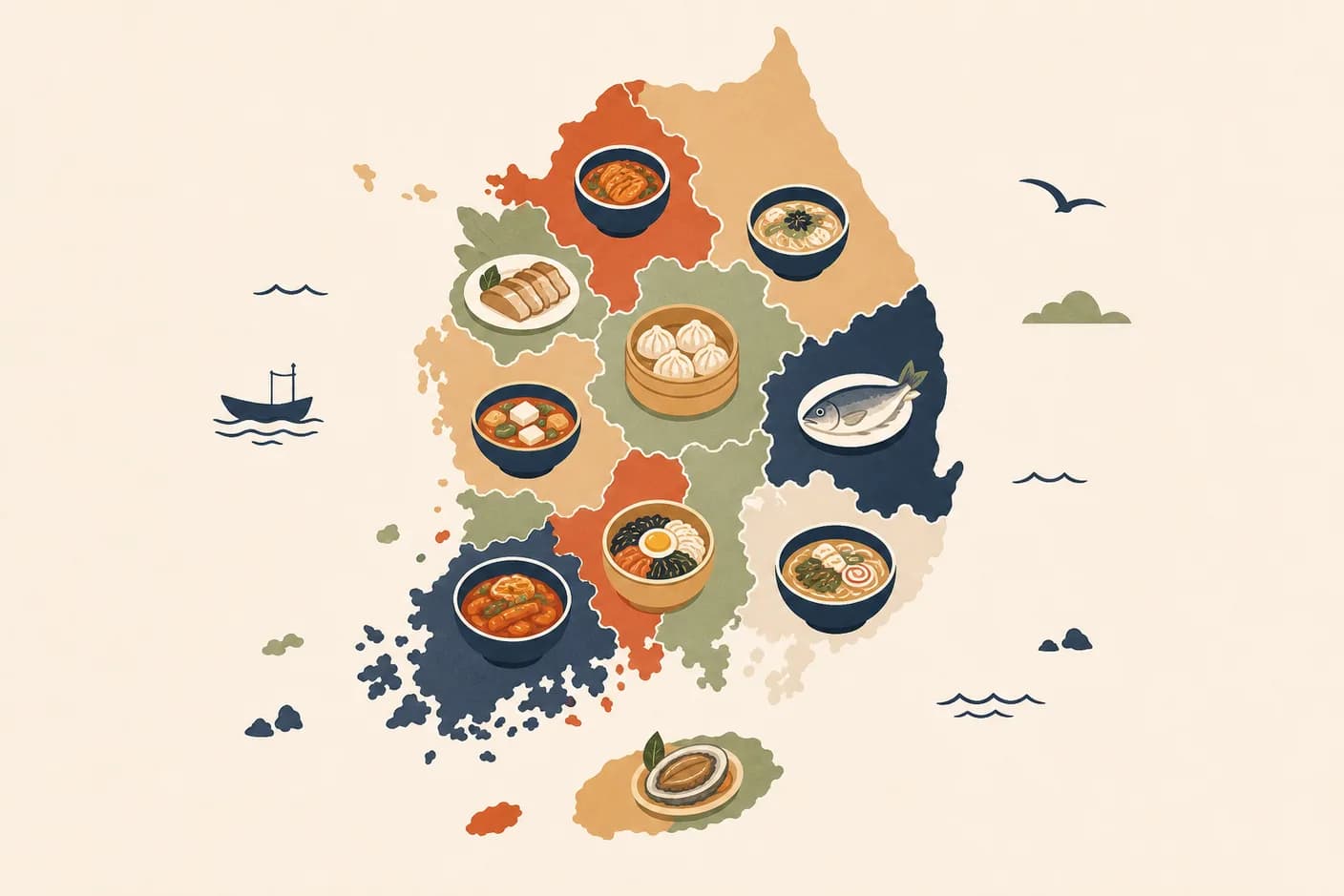
You live in Korea, you travel on weekends, and you want to know what Koreans mean when they say "you have to eat X when you go to Y." This is that map.
Korea has a strong culture of linking food to place. Ask a Korean colleague where they are going for Chuseok and they will mention what they plan to eat there. The government's K-Local Food 33 program has formalized one official signature dish per city, but the mental map Koreans carry is older and messier than any official list. This guide covers both.
The K-Local Food 33 program: a useful starting point
South Korea's government designates 33 cities and regions, each with one signature dish under the K-Local Food 33 program. VisitKorea publishes the full list in English. It is a reasonable first reference for trip planning, but the official picks do not always match what locals would tell you to order first. Where the two differ, this guide notes both.
If you would rather cook some of these dishes at home, Seoulstart's grocery directory lists foreign and international grocery stores around the country.
Once you know what a city is known for, you can find a long-running place to eat it. Seoulstart's Heritage Restaurants directory lets you browse by region and by dish.
Region by region
Chuncheon (춘천): spicy stir-fried chicken
Chuncheon is about an hour from Seoul by ITX express train, and the local food is the main reason many Seoulites make the trip. Dakgalbi (닭갈비) is the city's K-Local Food 33 dish: marinated chicken cooked on a large iron griddle with cabbage, sweet potato, rice cake, and a thick gochujang-based sauce. It is cooked at the table and arrives loud and smoking.
Makguksu (막국수, cold buckwheat noodles) is a secondary Chuncheon specialty, particularly popular in summer. Served chilled with radish kimchi and a vinegar-soy dressing, it is the dish locals eat after dakgalbi to cool down. It is not part of the K-Local Food 33 list but is widely associated with the city.
Both dishes are available at market-level stalls and sit-down restaurants. The market street near Chuncheon Station has stalls for makguksu at lower prices; sit-down restaurants around Myeongdong (Chuncheon's, not Seoul's) are the place for dakgalbi.
Suwon (수원): jumbo beef ribs
Suwon's wanggalbi (왕갈비, literally "king ribs") are long-cut beef ribs seasoned with salt rather than the sweet soy marinade common elsewhere in Korea. The portion is large, the cut is thick, and the flavor is about the beef itself. The city's rib street has operated for decades and was formalized as a K-Local Food 33 designation in 1985.
This is a sit-down grill restaurant experience, not a market stall. Most restaurants on Suwon's rib street serve the ribs with a set of side dishes.
Jeonju (전주): the most food-focused city in Korea
Jeonju (전주) is a UNESCO City of Gastronomy and the city Koreans most associate with food as a destination. Its K-Local Food 33 dish is bibimbap (비빔밥), the mixed rice bowl that appears on menus everywhere in Korea but reaches its highest form here. The Jeonju version uses a hot stone pot (dolsot, 돌솥), local bean sprout, seasoned vegetables, raw egg yolk, and gochujang. The toppings and side dishes that come alongside are far more numerous than the standard restaurant version.
Kongnamul gukbap (콩나물국밥, bean-sprout rice soup) is the city's breakfast dish and a legitimate reason to arrive hungry in the morning. It is a mild broth with rice and bean sprouts; you season it yourself with fermented shrimp and add a raw egg that cooks in the hot broth.
The Seosin-dong makgeolli (막걸리) alley is a third draw: small side dishes appear automatically when you order the rice wine, with more arriving as you order more bottles. Prices are low, the atmosphere is relaxed, and it runs well into the night.
Andong (안동): braised chicken and traditional rice
Andong (안동) is deep in North Gyeongsang Province and carries a reputation as one of Korea's most traditionally Confucian cities. Its food reflects that.
Jjimdak (찜닭) is the K-Local Food 33 designation: a wide shallow pot of braised chicken with glass noodles, potatoes, dried chili, and a soy-based sauce. It originated in the traditional market alley in central Andong in the 1980s. Spice level ranges from mild to very hot depending on the restaurant.
Heotjesabap (헛제사밥, "fake ancestral-rite rice") is a more unusual dish: a recreation of the food served at Confucian ancestral rites, intentionally plain, with no meat or garlic. The name literally means "empty ceremony rice." It is a sit-down experience at a handful of traditional restaurants and tells you something about the city's character.
Andong soju (안동소주, 안동소주) is also a K-Local Food 33 item: a traditionally distilled soju at 40–50% ABV, completely different from the commercial soju sold across Korea. A small bottle at a traditional market stall is a straightforward purchase.
Sokcho (속초): stuffed squid and refugee noodles
Sokcho sits on the east coast near the North Korean border, and its food carries the history of the Korean War refugees who settled here.
Ojingeo sundae (오징어순대) is Sokcho's local specialty: whole squid stuffed with seasoned rice and vegetables, then steamed or pan-fried. Sold at market stalls near the central bus terminal and the Abai Village area.
Abai sundae (아바이순대) is a separate dish with a separate origin. It is a North Korean-style pork sausage brought to Sokcho by refugees who recreated food from their home regions. Both are sold on the same market street, which causes confusion. They taste different and come from different traditions. Try both.
Tongyeong (통영): oysters and plain gimbap
Tongyeong (통영) on the southern coast produces a large share of Korea's farmed oysters (굴) and is the K-Local Food 33 designation for the city. Oysters here are eaten grilled, raw, in stew, and fried, in every possible preparation. The season to visit is November through March. Outside that window, freshness and preparation style vary, so winter is the best season for an oyster-focused trip.
Chungmu gimbap (충무김밥) is the city's other well-known dish: small, plain rice rolls with no filling, served alongside spicy squid and radish kimchi. The contrast between the plain rice and the spicy accompaniments is the point. It was originally street food sold on boats in the port; now it is found at sit-down restaurants and food stalls throughout the city.
Damyang and Gwangju: minced-rib patties and contested origin
Ddeokgalbi (떡갈비, minced rib patties) appears on both cities' food maps, and the overlap is genuine. Damyang (담양) holds the K-Local Food 33 designation. But Gwangju's Songjeong-dong neighborhood has had dedicated ddeokgalbi restaurants since 1976, and locals from both cities consider the dish their own. The official K-Local Food 33 entry for Gwangju city itself is actually yukjeon (육전, pan-fried battered beef slices), a different dish entirely.
Ddeokgalbi is minced beef and pork rib meat pressed around a rib bone and grilled. The texture is closer to a firm meatball than a standard galbi cut. Sit-down restaurants in both cities serve it as a main dish with rice and side dishes.
Damyang also produces daetongbap (대통밥, rice steamed inside bamboo segments), which arrives still inside the cane and has a faint bamboo fragrance. The surrounding area is famous for bamboo groves, and the ingredient runs through local food culture.
Boseong (보성): green tea as an ingredient
Boseong (보성) produces around 40% of Korea's green tea (녹차) on hillside plantations. It is an ingredient identity rather than a single dish. The Daehan Dawon plantation is the most photographed tea field in the country.
The food you encounter in Boseong is tea-inflected: green-tea ice cream, green-tea noodles, and green-tea rice. None of these is a formal K-Local Food 33 dish. The plantation visit is the main experience, and the tea-based food accompanies it.
Busan (부산): the city with two cold noodles and a morning soup
Busan is Korea's second city and has more food identity per square kilometer than almost anywhere else.
Dwaeji gukbap (돼지국밥, pork-bone rice soup) is the K-Local Food 33 dish and the city's morning staple. A milky pork-bone broth served with rice, thin-sliced pork, and a set of condiments you use to season the soup yourself: salted shrimp, fermented leek, and gochugaru. Most Busan dwaeji gukbap restaurants open early and close by the afternoon.
Milmyeon (밀면, cold wheat noodles) was created by Korean War refugees in Busan who could not get the buckwheat needed for naengmyeon. They adapted the dish using wheat flour, which was available from US military aid supplies. The result is a lighter, thinner noodle served cold with a mild beef broth or a spicy sauce. It is distinct from naengmyeon (냉면) and a genuinely Busan dish.
Ssiat hotteok (씨앗호떡, seed-filled pancake) is the street food of Nampo-dong near BIFF Square. Standard hotteok is sweet and filled with brown sugar; Busan's version adds sunflower seeds, pumpkin seeds, and peanuts to the filling. Sold from street stalls and eaten hot.
Gyeongju (경주): the old capital's bread and wraps
Gyeongju was the capital of the Silla Kingdom for nearly a thousand years, and the city's food culture draws on that heritage in various ways.
Hwangnam-ppang (황남빵, often translated as "Gyeongju bread") is the most tangible result. A soft pastry filled with red bean paste, it has been made by the same family operation since 1939. It is sold at dedicated bakeries and souvenir shops throughout the city. Market stalls near Tumuli Park sell it fresh.
Ssambap (쌈밥, leaf-wrap rice) appears on some menus in Gyeongju framed as a continuation of Silla court dining. This connection is a tourism narrative rather than a documented historical fact. Ssambap as a style of eating, rice and side dishes wrapped in fresh leaves, is widespread across Korea. Gyeongju restaurants serve a generous version of it; the Silla angle is marketing.
Mokpo (목포): fermented skate
Mokpo (목포) is the hongeo (홍어) city, and this is the dish most foreign residents find either fascinating or alarming. Hongeo is skate fermented without refrigeration, a process that produces ammonia as a byproduct. The smell in a hongeo restaurant is noticeable before you sit down.
The standard way to eat it is hongeo samhap: a single bite composed of fermented skate, sliced pork belly, and kimchi together. The pork and kimchi soften the intensity of the skate. The ammonia bite is real but brief; the aftertaste is savory. It is a K-Local Food 33 dish and a genuine regional specialty, not a novelty.
Yeosu (여수): pike eel
Yeosu (여수) on the southern coast is known for pike eel (갯장어), grilled or served as a soup. It is the city's K-Local Food 33 dish. The meat is firm, mild, and distinct from the freshwater eel (장어, jangeo) common elsewhere. Peak season is summer. Gejang (게장, raw marinated crab) is a secondary local specialty worth seeking out.
Daegu (대구): fried chicken and grilled intestines
Daegu is Korea's fried chicken capital by reputation. The yangnyeom (양념) sweet-spicy sauce that defines a major category of Korean fried chicken was invented here in 1982, and the city's K-Local Food 33 designation reflects that history. This is sit-down and delivery territory, not street food.
Makchang (막창, grilled pork large intestine) is the dish Daegu locals eat after work on the Anjirang street in Dalseong-gun. It is grilled over charcoal and dipped in doenjang sauce. The smell while cooking is strong, and the texture is chewy. It is specific enough to Daegu that Koreans from other cities treat visiting a makchang street as a worthwhile detour.
Napjak mandu (납작만두, flat dumplings) are Daegu's contribution to dumpling culture: thin, wide, almost cracker-like dumplings fried crisp, typically eaten as a street snack.
Jeju Island (제주도): black pork and hairtail fish
Jeju has two strong food identities.
Black pork (흑돼지, heuk-dwaeji), from the heritage breed raised on the island, is the K-Local Food 33 designation. The fat is darker, the flavor is stronger, and the texture is different from the pork available on the mainland. It is eaten grilled and wrapped with island-grown garlic, green onion, and ssamjang (쌈장).
Galchi (갈치, hairtail fish) is the other major Jeju dish. Served braised as galchi jorim (갈치조림) or grilled as galchi-gui, it is a long silver fish with a mild but distinctive flavor. Jeju galchi is considered superior to mainland-sourced hairtail, and locals can explain the difference in some detail.
Haenyeo (해녀, female divers) seafood including abalone (전복, jeonbok) and sea urchin (성게, seongge) is available at haenyeo-operated stalls near the coast. Prices vary widely; stalls near major tourist sites charge more than those in smaller coastal villages.
A few more cities worth noting
Incheon (인천) is where jjajangmyeon (짜장면, black bean sauce noodles) entered Korean cuisine through the Chinatown near the port. The dish is now everywhere in Korea, but the original Incheon Chinatown restaurants are the historical starting point. Ganjang gejang (간장게장, raw crab marinated in soy sauce) is also an Incheon K-Local Food 33 item.
Gangneung (강릉) on the east coast has chodang sundubu (초당순두부), fresh tofu made with seawater instead of the standard brine coagulant. The result is softer, creamier, and faintly briny. Available at tofu-specific restaurants near the Chodang neighborhood.
Daejeon (대전) holds a K-Local Food 33 designation for kalguksu (칼국수, hand-cut noodle soup), a category of soup common across Korea but made here with a broth and noodle style that locals consider distinctively their own.
FAQ
What is the K-Local Food 33 program?
The Korean government's K-Local Food 33 program designates one signature dish for 33 cities and regions. VisitKorea publishes the full list in English. It is a useful baseline for trip planning, though the official picks do not always match what locals would tell you to prioritize.
Is Jeonju worth visiting just for the food?
Yes. Jeonju is a UNESCO City of Gastronomy and the city Koreans most associate with food as a destination. Bibimbap (비빔밥) here is made with a hot stone pot, local ingredients, and far more side dishes than the standard restaurant version. Kongnamul gukbap (콩나물국밥, bean-sprout rice soup) is worth waking up early for. The Seosin-dong makgeolli (막걸리) alley serves traditional rice wine with small plates at low prices, and more plates arrive automatically as you order more.
What should I know before trying hongeo in Mokpo?
Hongeo (홍어, fermented skate) has a strong ammonia smell and a sharp heat on the tongue from the fermentation. That is not a sign the fish has gone off. Locals eat it as hongeo samhap: one bite of skate wrapped with pork belly and kimchi together. That combination softens the intensity. The smell in the restaurant will be noticeable before you sit down.
What is the difference between ojingeo sundae and abai sundae in Sokcho?
These are two separate dishes. Ojingeo sundae (오징어순대) is a local Sokcho specialty: whole squid stuffed with seasoned rice and vegetables, then steamed or pan-fried. Abai sundae (아바이순대) is a North Korean-style pork sausage brought to Sokcho by Korean War refugees. Both are sold on the market street near Abai Village. They taste different and have different origins.
Are there good regional dishes to try on a day trip from Seoul?
Several. Chuncheon (춘천) is about an hour from Seoul by ITX and is the place for dakgalbi (닭갈비, spicy stir-fried chicken). Suwon (수원) is 30 minutes by train and built its reputation on wanggalbi (왕갈비, jumbo salt-seasoned beef ribs). Gangneung (강릉) is a two-hour KTX ride and has chodang sundubu (초당순두부), fresh seawater tofu that tastes different from anything available in Seoul.
What is Namdo cuisine?
Namdo (남도) refers to the cuisine of South Jeolla Province, in the southwestern corner of Korea. It is known for serving the largest number of side dishes at a single meal, bold fermented flavors, and heavy use of seafood. Gwangju (광주) and Jeonju (전주) are the two main cities. A traditional Namdo meal served at a hanjeongsik (한정식) restaurant will arrive with 20 or more small dishes alongside the main course.