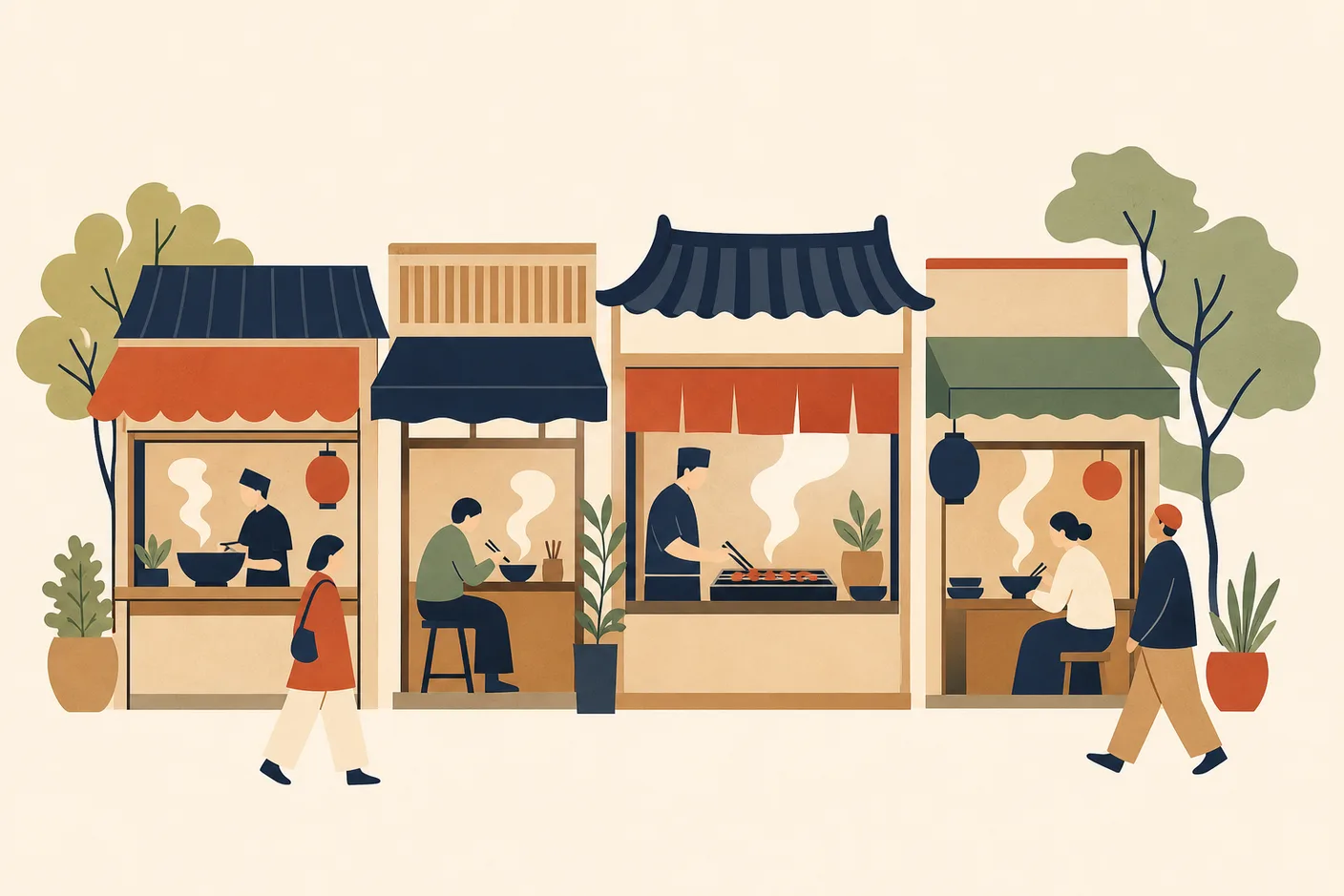
The sign tells you everything
Korean restaurant signs carry information that English-speaking visitors miss entirely. The signs say 분식, 고깃집, 포차, 호프, 한정식. None say "restaurant" in English. One is a beer pub, one is a full dinner, one is the Korean equivalent of a fast-food counter.
The sign is the entire menu before you walk in. It tells you the price range, the type of food, the social context, and roughly how long you will be there. Learn the system and you can read a Korean street in about ten seconds.
This guide decodes the taxonomy.
The cuisine prefix: what comes before -식
Many restaurant signs begin with a cuisine marker followed by 식 (食, food) or 식당 (食堂, dining hall). The prefix tells you the cuisine.
| Prefix | Korean | Cuisine |
|---|---|---|
| 한식 | 韓食 | Korean food |
| 일식 | 日食 | Japanese food |
| 중식 | 中食 | Chinese-Korean food |
| 양식 | 洋食 | Western food (pasta, steak, pizza) |
A note on 중식 (jungsik): in Korea, Chinese-style restaurants typically serve the Korean-Chinese canon, not mainland Chinese cooking. That means jjajangmyeon (짜장면, black bean noodles), jjamppong (짬뽕, spicy seafood soup), and tangsuyuk (탕수육, sweet-and-sour pork). These are Korean adaptations developed over decades. They are their own category of food.
The major venue types: decoded by price and context
Quick reference table
The price bands below are rough orientation only, to help you sort venues from cheapest to most formal. Individual dish prices are not centrally tracked and move with inflation, so always confirm current prices on Naver Maps or at the venue.
| Sign | What it is | Relative cost | Notes |
|---|---|---|---|
| 식당 | Generic casual restaurant | Low to mid | Usually Korean, affordable |
| 분식집 | Cheap snack food | Lowest | Counter service, fast |
| 백반집 | Home-style set meal | Low | Declining fast nationwide |
| 고깃집 | Korean BBQ | Mid to high | Pork more affordable; Korean beef much higher |
| 횟집 | Raw fish restaurant | Mid to high | Common in coastal cities |
| 한정식집 | Full-course traditional Korean | Mid to very high | Formal; some neighborhood spots cheaper |
| 포장마차/포차 | Tent bar | Low (per dish) | Soju culture, often cash only |
| 호프집 | Korean beer pub | Low to mid | Draft beer, fried chicken |
| 국밥집 | Rice-in-soup | Low | Often 24 hours |
| 냉면집 | Cold noodles | Low to mid | Two main regional styles |
| 칼국수집 | Knife-cut noodle soup | Low | Prices rose fast recently |
| 한식뷔페 | Korean buffet | Mid | Unlimited banchan and rice |
| 김밥천국 type | 24h fast-casual | Low | Extensive laminated menu |
The generic restaurant (식당, sikdang)
식당 is the Korean word for "restaurant." When it appears alone on a sign, it usually means a casual Korean meal at a reasonable price. You sit down, order from a menu, food arrives. Think neighborhood lunch spot.
The word also combines with cuisine prefixes: 한식당 (Korean restaurant), 일식당 (Japanese restaurant). When you see the prefix, use the cuisine table above.
The cheap snack shop (분식집, bunsik-jip)
분식집 (bunsik-jip) is one of the lowest-cost sit-down options on a Korean street. The menu centers on Korean snacks: tteokbokki (떡볶이, spicy rice cakes), kimbap (김밥, seaweed rice rolls), ramyeon (라면), mandu (만두, dumplings), and sundae (순대, blood sausage). Counter service is common. Trays are returned after eating.
Even after years of food inflation, 분식집 remains among the cheapest hot-meal options in Korea. Kimbap in particular has been one of the faster-rising everyday dishes in recent price tracking, but a single roll is still inexpensive.
The home-style set meal (백반집, baekbanjip)
백반집 (baekbanjip) serves a fixed-price set: steamed rice, a soup, and several banchan (반찬) side dishes. No menu decisions. You sit down, the food comes. It has long been one of the most affordable full meals you can buy.
백반집 is disappearing. The section on what's changing in 2024-2026 covers this in detail.
Korean BBQ (고깃집, gogi-jip)
고깃집 (gogi-jip) means "meat restaurant." Table-mounted charcoal or gas grills are built into every table. The staff or the junior member of your group grills the meat.
The most common pork options are 삼겹살 (samgyeopsal, pork belly) and 목살 (moksal, pork neck). Pork belly is the everyday default and the more affordable choice. For two people with drinks, a mid-range pork BBQ dinner is a moderate spend; check the per-serving price on the menu, which is usually shown per 100g.
Beef options are significantly more expensive. 갈비 (galbi, short ribs) and 한우 (hanu, Korean native beef) cost much more per portion. Premium 한우 restaurants are a different price category entirely.
Raw fish (횟집, hoet-jip)
횟집 (hoet-jip) is the raw fish restaurant. You will usually see fish tanks near the entrance displaying live fish and shellfish. The main event is 회 (hoe), a communal platter of raw fish slices, typically eaten with sesame oil and salt, chogochujang (초고추장, vinegared chili-pepper paste), or wasabi and soy sauce.
The sesame-oil-and-salt dip is most common with 광어회 (gwangeo-hoe, olive flounder), by far the most popular fish for hoe in Korea. Note that 회 refers broadly to raw preparations, not only raw fish: on other menus you may see 육회 (yukhoe, raw seasoned beef), which is eaten differently.
A 회 meal often ends with 매운탕 (maeun-tang), a spicy stew made from the fish frames and scraps. This is included in the meal or priced separately.
횟집 are densest in coastal cities: Busan, Sokcho, Yeosu. A basic shared platter is a mid-to-higher spend; confirm the price before you sit.
Traditional full-course Korean (한정식집, hanjeongsik-jip)
한정식 (hanjeongsik) is a multi-course traditional Korean meal. Dozens of small dishes arrive in succession or together: cold appetizers, grilled items, steamed fish, soups, rice, and seasonal banchan. The setting is formal. The pace is slow.
Price range is wide. Some neighborhood 한정식집 are surprisingly affordable per person. Restaurant-district and tourist-area venues run much higher, and top-end 한정식 is considered comparable to formal Western fine dining in price and ceremony. Check the per-person price before you sit down.
The tent bar (포장마차 / 포차, pojangmacha / pocha)
포장마차 (pojangmacha) is the orange-tarp tent stall that appears on Korean streets and alleys in the evening. Originally mobile carts dating to the early 1950s, many are now semi-permanent or franchised. The word shortens informally to 포차 (pocha).
The menu is 안주 (anju) and soju. Common items: tteokbokki, ramyeon, odeng (fish cakes), jeon (savory pancakes), fried snacks. You sit on plastic stools at a low table.
Many 포장마차 operate informally, and a good number lack a business license. As a result, many do not accept card payments. Bring cash. A notable cluster in Seoul is around Jongno 3-ga.
The Korean beer pub (호프집, hof-jip)
호프 (hof) comes from the German word for a beer hall. A 호프집 serves draft beer and anju. The draft options are typically domestic lagers: Hite, Cass, Kloud, OB.
The defining order at a 호프집 is 치맥 (chimaek): fried chicken (치킨) and beer (맥주). The combination became a cultural touchstone during the 2002 FIFA World Cup, when Koreans watched matches at outdoor screens and ate fried chicken with cold beer. It stuck.
A 호프집 is typically a 2차 (second-round) destination: you go after dinner, not for dinner.
Rice-in-soup (국밥집, gukbap-jip)
국밥집 specializes in 국밥 (gukbap), rice served in a hearty broth. The main styles:
- 설렁탕 (seolleongtang): milky ox bone broth, slow-boiled for hours
- 해장국 (haejanguk): "hangover soup," usually pork or beef broth with vegetables
- 순댓국 (sundaetguk): blood sausage in pork broth
국밥집 are workhorses. Many are open 24 hours. They are an affordable, filling, reliable meal at any hour. Seasoning is done at the table with salt and fermented shrimp paste (새우젓).
Cold noodles (냉면집, naengmyeon-jip)
냉면 (naengmyeon) is cold noodles, served in two main regional styles:
- 평양냉면 (Pyongyang naengmyeon): mild, slightly sweet beef broth with thin buckwheat noodles. Subtle flavor. The broth is the focus.
- 함흥냉면 (Hamheung naengmyeon): chewy sweet potato or arrowroot starch noodles, usually mixed with a spicy sauce (비빔냉면) or served in a cold broth.
냉면집 tend to specialize in one style. Cold noodles are considered a summer dish but are served year-round.
Knife-cut noodles (칼국수집, kalguksu-jip)
칼국수 (kalguksu) is thick, hand-cut wheat noodle soup. The broth varies by restaurant: clam, anchovy, chicken, or beef. A summer variant uses cold soy milk broth (콩국수).
칼국수 was among the menu items whose prices rose fastest in recent tracking, alongside kimbap. Even so, it remains an affordable meal option.
Korean buffet (한식뷔페, hansik buffet)
한식뷔페 combines the format of a set-meal with unlimited banchan, rice, and a rotating selection of Korean dishes. Chain examples include Olbaan (올반). This is distinct from 백반집: at 한식뷔페 you serve yourself from a central spread rather than having dishes brought to you.
Lunch is the cheaper service; dinner and weekends cost more. Useful for eating a wide variety of Korean food in one sitting without ordering decisions.
The 24-hour fast-casual chains (김밥천국 type)
김밥천국 (Gimbap Cheon-guk, "Kimbap Heaven") is one specific chain among several similar brands (such as 김밥나라 and 종로김밥). They operate as 24-hour fast-casual Korean diners. The laminated menu is extensive: kimbap, ramyeon, bibimbap (비빔밥), jjigae (찌개, stews), bokkeum-bap (볶음밥, fried rice), mandu. Quality is consistent and prices are low. These are practical at all hours and require no Korean to order: point at the menu.
Side-dish culture (반찬, banchan): what arrives before you order
Before your food comes at most Korean restaurants, side dishes (반찬, banchan) arrive at the table. These are free. They are refillable. You do not pay extra for them and you do not need to finish them.
Common banchan: kimchi, seasoned spinach (시금치나물), bean sprouts (콩나물), pickled radish (깍두기), braised tofu (두부조림), and many others. The selection varies by restaurant and season.
To ask for a refill, say: "반찬 더 주세요" (banchan deo juseyo), meaning "more banchan, please." At busy restaurants, staff often wait until your dishes are mostly finished before refilling.
Banchan is shared. Take from the communal dishes with your chopsticks. At more formal meals, individual serving chopsticks may be provided.
The 1차/2차/3차 evening map
Korean group evenings, whether with colleagues, friends, or on social occasions, often follow a three-stage progression.
1차 (il-cha): first round. Dinner at a 식당 or 고깃집. Beer or soju with the meal. This is the main event. Everyone expected to attend.
2차 (i-cha): second round. After dinner, the group moves to a 호프집 or bar. Drinking continues, often with 소맥 (somaek): a glass of beer with a shot of soju poured in. Anju continues.
3차 (sam-cha): third round. Usually private karaoke (노래방, noraebang), rented by the hour. Bottles of beer or soju come with the room.
3차 is the usual opt-out point, and increasingly so is 2차. Among younger Koreans (MZ generation), leaving after 1차 or 2차 draws less social friction than it once did. In a workplace context, the norms are more nuanced. See the working at a Korean company guide for hoesik (회식, work dinner) etiquette.
A deeper guide on Korean drinking culture is coming.
Soju etiquette: a quick reference
These four rules cover most situations:
- Pour for others, not yourself. With company present, filling your own glass is considered rude. Someone else pours for you; you pour for them.
- Two-handed pour and receive. Hold the bottle with both hands when pouring, or support your right wrist with your left hand. Receive a glass the same way, or hold your glass with both hands.
- The junior grills. At a 고깃집, the youngest person at the table typically manages the grill and serves the cooked meat to others.
- Turn your head when drinking near elders. When drinking in front of someone significantly older, turn your head slightly to the side before sipping. Direct eye contact while drinking can read as disrespectful.
These are general norms. They vary by relationship, age gap, and formality. A casual dinner with friends has less ceremony than a formal work dinner.
Payment: no tips, card mostly accepted
No tipping. Korea does not have a tipping culture. Staff earn fixed wages. Since January 2013, the Food Sanitation Act (식품위생법) requires restaurants to display menu prices as the final amount you actually pay, with VAT and any service charge already included. A 2025 wave of tip-prompt screens at some cafes and kiosks met strong consumer resistance. Ignore tip prompts. No one expects them.
Service charge (봉사료, bongsaryo). Some upscale restaurants and hotels add a service charge to the bill. If it appears on your receipt, it is already included in what you pay. No additional amount is expected.
Splitting the bill (더치페이). Splitting is increasingly common among MZ-generation friend groups but uncommon at traditional or workplace dinners. The default norm is that the inviter or the senior person pays for the group. At casual meals among peers, negotiation is normal. Do not assume.
Card payments. Most modern restaurants accept Kakao Pay (카카오페이) and Naver Pay (네이버페이) in addition to credit and debit cards. See the Naver vs Kakao guide for how to set up mobile payment in Korea. Informal 포장마차 and some small 분식집 remain cash-only.
Break time (브레이크타임)
Many Korean restaurants operate lunch and dinner services separately, with a gap in between. Break time (브레이크타임) typically runs from around 15:00 to 17:00.
During break time, the restaurant is physically closed. The kitchen is not taking orders. Arriving at 15:30 expecting lunch will often result in a closed door and a handwritten sign.
Check hours on Naver Maps or the restaurant's Instagram before arriving in the afternoon. Popular lunch spots also sell out of the day's specials before the break starts.
Solo dining (혼밥)
Solo dining (혼밥, honbap) is normalized in Korea. South Korea ranks among the least likely G20 populations to eat communal evening meals. Eating alone is not a social statement.
Restaurants have adapted. Counter seating facing a wall, single-portion set meals, and solo-friendly booth configurations are increasingly common, especially at 국밥집, 분식집, and fast-casual chains. At more communal venues like 고깃집, single diners are still occasionally turned away at busy times, but this has become less common as the norm has shifted.
What is disappearing: 2024-2026
In 2024, restaurant closures in Korea reached a multi-year high, and for the first time in years more restaurants closed than opened. Full-service restaurants were hit especially hard, and closure rates in Seoul ran higher than the national average.
Korean cuisine itself is losing market share. Traditional Korean restaurants (한식당) have seen the most closures of any category, with thousands shuttering in a single year. Korean cuisine's share of the total dining market has fallen steadily over recent years, while Japanese, Western, and Chinese eateries grew during the same period.
백반집 are disappearing fastest. In one documented Seoul neighborhood (Hapjeong-dong), a strip that once held roughly ten competing 백반집 was down to a single survivor over about two decades. Customer counts have fallen sharply while ingredient costs have climbed. The fixed-price home-style set meal is no longer financially viable in most locations.
The long-running survivors are worth seeking out. Seoulstart's Heritage Restaurants directory lets you browse them by dish, including hanjeongsik and other home-style spots, and by region.
Everyday dish prices have kept rising across the board in recent years, with kimbap and kalguksu among the faster-rising staples. Budget a little more than you would have a few years ago.
Vegetarian and halal: what's realistic
Vegetarian (채식)
Finding strictly vegetarian food at a traditional Korean restaurant is difficult. Many dishes that appear vegetarian contain anchovy stock (멸치육수) as the broth base, shrimp paste (새우젓) as a seasoning, or pork in what looks like a vegetable preparation.
The Korea Agency of Vegan Certification and Services (KVCS) has certified a large and growing number of products, but most of these are packaged goods sold in supermarkets. Certified vegetarian restaurants are a much smaller subset and are not widely distributed outside major cities.
Practical options for vegetarians: Buddhist temple cuisine restaurants (사찰음식), some Korean vegan cafes in larger cities, international restaurant neighborhoods. Genuine temple cuisine restaurants (such as Sanchon, Balwoo Gongyang, or Doolae) are limited in number and usually priced as fine dining, not casual everyday alternatives. Translation apps help verify ingredients when ordering from Korean menus.
Halal (할랄)
The Korea Tourism Organization (KTO) maintains a live directory of Muslim-friendly and halal-certified restaurants. Itaewon has the highest concentration of halal-certified options in Seoul. The KTO sorts venues into four tiers: Halal-Certified, Self-Certified, Muslim-Friendly, and Pork-Free.
The Korea Muslim Federation (KMF) is the most established Halal certifier in Korea, but the KTO directory also accepts self-certified and Muslim-friendly venues, so not every listing carries KMF certification. KVCS-certified products are packaged foods available in supermarkets, not a halal reference. Search "KTO Muslim-friendly restaurant" to reach the current KTO directory, which is updated regularly.
KTO also runs an annual Halal Restaurant Week with expanded listings.
A note on 룸살롱
룸살롱 (rum salon) refers to private-room hostess bars. In Korean law, these are classified as 유흥주점 (yuheung jupjeom), adult entertainment establishments.
룸살롱 are primarily a Korean business entertainment context. They are used for client hospitality in certain industries and at certain seniority levels, and corporate card spending at adult entertainment venues runs into the hundreds of billions of won a year.
룸살롱 are distinct from 노래방 (noraebang), which are non-hostess private karaoke rooms and entirely ordinary. As a foreign resident in Korea, you are unlikely to encounter 룸살롱 unless you are in a specific Korean corporate entertainment context where it is explicitly offered.
Reading a Korean street in practice
Walk down any Korean street and you now have the decoder. The sign tells you the price, the food, and the social occasion before you enter.
분식집: fast and cheap. 백반집: home-style set, if you can still find one. 고깃집: Korean BBQ, a moderate spend for two with drinks at a pork place. 횟집: raw fish, coastal cities especially. 포차: tent bar, soju and anju, bring cash. 호프집: beer pub, fried chicken and cold beer. 국밥집: rice-in-soup, often 24 hours, always affordable. 냉면집: cold noodles, two regional styles. 한정식집: multi-course traditional Korean, check the price per person before you sit.
The banchan arrives free. You do not tip. Break time is real. And 1차 just means dinner.