Korea's Bare Mountains: How the Country Reforested Itself in a Generation

South Korea's mountains look like they have always been forested. They have not. A plain-language explainer on how the Park Chung-hee government turned bare hillsides green within one generation, and what that story means today.

Reviewed by the Seoulstart teamLast updated · August 2026~14 min read
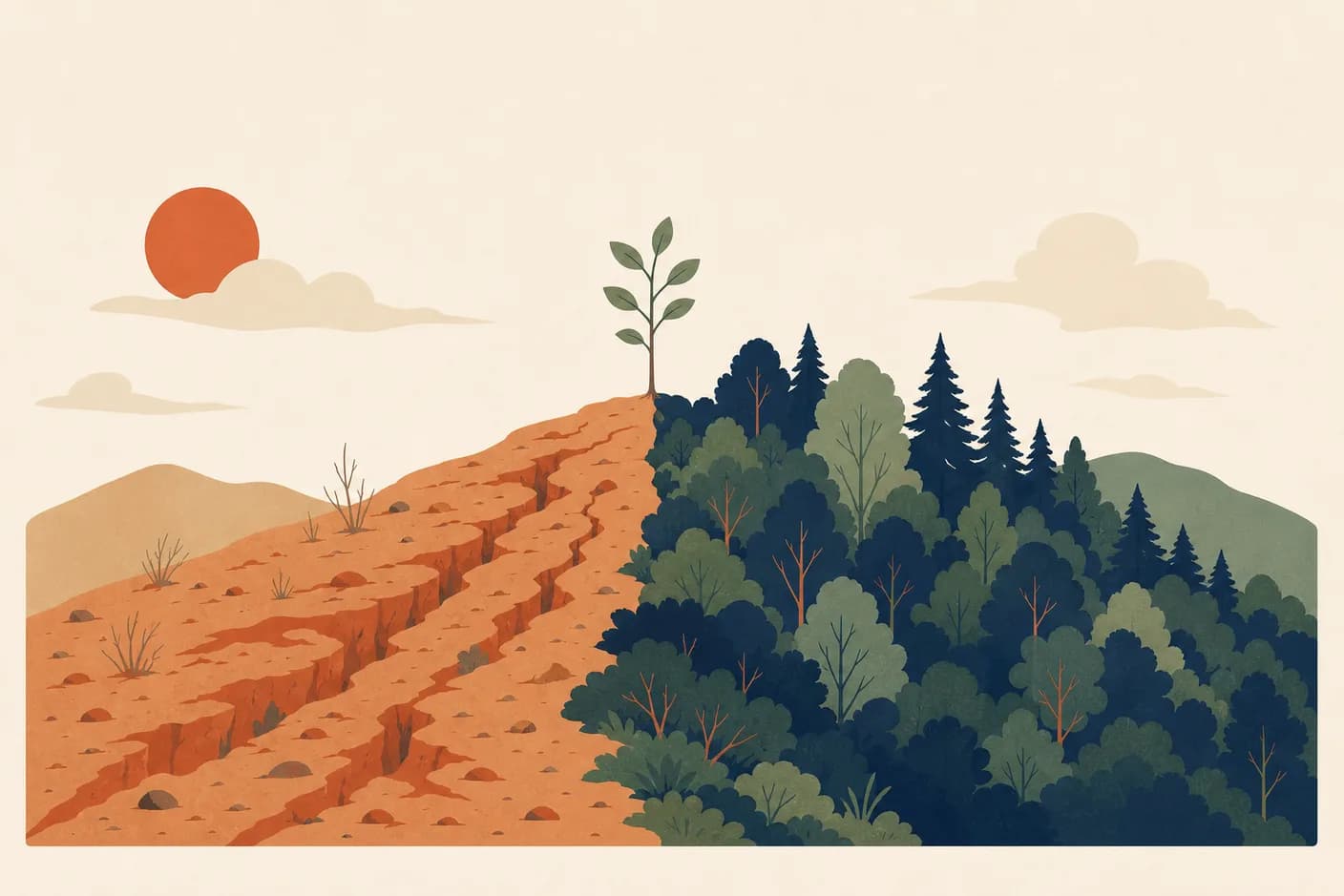
Illustration of a hillside split down the middle, bare eroded soil on one side and dense forest on the other, a single sapling growing at the seam between them

Verified against 15 primary sources. Fact-checked August 2026. Every figure linked to its source.

Key facts

  • By 1953, roughly half of Korea's forest area was degraded and national growing stock had collapsed to about 5.7 cubic metres per hectare, the worst figure recorded since Japanese-era forest statistics began in 1927.
  • By 2020, national growing stock had recovered to about 165 cubic metres per hectare, which the Korea Forest Service describes as 29 times the 1953 figure.
  • On February 23, 1973, the Korea Forest Service was transferred from the Ministry of Agriculture to the Ministry of Home Affairs, putting provincial governors, county officials, and police chiefs directly behind forest enforcement targets.
  • The First Ten-Year Forest Rehabilitation Plan (1973-1978) reforested 1,080,000 hectares, 108% of its target, and was completed four years ahead of its original 10-year schedule.
  • Saemaul Undong village nurseries produced about 34.8% of all national seedling output between 1973 and 1978, while village-level planting (새마을조림) covered roughly 473,000 hectares, about 44% of the First Plan's total planted area.
  • On April 10, 2025, UNESCO inscribed the Korea Reforestation Archives, a collection of 9,619 government records, into the Memory of the World Register.
  • Firewood supplied roughly 90% of Korea's national primary energy in 1950. The state-driven shift to coal briquettes (연탄, yeontan) removed the root cause of deforestation alongside the planting campaigns.
  • Korea now runs bilateral forest-cooperation agreements with 37 countries (as of 2022), supports forestry cooperation projects across Asia through the Asian Forest Cooperation Organization (AFoCO), and co-hosted the 15th World Forestry Congress with the FAO in Seoul in May 2022.
ShareWhatsAppTelegramEmailSend it to someone who'd find it useful.

Look out the window of any KTX heading south from Seoul and the mountain ridgelines are densely forested. That forest is roughly 50 years old.

In the early 1950s, most of those same ridgelines were bare. Historical photographs from that period show hillsides scoured down to exposed soil: the landscape of a country that had survived Japanese colonial timber extraction, a devastating war, and decades of its own citizens stripping hillsides for firewood. Korea reversed that within one generation through two state-run Ten-Year Forest Rehabilitation Plans that combined a critical bureaucratic reorganization, village-level mobilization, and a parallel push to get rural households off firewood entirely.

This guide explains how it happened, what it cost, and what it means for the country you are living in.


Why Korea's mountains were bare

The deforestation had multiple causes. They stacked on top of each other over more than a century.

Traditional Korean households heated themselves through underfloor heating (온돌, ondol), a radiant system that burned wood beneath stone floors. By 1950, firewood supplied roughly 90% of Korea's national primary energy. By 1955, Korea was burning an estimated 10 million cubic metres of timber and branches per year for household fuel alone, equivalent to about 17% of the country's entire standing forest stock at the time. A National Archives of Korea account states that without intervention, Korea's forests would have become completely barren within 10 years.

Japanese colonial rule from 1910 to 1945 accelerated the problem. Korean government archival records show average forest stock falling from 16.7 cubic metres per hectare in 1927 to 13.2 cubic metres per hectare by 1943, with the sharpest losses in the northern provinces. The same records note that in 1910, only about 21% of Korea's mountain land was actually forested; most of the rest was young regrowth or bare wasteland, meaning serious deforestation pressure predated the colonial period too. The Korean War (1950-1953) caused further destruction across the peninsula.

Illegal logging (도벌, dobeol) was a chronic additional drain. Between 1953 and 1963, unauthorized felling nationally ran at roughly 1.3 times the volume of authorized cutting. A single 1964 case at Jirisan removed more than 10,000 cubic metres of temple-forest timber over two years. An average of about 3,000 illegal-logging incidents per year occurred between 1967 and 1972.

Slash-and-burn farming (화전, hwajeon) covered about 125,000 hectares by 1973, worked by roughly 300,000 households.

By 1953, roughly half of Korea's forest area was degraded, and national growing stock had fallen to about 5.7 cubic metres per hectare, the worst figure recorded since Japanese-era forest statistics began in 1927.


How it was fixed

The organizational move that made everything else work

The most important thing about the reforestation campaign is not the tree-planting. It is where the Korea Forest Service was housed.

From 1967, the Korea Forest Service (산림청, Sallimcheong) operated as an independent agency under the Ministry of Agriculture. It had technical expertise but limited enforcement power. The forests continued to deteriorate.

That changed on February 23, 1973. President Park Chung-hee transferred the Korea Forest Service from the Ministry of Agriculture to the Ministry of Home Affairs (내무부, naemubu). This move put the country's entire local administrative apparatus behind forest enforcement: provincial governors, county officials, and police chiefs now bore direct responsibility for meeting reforestation targets, alongside forest officials providing technical guidance. It was an enforcement decision, not just a policy shift.

Park announced the First Ten-Year Forest Rehabilitation Plan (제1차 치산녹화 10개년계획) at a press conference on January 12, 1973. The final plan was in place by June 21, 1973. Its targets were ambitious: reforest 1 million hectares and produce roughly 2.1 billion seedlings over 10 years.

The results exceeded those targets, and well ahead of schedule. By 1978, the plan had reforested 1,080,000 hectares, 108% of its target, four years before the original 1982 finish date. The Korea Forest Service English site states that more than one million hectares of denuded forest were restored and that the 10-year project was completed four years in advance.

What Saemaul Undong did

The village-level operation ran through the Saemaul Undong (새마을운동, New Village Movement), Park's nationwide rural-development campaign. Village nurseries called 새마을양묘 (Saemaul yangmyo) produced about 34.8% of all national seedling output between 1973 and 1978. Village-level planting covered roughly 473,000 hectares, about 43 to 44% of the First Plan's total planted area.

The division of labor was clear: the government supplied seedlings and fertilizer for free, municipalities organized transport, and residents contributed land and labor. Village income from the program, including wages paid to participating households, came to a reported 12.3 billion won between 1973 and 1979. Saemaul-run erosion-control work also handled about 70.7% of all national erosion-control (사방사업, sabang-saeop) work in 1973 to 1975.

Over the First Plan's full run, a reported 16 million people from 175,000 institutions took part in tree-planting activities. Korea's forestry budget rose from 6.275 billion won in 1972 to 27.319 billion won in 1978, a more than fourfold increase.

The fuel substitution side

Tree-planting alone could not have succeeded as long as firewood remained the primary household fuel. The government ran a parallel push to move rural and urban households onto anthracite coal briquettes (연탄, yeontan), building out coal-rail infrastructure and briquette supply chains to reach rural families. By the 1980s, cooking had largely shifted to gas and heating to briquettes nationally. This removed the underlying driver of deforestation.

What was planted

Foresters leaned on fast-growing species, and the First Plan cut the list of recommended species from 42 down to 10. Black locust (아까시나무) and pitch pine (리기다소나무) were among the species village forest associations had been directed to raise since the 1950s, because they were relatively easy to grow in a nursery.

Korean forest science also contributed to the effort. Dr. Hyun Shin-gyu (현신규) bred improved pine varieties that were supplied to both Korea and the United States, and a fast-growing poplar hybrid that came to be known as Hyun poplar (현사시나무), named after him. The Hyun poplar was later exported to New Zealand.

Survival inspection

Seedling inspection was built into the plan: a 검목책임제, an inspection-responsibility system, was one of the First Plan's 31 priority measures.

The Second Plan

The First Plan's results led directly to a Second Ten-Year Forest Rehabilitation Plan (제2차 치산녹화 10개년계획) running from 1979 to 1987. Park Chung-hee was assassinated in October 1979, so the second plan ran mostly under Chun Doo-hwan. It shifted focus from erosion-control pioneer species toward commercial timber zones, establishing large-scale economic forest complexes that reached 334,000 hectares by 1986, about 83.5% of the original target. The plan's afforestation target was itself cut twice during its run, down to 997,000 hectares, 64.7% of the original goal; the eventual result of 966,000 hectares reforested reached about 97% of that reduced target. Despite missing even the reduced target, the government ended the plan a year early.


The authoritarian context

This story needs to be told plainly.

The program did not run on goodwill. Moving the Korea Forest Service into the Ministry of Home Affairs was an enforcement decision: it attached local police and administrative officials to forestry targets, not just forestry technical staff. Village-level planting quotas were compulsory and backed by the full weight of the local government hierarchy.

In the early 1960s, the government designated illegal logging one of "4 great social evils" (4대 사회악), alongside smuggling, drug trafficking, and organized crime, with an explicit policy of severe punishment for anyone caught cutting timber regardless of their status. Slash-and-burn farming households were resettled or stabilized through a government program between 1974 and 1979, affecting a reported 267,301 households.

The campaign was also explicitly political. It carried the name "Green Yushin" (푸른유신) from its March 1973 draft plan, explicitly linking forest greening to Park's Yushin constitutional system, the authoritarian governing framework in place from October 1972 to 1979. After public pushback over blanket mountain-entry restrictions, the government eased entry rules in a June 1973 revision to target only protected areas, and in that same revision renamed the plan's nationwide public-education measure away from the Green Yushin branding. The National Archives of Korea records Park as saying: "There is no change in basic plans and policies for completely greening these mountains within the next 10 years to match foreign forests."

A 2026 peer-reviewed study in Environmental Management by Park, Han, Kim, and Kim argues that Korea's strong state authority and centralized decision-making means the case is best understood as a reference to adapt rather than a template to copy directly, especially for countries with more participatory governance norms. Korean government and forestry-literature sources largely present the centralized enforcement as a success factor. The academic literature is more cautious about how transferable the model is.

This sits alongside other Park-era material: the same period that produced the economic miracle also produced the Gwangju Uprising. The 5.18 Gwangju Uprising Decoded guide covers the political suppression of that era in detail.


The impact today

The recovery is one of the clearest large-scale environmental turnarounds on modern record.

National growing stock went from roughly 5.7 cubic metres per hectare in 1953 to about 165 cubic metres per hectare by 2020. The Korea Forest Service describes this as 29 times the 1953 figure. Korea now has forest cover of about 63% of national land, roughly 6.3 million hectares, ranking fourth among OECD member countries by forest-area ratio. For comparison, the OECD average growing stock is about 131 cubic metres per hectare; Korea's is about 165.

Korean government and archival sources, including the National Archives of Korea newsletter, describe Korea as the only nation to have succeeded in forest restoration since World War II.

On April 10, 2025, UNESCO formally inscribed the Korea Reforestation Archives into the Memory of the World Register. The collection includes 9,619 government records: official gazettes, presidential decrees, administrative documents, photographs, and brochures documenting the reforestation program. UNESCO's own listing describes the archive as offering insight into policies and programs addressing climate change, soil erosion, and forest ecosystem restoration, and calls it a successful example of public-private governance in reforestation. Korea's total Memory of the World inscriptions reached 20 with this addition.

From recipient to donor

Korea co-hosted the 15th World Forestry Congress with the FAO in Seoul in May 2022, with roughly 15,000 attendees from about 160 countries. The congress adopted the Seoul Forest Declaration on forests' role in addressing climate change, biodiversity loss, land degradation, and poverty.

The Korea Forest Service runs bilateral forest-cooperation agreements with 37 countries (as of 2022) and supports forestry cooperation projects across Asia through the Asian Forest Cooperation Organization (AFoCO). The pattern mirrors the trajectory covered in the After the IMF Decoded guide: a country that once received international attention for a crisis becomes a country that exports its solutions.


Later plans and an open question

Forest planning did not stop with the two Ten-Year Plans. When the Second Plan ended in 1987, the Korea Forest Service moved back to the agriculture ministry, and the Third Basic Forest Plan was renamed from a forest-rehabilitation plan to a mountain-resource-development plan. The National Archives' own assessment is that, greening achieved, the government now pursues sustainable forest management balancing the forest's public-benefit and economic functions, crediting the recovery with gains in biodiversity and in forest water and recreation services.

The First Plan's own priority was speed. The National Archives describes it as quantitative afforestation aimed at national greening, and records that the Second Plan's biggest policy change was the move from quantitative to qualitative planting. The ecological quality story of Korea's forests continues to develop past the reforestation achievement itself.


Arbor Day and what foreign residents encounter

Arbor Day (식목일, Sikmogil) falls on April 5. Korea held its first Arbor Day ceremony on April 1, 1946; April 5 was designated the official date and a public holiday by 1949, and it served as one of the main mass-mobilization dates for planting campaigns through the reforestation era. It lost its public-holiday status from 2006, under a 2005 revision to the government's public-holiday regulation.

Tree-planting events still happen around April 5 each year, organized by local governments, schools, and community groups. If you encounter a tree-planting volunteer event at your child's school or your local community center in early April, that is the origin. The forests around you are the product of the campaign those events descend from.


Frequently asked questions

Is it true Korea reforested its mountains under Park Chung-hee?

Yes. The First Ten-Year Forest Rehabilitation Plan launched in 1973 under Park and was completed by 1978, four years ahead of schedule. The Second Plan ran from 1979 to 1987, mostly under Chun Doo-hwan. The methods were state-directed and coercive in places, but the outcome, a near-complete reversal of national deforestation within about 25 years, is documented in Korean government archives and peer-reviewed research.

Why were Korea's mountains bare in the first place?

Several causes overlapped. Japanese colonial rule from 1910 to 1945 removed large volumes of timber. The Korean War (1950-1953) caused further destruction. The biggest ongoing driver was firewood demand for ondol floor heating: by 1950 firewood supplied roughly 90% of Korea's national primary energy. Illegal logging ran at about 1.3 times the volume of legal cutting between 1953 and 1963. Slash-and-burn farming covered about 125,000 hectares by 1973. By 1953, roughly half of Korea's forest area was degraded, and national growing stock had collapsed to about 5.7 cubic metres per hectare.

How did the shift from firewood to coal briquettes help?

It removed the root cause. As long as rural and urban households depended on firewood to heat ondol (온돌) floors, any trees planted would be stripped again. The government pushed coal briquettes (연탄, yeontan) as a replacement fuel and built out coal-rail infrastructure to supply them at scale. Urban substitution was essentially complete by 1970, when only about 7% of urban households still relied on forest fuel; through the 1980s, cooking shifted to gas nationally while heating stayed on briquettes, ending the incentive to cut trees for fuel. Fuel substitution and tree-planting worked together; neither alone would have been enough.

What was Saemaul Undong's role?

Saemaul Undong (새마을운동, New Village Movement) ran the village-level side of the campaign. Village nurseries produced about 34.8% of all national seedling output between 1973 and 1978. Village-level planting (새마을조림) covered about 473,000 hectares, roughly 44% of the First Plan's total area. The government supplied seedlings and fertilizer for free; municipalities organized transport; residents contributed labor. Village income from the program came to a reported 12.3 billion won between 1973 and 1979.

How authoritarian were the methods?

Explicitly coercive in places. Moving the Korea Forest Service into the Ministry of Home Affairs gave provincial governors and police chiefs direct enforcement power over planting targets. Illegal logging was designated one of the "4 great social evils" with stated severe punishment regardless of the offender's status. Village quotas were compulsory. The campaign carried the name "Green Yushin" (푸른유신) from its March 1973 draft, explicitly tying forest greening to Park's authoritarian Yushin constitutional system (1972-1979). A 2026 peer-reviewed study in Environmental Management notes that Korea's centralized-authority model is best understood as a reference to adapt, not a universal template, precisely because many countries operate under more participatory governance norms.

What does Korea's forest look like today?

National growing stock went from roughly 5.7 cubic metres per hectare in 1953 to about 165 cubic metres per hectare by 2020, 29 times the 1953 figure according to the Korea Forest Service. Forest cover stands at about 63% of national land, roughly 6.3 million hectares, ranking fourth among OECD members by forest-area ratio. Korean government and archival sources describe Korea as the only nation to have succeeded in forest restoration since World War II.

Is Arbor Day (식목일) still a thing?

Yes, though it changed. Arbor Day (식목일, Sikmogil) falls on April 5. Korea held its first Arbor Day ceremony on April 1, 1946, and April 5 was designated the official date and a public holiday by 1949. It was a full public holiday through most of the reforestation era, and it lost that status from 2006. Tree-planting events and volunteer campaigns still take place around April 5, organized by local governments, schools, and community groups across Korea.

Why is this story relevant to understanding Korea today?

The reforestation effort sits alongside the economic miracle and the democratization movement as one of the defining large-scale achievements of the Park-era developmental state. It shows the same pattern visible in the chaebol story and the post-IMF recovery arc: a centralized, state-directed mobilization campaign producing measurable results quickly, at the cost of individual autonomy, with consequences that outlasted the political system that created them. The forests visible from any KTX window are the physical legacy of that state capacity. Korea's current position as a forestry-aid donor to developing countries is its diplomatic legacy.

ShareWhatsAppTelegramEmailSend it to someone who'd find it useful.

Advertisement

Related guides

Frequently asked questions

Is it true Korea reforested its mountains under Park Chung-hee?

Yes. The First Ten-Year Forest Rehabilitation Plan (치산녹화 10개년계획) launched in 1973 under Park and was completed by 1978, four years ahead of schedule. The Second Plan ran from 1979 to 1987, mostly under Chun Doo-hwan. The methods were state-directed and coercive in places, but the outcome, a near-complete reversal of national deforestation within about 25 years, is documented thoroughly in Korean government archives and peer-reviewed research.

Why were Korea's mountains bare in the first place?

Several causes overlapped. Japanese colonial rule from 1910 to 1945 removed large volumes of timber. The Korean War (1950-1953) caused further destruction. The biggest ongoing driver was firewood demand: by 1950 firewood supplied roughly 90% of Korea's national primary energy. Illegal logging (도벌, dobeol) ran at about 1.3 times the volume of legal cutting between 1953 and 1963. Slash-and-burn farming (화전, hwajeon) covered about 125,000 hectares by 1973. By 1953, roughly half of Korea's forest area was degraded, and national growing stock had collapsed to about 5.7 cubic metres per hectare.

How did the shift from firewood to coal briquettes help the forests?

It removed the root cause. As long as rural and urban households depended on firewood for ondol (온돌) floor heating, any trees planted would be stripped again. The government pushed coal briquettes (연탄, yeontan) as a replacement and built out coal-rail infrastructure to supply them at scale. Urban substitution was essentially complete by 1970, when only about 7% of urban households still relied on forest fuel; through the 1980s, cooking shifted to gas nationally while heating stayed on briquettes, ending the incentive to cut trees for fuel.

Show all 8 questions

What was Saemaul Undong's role in the reforestation?

Saemaul Undong (새마을운동, New Village Movement) ran the village-level side of the campaign. Village nurseries produced about 34.8% of all national seedling output between 1973 and 1978. Village-level planting (새마을조림) covered about 473,000 hectares, roughly 44% of the First Plan's total area. The government supplied seedlings and fertilizer for free; municipalities organized transport; residents contributed labor and land.

How authoritarian were the methods?

Explicitly coercive in places. Moving the Korea Forest Service into the Ministry of Home Affairs gave provincial governors and police chiefs direct enforcement power over planting targets. Illegal logging was designated one of the '4 great social evils' with stated severe punishment. Village quotas were compulsory. The campaign carried the name 'Green Yushin' (푸른유신) from its March 1973 draft, explicitly tying forest greening to Park's authoritarian Yushin constitutional system (1972-1979). A 2026 peer-reviewed study in Environmental Management notes that Korea's centralized-authority model is best understood as a reference to adapt, not a universal template.

What does Korea's forest look like today?

National growing stock went from roughly 5.7 cubic metres per hectare in 1953 to about 165 cubic metres per hectare by 2020, 29 times the 1953 figure, according to the Korea Forest Service. Forest cover now stands at about 63% of national land, roughly 6.3 million hectares, ranking fourth among OECD member countries by forest-area ratio. Korean government and archival sources describe Korea as the only nation to have succeeded in forest restoration since World War II.

Is Arbor Day (식목일) still a thing in Korea?

Yes, though it changed. Arbor Day (식목일, Sikmogil) falls on April 5. Korea held its first Arbor Day ceremony on April 1, 1946, and April 5 was designated the official date and a public holiday by 1949. It was a full public holiday through most of the reforestation era, and it lost that status from 2006. Tree-planting events and volunteer campaigns still take place around April 5, organized by local governments, schools, and community groups across Korea.

How is Korea positioned in global forestry today?

Korea has moved from a country that received international forestry attention to one that provides it. It co-hosted the 15th World Forestry Congress with the FAO in Seoul in May 2022, attended by roughly 15,000 participants from about 160 countries. The Korea Forest Service runs bilateral forest-cooperation agreements with 37 countries (as of 2022) and supports forestry cooperation projects across Asia through the Asian Forest Cooperation Organization (AFoCO).

Fact-check record

98 key claims checked against the exact wording of official sources · Verified August 2026

Show

Our fact-check pulls the most important claims out of this guide and checks each one against its official source, quoted word for word so you can confirm it yourself. This is a sample of the guide's facts, not the full reference list. For everything we consulted, see the verified sources below.

  • 01

    On February 23, 1973 the Korea Forest Service was transferred from the Ministry of Agriculture to the Ministry of Home Affairs, which put provincial and county administration and the police behind forest enforcement.

    정부는 1973년 2월 23일 『정부조직법 중 개정 법률』을 의결하여 농림부 소속의 산림청을 내무부로 이관하였다. 산림청의 내무부 이관은 정부조직법 개정의 이유에서 알 수 있듯이, ‘산림행정을 보다 효율적으로 수행’하기 위해서였다. 효율적인 수행은 곧 내무부의 강력한 행정력과 경찰력을 의미하는 것이었다. 즉, 중앙과 지방의 시·도, 시·군 행정조직과 경찰력을 활용하여 단기간에 산림녹화를 이루어내자는 의도였다.
    theme.archives.go.kr
  • 02

    The Korea Forest Service transfer put the three-way division of provincial governors/mayors/county heads on protection management, police chiefs on enforcement, and forest officials on technical guidance.

    즉, 산림보호 관리는 도지사-시장·군수의 몫이 되고 보호 단속은 경찰서장이, 기술 지도는 산림공무원이 맡게 됨으로써 오히려 산림청이 농림부에 있던 때보다 실질적인 행정력을 발휘할 수 있게 되었다.
    theme.archives.go.kr
  • 03

    By 1953 roughly half of Korea's forest area was degraded and national growing stock had fallen to about 5.7 cubic metres per hectare, the worst forest condition recorded since Korean forest statistics began in 1927.

    6·25전쟁 중이던 1953년은 1927년 산림통계가 만들어진 이후 지금까지 최악의 산림 상태를 보였다. 산림의 반은 헐벗었고 ha당 임목축적은 5.7㎥에 불과했다.
    theme.archives.go.kr
  • 04

    By 1953 roughly half of Korea's forest area was degraded and national growing stock had collapsed to about 5.7 cubic metres per hectare, the worst figure recorded since Korean forest statistics began in 1927.

    6·25전쟁 중이던 1953년은 1927년 산림통계가 만들어진 이후 지금까지 최악의 산림 상태를 보였다. 산림의 반은 헐벗었고 ha당 임목축적은 5.7㎥에 불과했다.
    theme.archives.go.kr
  • 05

    As of 2020 Korea's average growing stock was 165 cubic metres per hectare, which the Korea Forest Service states is 29 times the 1953 figure.

    As of 2020, Korea's average growing stock is 165㎥/ha, 29 times higher than in 1953. This figure exceeds the OECD average of 131㎥/ha.
    english.forest.go.kr
  • 06

    Korea's forested area covers 6.3 million hectares, 63% of total land area, ranking fourth among OECD countries by forest-area ratio.

    The forested area in Korea covers 6.3 M ha, accounting for 63% of the total land area.
    english.forest.go.kr
  • 07

    The OECD average growing stock is 131 cubic metres per hectare against Korea's 165.

    As of 2020, the growing stock in South Korea is 165㎥/ha, while the OECD average is 131㎥/ha. It means that South Korea's growing stock per hectare is 1.26 times higher than the OECD average.
    english.forest.go.kr
  • 08

    The First Ten-Year Forest Rehabilitation Plan reforested 1,080,000 hectares, 108% of its 1,000,000-hectare target, and was completed four years ahead of its original ten-year schedule.

    사방사업이 목표에 도달하지 못하였음에도 제1차 계획이 세웠던 최대 목표인 100만 ㏊ 조림을 달성하자 계획기간을 4년 단축하여 1978년에 제1차 계획의 성공을 알리고 종료했다.
    theme.archives.go.kr
  • 09

    By 1978 the First Plan had reforested 1,080,000 hectares, 108% of its target, four years before the original 1982 finish date.

    사방사업이 목표에 도달하지 못하였음에도 제1차 계획이 세웠던 최대 목표인 100만 ㏊ 조림을 달성하자 계획기간을 4년 단축하여 1978년에 제1차 계획의 성공을 알리고 종료했다.
    theme.archives.go.kr
  • 10

    The Korea Forest Service English site states that more than one million hectares of denuded forest were restored and that the 10-year project was completed four years in advance.

    More than one million ha of denuded forest were restored with fast growing tree species through public participation. The 10-year project was completed 4 years in advance of its target.
    english.forest.go.kr
  • 11

    Park Chung-hee first presented the ten-year national greening plan at his 12 January 1973 New Year press conference.

    제1차 계획의 모습은 1973년 1월 12일 박정희 대통령의 연두 기자회견에서 처음 제시되었다.
    theme.archives.go.kr
  • 12

    The final version of the First Plan was completed on 21 June 1973.

    이 계획은 3월 27일 국무회의 결정에 따라 수정을 거친 후 6월 21일 최종 계획이 완성되었다.
    theme.archives.go.kr
  • 13

    The First Plan targeted reforestation of 1 million hectares and production of roughly 2.1 billion seedlings over ten years.

    양묘 2,132백만본 3,054백만본 143
    theme.archives.go.kr
  • 14

    Saemaul village nurseries produced about 34.8% of national seedling output between 1973 and 1978, and Saemaul village-level planting (새마을조림) separately covered roughly 473,000 hectares, about 44% of the First Plan's total planted area.

    새마을양묘는 제1차 계획기간(1973~1978) 동안 전국 묘목 생산량 27억 그루의 34.8%에 해당하는 940백만 그루를 담당했다. 새마을양묘 사업으로 1973년부터 1979년까지 총 123억 원의 양묘 소득을 올렸는데, 마을당 소득은 연간 375천 원이었다. 마을 양묘 소득은 참여자에게 모두 분배하지 않고 일부를 적립하여 차기 마을사업 자금으로 쓸 수 있게 했다. 새마을조림은 새마을운동 본부가 주관한 마을 주변의 조림 사업을 뜻한다. 새마을조림은 제1차 계획기간(1973~1978) 동안 전국 조림 면적 108만 ha의 약 44%에 해당하는 473천 ha를 담당했다.
    theme.archives.go.kr
  • 15

    Saemaul village nurseries produced about 34.8% of all national seedling output between 1973 and 1978, and Saemaul village planting covered roughly 473,000 hectares, about 43 to 44% of the First Plan's total planted area.

    새마을양묘는 제1차 계획기간(1973~1978) 동안 전국 묘목 생산량 27억 그루의 34.8%에 해당하는 940백만 그루를 담당했다. 새마을양묘 사업으로 1973년부터 1979년까지 총 123억 원의 양묘 소득을 올렸는데, 마을당 소득은 연간 375천 원이었다. 마을 양묘 소득은 참여자에게 모두 분배하지 않고 일부를 적립하여 차기 마을사업 자금으로 쓸 수 있게 했다. 새마을조림은 새마을운동 본부가 주관한 마을 주변의 조림 사업을 뜻한다. 새마을조림은 제1차 계획기간(1973~1978) 동안 전국 조림 면적 108만 ha의 약 44%에 해당하는 473천 ha를 담당했다.
    theme.archives.go.kr
  • 16

    Saemaul erosion-control work handled 70.7% of all national erosion-control work carried out between 1973 and 1975.

    새마을사방 사업은 1973년부터 1975년까지 수행한 총 22,976ha의 70.7%에 해당하는 16,238ha를 담당했다.
    theme.archives.go.kr
  • 17

    Village nursery income from the programme totalled 12.3 billion won between 1973 and 1979.

    새마을양묘 사업으로 1973년부터 1979년까지 총 123억 원의 양묘 소득을 올렸는데, 마을당 소득은 연간 375천 원이었다.
    theme.archives.go.kr
  • 18

    Over the First Plan's full run, a reported 16 million people from 175,000 institutions took part in tree-planting activities.

    제1차 계획기간 내내 매년 3월 21일부터 4월 20일까지 한 달간을 국민식수기간으로 정하고 가정, 마을, 직장, 학교 등 모든 국민이 참여하는 식수 운동이 전개되었다. 제1차 계획기간 동안 식목일에 참여한 연인원만도 175천 개 기관, 16백만 명에 달하였다.
    theme.archives.go.kr
  • 19

    Korea's forestry budget rose from 6.275 billion won in 1972 to 27.319 billion won in 1978.

    즉 1972년 62억 7,500만 원이었던 산림청 예산 규모는 1973년 100억 원을 돌파하였고, 1978년에는 273억 원으로 증가했다.
    theme.archives.go.kr
  • 20

    Firewood accounted for 90% of Korea's national primary energy in 1950.

    가정용 임산연료를 대표하는 신탄은 1950년 국가 1차 에너지의 9할을 차지하였다.
    theme.archives.go.kr
  • 21

    In 1955 Korea used roughly 10 million cubic metres of wood and branches as household fuel, equal to about 17% of that year's total standing forest stock.

    1955년 한국은 약 1천만 ㎥ 내외의 나무와 가지 등을 가정용 연료로 사용하였다. 가정용 연료로 사용된 목재의 양은 같은 해 총 임목축적의 17%에 해당하였다.
    theme.archives.go.kr
  • 22

    A National Archives of Korea account states that if household fuelwood use continued, Korea's forests would be completely barren within ten years.

    이러한 가정용 임산연료의 이용 추세가 계속된다면 10년 안에 한국의 산림은 완전히 민둥산이 될 위기에 처해 있었다.
    theme.archives.go.kr
  • 23

    Between 1953 and 1963 unauthorised felling nationally ran at about 1.3 times the volume of authorised cutting.

    당시 정부조차 1953년~1963년까지의 산업용재 수급 추정 시 국내의 미허가 벌채량이 허가 벌채량보다 1.3배나 많았다는 것을 인정할 정도였다.
    theme.archives.go.kr
  • 24

    A 1964 illegal-logging case at Jirisan removed more than 10,000 cubic metres of temple-forest timber over two years.

    벌채 허가를 빌미로 국회의원, 산림공무원, 목재회사 등이 유착하여 2년간 1만 ㎥가 넘는 나무 3,000트럭을 실어 나르는 대규모 도벌 사건이 발생했다.
    theme.archives.go.kr
  • 25

    An average of about 3,000 illegal-logging incidents per year occurred between 1967 and 1972.

    산림청이 신설되고 「제1차 치산녹화 10개년 계획」이 수립되기 직전인 1967년~1972년간 연평균 3천 건의 도벌로 인해 매년 17,673㎥의 재적 피해를 보았다.
    theme.archives.go.kr
  • 26

    Slash-and-burn farming covered about 125,000 hectares in 1973, worked by roughly 300,000 households.

    1973년 산림녹화 프로그램을 수립할 당시에도 약 12만5천 ㏊의 화전과 30만 호의 화전민이 존재하였다.
    theme.archives.go.kr
  • 27

    Slash-and-burn farming households were resettled or stabilized through a government program between 1974 and 1979, affecting a reported 267,301 households.

    1974년~1979년 동안 화전민 호수 267,301호가 정리되었는데, 현지 정착이 93.4%로 대부분이었고 이주는 5.7%, 이전은 0.9%였다.
    theme.archives.go.kr
  • 28

    In the early 1960s the government designated illegal logging one of four great social evils alongside smuggling, drug trafficking and gangsterism, with a stated policy of severe punishment for anyone cutting timber regardless of status.

    결국 1960년대 초부터 정부는 ‘산림녹화운동’을 시작하고 당시 도벌을 밀수, 마약, 깡패와 같이 4대 사회악으로 규정하고 철퇴를 내리기 시작했다. 산에서 나무를 베기만 하면 누구든 엄벌에 처한다는 방침을 실행했다.
    theme.archives.go.kr
  • 29

    The reforestation campaign carried the name Green Yushin (푸른유신) from its March 1973 draft plan, linking forest greening to Park's Yushin constitutional system.

    이러한 변화가 마무리되자 3월 10일 제1차 계획이 발표되었다. 이 계획은 3월 27일 국무회의 결정에 따라 수정을 거친 후 6월 21일 최종 계획이 완성되었다. 제1차 계획의 이름에 ‘푸른유신’이 표기되었다는 것만으로도 당시의 특수한 정치적 상황을 엿볼 수 있다.
    theme.archives.go.kr
  • 30

    After public criticism of the plan's blanket mountain-entry ban the government eased entry rules in the revised plan, limiting administrative control to legally restricted forests, and in the same revision renamed the plan's nationwide public-education measure away from the Green Yushin branding.

    결국 국무회의의 지적 사항을 반영하여 수정된 제1차 계획은 ①지력 증진을 위해 낙엽채취는 전면 금지하고 ②당초 계획의 전면 입산 금지 방침은 입산 통제 지역을 시장․군수가 지정하는 행정 통제로 전환하고, ③조림 지역의 간벌을 허용하며, ④목재의 대체 계획을 2년간 연기하고 연료대체 계획을 재조정했다.
    theme.archives.go.kr
  • 31

    The final version of the First Plan (1973-06-21) renamed priority measure 25 from 푸른 유신의 전국민교육 to 치산녹화의 전국민 교육 및 홍보, marked 개칭 (renamed).

    25 푸른 유신의 전국민교육 국민조림시책 25 치산녹화의 전국민 교육 및 홍보 개칭
    theme.archives.go.kr
  • 32

    The Yushin constitutional system was in place from October 1972 to 1979.

    1972년 10월 17일 제7차 헌법 개정(유신헌법)을 알리는 대통령 특별선언 이후 국회가 해산되고 정당 활동이 중단되는 비상시국하에서 1972년 10월 17일부터 1973년 3월 11일까지 약 5개월간 국회가 아닌 비상국무회의에서 법이 제정되었다.
    theme.archives.go.kr
  • 33

    The National Archives of Korea records Park Chung-hee saying there is no change to the basic plans and policies for completely greening the country's mountains within the next ten years to at least the level of foreign mountains.

    “앞으로 10년 동안에 이 나라의 산을 완전히, 적어도 외국의 산 정도로 푸르게 만들기 위한 기본계획과 방침에는 하나도 변동이 없습니다. 이것은 기어이 해야 되겠습니다.”
    theme.archives.go.kr
  • 34

    The government promoted anthracite coal briquettes as a household fuel substitute and expanded coal railways such as the Yeongam and Taebaek lines to supply them.

    상공부는 1956년 임산연료의 화석연료 대체를 위해 우리나라의 유일한 부존 에너지 자원인 무연탄 생산을 늘리는 정책을 강력히 추진하였다. 농림부는 1958년 도시지역으로 유입되는 임산연료 반입을 금지하고 상대적으로 연료재의 압박이 덜한 농산촌에는 연료림을 조성하는 정책을 추진하였다. 영암선, 태백선 등 석탄철도 부설이 확장됨에 따라 무연탄 생산은 급속하게 증가하였고 상대적으로 교통이 편리하고 인구가 밀집된 도시지역부터 임산연료의 대체가 이루어졌다.
    theme.archives.go.kr
  • 35

    By the 1980s cooking had largely shifted to gas and heating to coal briquettes nationally.

    더욱이 1970년대에 들어서면서 농촌 지역도 서서히 연탄이 임산연료를 대체하기 시작하였고, 1980년대에 들어서면 취사용은 가스로, 난방용은 연탄으로 대체되었다.
    theme.archives.go.kr
  • 36

    Average national forest growing stock fell from 16.7 cubic metres per hectare in 1927 to 13.2 cubic metres per hectare by 1943.

    전국 산림의 ha당 임목축적은 1927년 16.7㎥에서 1943년 13.2㎥로 줄었다.
    theme.archives.go.kr
  • 37

    In 1910 only about 21% of the territory corresponding to present-day South Korea was forested, the remaining 79% being young regrowth or bare degraded mountain land.

    1910년 당시 대한민국에 해당하는 지역은 단 21%만이 산림이었고, 나머지 79%는 어린나무가 자라거나 그마저도 없는 황폐한 산지였다.
    theme.archives.go.kr
  • 38

    The sharpest colonial-era growing-stock losses were in the northern provinces.

    1927년~1943년 사이에 두 강 유역의 산림이 있는 평안북도와 함경북도의 임목축적은 36%, 함경남도의 임목축적은 51%가 사라졌다.
    theme.archives.go.kr
  • 39

    The Second Ten-Year Forest Rehabilitation Plan ran from 1979 to 1987 and was ended a year early.

    조림 계획을 두 차례 조정하고, 제2차 계획을 1년 앞당겨 1987년에 종료하였다.
    theme.archives.go.kr
  • 40

    Second Plan economic forest complexes reached 334,000 hectares by 1986, about 83.5% of the original plan.

    정부는 이를 위해 5,000ha 규모의 80개 경제조림단지를 조성하고 경제수종으로 선정된 수종을 중심으로 조림을 추진하였다. 1986년까지 경제조림단지 실적은 처음 계획의 83.5%인 334천 ha였다.
    theme.archives.go.kr
  • 41

    The Second Plan's afforestation target was adjusted twice down to 997,000 hectares, 64.7% of the original plan, and the result of 966,000 hectares reached 97% of that reduced target.

    기타 조림 여건의 변동 등으로 처음에 수립한 추진계획에 차질이 생겨 결국 조림 계획을 두 차례 조정하고, 제2차 계획을 1년 앞당겨 1987년에 종료하였다. 조정된 조림 계획은 997천 ha로, 처음 계획의 64.7%로 축소되었다. 실적은 966천 ha로 조정 계획의 97%에 머물렀다.
    theme.archives.go.kr
  • 42

    The government ended the Second Plan a year early even though it did not meet the reduced afforestation target.

    제2차 계획의 핵심 목표 중 하나인 조림 목표를 대폭 축소하였고, 이를 달성하지 못했음에도 계획기간을 1년 단축하여 제2차 계획을 종료하였다.
    theme.archives.go.kr
  • 43

    On 10 April 2025 UNESCO inscribed the Korea Reforestation Archives, a collection of 9,619 records, on the Memory of the World Register.

    산림청(청장 임상섭)은 10일 23시(현지시간) 프랑스 파리에서 열린 제221차 유네스코 집행이사회(4.2.~4.17, Executive Board)에서 산림녹화기록물*이 유네스코 세계기록유산(UNESCO Memory of the World)에 등재되었다고 밝혔다. 산림녹화기록물은 6.25 전쟁 이후 황폐해진 국토를 복구하기 위해 정부와 국민이 함께 추진한 산림녹화사업의 전 과정을 담은 자료로, 법령, 공문서, 사진, 필름 등 총 9,619건으로 구성되어 있다.
    forest.go.kr
  • 44

    The inscribed collection includes government gazettes, decrees, administrative documents, photographs and brochures documenting the reforestation programme.

    Comprising 9,619 documents – including government gazettes, decrees, official documents, brochures, and photographs, the archives provide insights into policies and programs that address issues such as climate change, soil erosion, and forest ecosystem restoration.
    unesco.org
  • 45

    UNESCO's Memory of the World listing describes the archives as providing insight into policies and programs addressing climate change, soil erosion and forest ecosystem restoration, and recognises them as a successful example of public-private governance in reforestation.

    Comprising 9,619 documents – including government gazettes, decrees, official documents, brochures, and photographs, the archives provide insights into policies and programs that address issues such as climate change, soil erosion, and forest ecosystem restoration. The Forestry Act in 1961 and the First Ten-Year Forest Rehabilitation Plan in 1973 were pivotal in these efforts, providing various incentives to encourage public participation. Recognized as successful examples of public-private governance in reforestation, the materials contained in the archives are widely used in international training programs for forest officials in developing countries and forest-oriented Official Development Assistance (ODA) initiatives.
    unesco.org
  • 46

    Korea's total Memory of the World inscriptions reached 20 with this addition.

    10일 오후 11시경(현지 시간) 프랑스 파리에서 열린 제221차 유네스코 집행이사회가 이 같이 최종 결정한 바, 우리나라는 총 20건의 유네스코 세계기록유산을 보유하게 됐다.
    korea.kr
  • 47

    Korean government and archival sources describe Korea as the only nation to have succeeded in forest restoration since World War II.

    4월호에는 식목일을 맞아 산림녹화 기록물들을 통해 우리나라가 2차 세계대전 이후 산림복구에 성공한 유일한 국가가 될 수 있었던 과정을 살펴본다.
    theme.archives.go.kr
  • 48

    Korea co-hosted the 15th World Forestry Congress with the FAO in Seoul in May 2022, with roughly 15,000 attendees from about 160 countries, and the congress adopted the Seoul Forest Declaration covering climate change, biodiversity loss, land degradation and poverty.

    이번 제15차 세계산림총회는 전 세계적인 코로나19 확산에도 164개국에서 1만 5000여 명이 참여, 역대 최대 규모의 참가를 이끈 세계산림총회로 기록됐다고 산림청은 전했다.
    korea.kr
  • 49

    As of a Korea Forest Service statement dated 2022-02-09, the Korea Forest Service had bilateral forest-cooperation relationships with 37 countries.

    이로써 산림청은 중미 북부 3개국과 모두 양자 협력관계를 체결하게 되었고, 총 전 세계적으로 37개국와의 양자 협력관계를 구축하게 되었습니다.
    fmc.forest.go.kr
  • 50

    Korea supports forestry cooperation projects across Asia through the Asian Forest Cooperation Organization.

    (Purpose of Establishment) The Asian Forest Cooperation Organization (AFoCO) is an intergovernmental organization established to address international forest issues such as climate change response and mitigation, desertification, and to secure a leading position in the forest sector.
    english.forest.go.kr
  • 51

    As of 2022 Korea ran bilateral forest-cooperation agreements with 37 countries, supports forestry cooperation projects across Asia through the Asian Forest Cooperation Organization, and co-hosted the 15th World Forestry Congress with the FAO in Seoul in May 2022.

    이로써 산림청은 중미 북부 3개국과 모두 양자 협력관계를 체결하게 되었고, 총 전 세계적으로 37개국와의 양자 협력관계를 구축하게 되었습니다.
    fmc.forest.go.kr
  • 52

    Korea held its first Arbor Day ceremony on 1 April 1946.

    1946년 4월 1일 제1회 식목일 행사 개최 1946년 4월 1일, 미군정 장관 러취와 김구, 이승만, 김규식, 홍진, 조소앙 등이 참석해 경성여자기예학교 교정에서 제1회 식목일 행사 개최
    theme.archives.go.kr
  • 53

    April 5 was designated Arbor Day and a public holiday by 1949.

    1948년 3월 31일 미군정청, 식목일 지정 군정법령 제10호를 통해 매년 4월 5일을 식목일로 정하고 공휴일로 지정
    theme.archives.go.kr
  • 54

    Arbor Day stopped being a public holiday from 2006, under a 2005 amendment to the Regulation on Public Holidays of Government Offices.

    행정기관의 주 40시간 근무제가 2005년 7월 1일부터 도입됨에 따라 공직사회 및 사회전반의 열심히 일하는 분위기를 조성하기 위하여 관공서의 공휴일중 식목일(4월 5일)을 2006년부터, 제헌절(7월 17일)을 2008년부터 관공서의 공휴일에서 제외하려는 것임.
    law.go.kr
  • 55

    Arbor Day falls on April 5.

    매년 4월 5일이다.
    encykorea.aks.ac.kr
  • 56

    Arbor Day served as one of the main mass-mobilization dates for planting campaigns through the reforestation era, with a nationwide tree-planting period running 21 March to 20 April each year through the First Plan.

    제1차 계획기간 내내 매년 3월 21일부터 4월 20일까지 한 달간을 국민식수기간으로 정하고 가정, 마을, 직장, 학교 등 모든 국민이 참여하는 식수 운동이 전개되었다.
    theme.archives.go.kr
  • 57

    The Korea Forest Service was established in 1967 and operated as an agency under the Ministry of Agriculture before 1973.

    또한 1967년 산림청을 신설하고 본격적으로 치산녹화 사업의 홍보와 행정지도를 강화했다.
    theme.archives.go.kr
  • 58

    Ondol underfloor heating spread from the 17th century and its firewood demand progressively stripped the hills around settlements.

    17세기 추운 날씨가 이어지자, 사람들은 방마다 온돌을 설치했다. 사람이 사는 곳 주변의 산림은 온돌에 들어가는 땔감 채취로 갈수록 민둥산이 되었다.
    theme.archives.go.kr
  • 59

    The First Ten-Year Forest Rehabilitation Plan cut the list of recommended tree species from 42 down to 10.

    〈제1차 치산녹화 10개년계획〉이 추진되면서 기존의 42개의 권장수종을 10개로 줄이고 양묘작업을 대대적으로 실시하여 치산녹화에 필요한 묘목을 공급하였다.
    archives.go.kr
  • 60

    Black locust (아까시나무) and pitch pine (리기다소나무) were among the species village forest associations were directed to raise from the 1950s, because they were relatively easy to raise in a nursery.

    1951년 제정된「산림보호림시조치법」에 의거하여 부락산림계가 조직되고, 수익사업에서 비교적 양묘가 용이한 아까시나무, 리기다소나무 등을 양묘하도록 하여 부락산림계의 기본재산 조성과 산림계원의 임업기술의 습득, 양묘기술향상과 애림사상 등에 기여하였다.
    archives.go.kr
  • 61

    Under the First Ten-Year Forest Rehabilitation Plan, foresters leaned on fast-growing species.

    조림은 유실수 조림에서 속성수와 장기수 조림으로 목표를 선회하였으나, 전체 실적은 원래 계획인 100만 ㏊를 초과하였다. 이런 영향으로 양묘 실적 역시 유실수 조림에 비해 속성수와 장기수 조림이 많았다.
    theme.archives.go.kr
  • 62

    Dr Hyun Shin-gyu bred improved pine varieties supplied to Korea and the United States, and a fast-growing poplar hybrid later called Hyun poplar (현사시나무) after his surname.

    연료림 조성과정에서는 임학자 현신규 박사의 공이 컸다. 일본 소나무를 개량해 병충해에 강하고 보다 크게 자라는 신품종을 개발해서 우리나라는 물론 미국에까지 공급했다.
    theme.archives.go.kr
  • 63

    The Hyun poplar was later exported to New Zealand.

    이 나무는 나중에 그의 성을 딴 ‘현(玄)사시나무’로 불리게도 되었고, 멀리 뉴질랜드로 수출돼 지금도 무성한 나무숲을 이루고 있다.
    theme.archives.go.kr
  • 64

    An inspection-responsibility system (검목책임제) was one of the First Plan's priority measures.

    이런 국민식수 시책은 제1차 계획 초안에 제시된 자연보호, 산림병해충 방제 대책, 입산통제, 산화방지 경보망, 농촌연료대책, 검목책임제, 산림책임 분담, 의무조림 강화 등이 추구하는 중앙과 지방의 행정력 및 경찰력을 최대한 동원하여 단기간 내에 산림을 녹화하겠다는 정부 의지와 연결된 국민식수 운동이었다.
    theme.archives.go.kr
  • 65

    The First Plan set a total of 31 priority measures (중점시책).

    내무부 계획 부호 산림1호로, 『전 국토의 녹화』라는 목표 밑에 총 31개 중점시책을 두었다.
    theme.archives.go.kr
  • 66

    When the Second Plan ended in 1987 the Korea Forest Service was transferred back from the Ministry of Home Affairs to the agriculture ministry.

    1987년 1월 1일 농수산행정과 산림행정 상호 간에 연계성을 확보하기 위하여 산림청의 소속을 내무부에서 농수산부로 다시 이관하였다. 산림녹화라는 최종 목표가 달성되었다고 보고 산림청을 경제 부처인 본래의 자리로 돌려놓은 것이다.
    theme.archives.go.kr
  • 67

    Forest planning continued after the two Ten-Year Plans, and the Third Basic Forest Plan was renamed from 치산녹화 계획 (forest rehabilitation) to 산지자원화 계획 (mountain resource development).

    조직 개편과 함께 제2차 계획은 기간을 1년 앞당겨 종료하고 제3차 산림기본계획의 이름 역시 ‘치산녹화 계획’에서 ‘산지자원화 계획’으로 변경되었다.
    theme.archives.go.kr
  • 68

    The National Archives of Korea states that, greening having succeeded, the government now pursues sustainable forest management in which the forest's public-benefit and economic functions are exercised in balance.

    산림녹화에 성공한 지금, 정부는 산림의 공익기능과 경제기능을 조화롭게 발휘하는 지속가능한 산림경영을 추진하고 있다.
    theme.archives.go.kr
  • 69

    The National Archives of Korea credits the reforestation programme with gains in biodiversity and in forest water-resource and forest-recreation services.

    또한 산림녹화의 효과는 토양 복구, 홍수 예방, 생물다양성 회복, 산림 수자원 및 산림휴양 서비스 증가 등 여러 분야에서 나타나고 있다.
    theme.archives.go.kr
  • 70

    The First Plan's own priority was speed.

    이런 국민식수 시책은 제1차 계획 초안에 제시된 자연보호, 산림병해충 방제 대책, 입산통제, 산화방지 경보망, 농촌연료대책, 검목책임제, 산림책임 분담, 의무조림 강화 등이 추구하는 중앙과 지방의 행정력 및 경찰력을 최대한 동원하여 단기간 내에 산림을 녹화하겠다는 정부 의지와 연결된 국민식수 운동이었다.
    theme.archives.go.kr
  • 71

    The National Archives of Korea describes the First Plan as afforestation focused on quantity, aimed at greening the national territory.

    국토 녹화라는 양적 조림에 초점을 둔 제1차 계획에 이어 제2차 계획 역시 국토 녹화를 위한 조림 사업이 강조되었다.
    theme.archives.go.kr
  • 72

    The National Archives of Korea records that the biggest change in afforestation policy under the Second Plan was the shift from quantitative to qualitative planting.

    조림 정책의 가장 큰 변화는 과거 양적인 조림에서 벗어나 질적인 조림으로 전환한 것이다.
    theme.archives.go.kr
  • 73

    A 2026 study in Environmental Management by Park, Han, Kim and Kim argues that Korea's strong state authority and centralized decision-making mean the case is best treated as a reference to be adapted rather than a template to be copied, for countries with more participatory governance.

    Korea’s pathway was shaped by a particular political and cultural context marked by strong state authority and centralized decision making. For countries where multi-stakeholder governance and community-led processes are more prominent, the Korean case is best treated as a reference to be adapted rather than a template to be copied, illustrating how structured management cycles can be combined with more inclusive and locally driven forms of forest governance.
    pmc.ncbi.nlm.nih.gov
  • 74

    The FAQ answer states the First Plan was completed by 1978 four years ahead of schedule and that the Second Plan ran from 1979 to 1987, mostly under Chun Doo-hwan.

    사방사업이 목표에 도달하지 못하였음에도 제1차 계획이 세웠던 최대 목표인 100만 ㏊ 조림을 달성하자 계획기간을 4년 단축하여 1978년에 제1차 계획의 성공을 알리고 종료했다.
    theme.archives.go.kr
  • 75

    The FAQ answer states urban substitution was essentially complete by 1970, when only about 7% of urban households still relied on forest fuel, and that through the 1980s cooking shifted to gas nationally while heating stayed on briquettes.

    특히, 1960년대 도시의 가정 연료는 무연탄이 임산연료를 대체하는 데 큰 역할을 하였다. 이런 영향으로 1970년에는 이미 도시지역의 단 7%만이 가정용 난방 및 취사 에너지로 임산연료를 사용하였다. 더욱이 1970년대에 들어서면서 농촌 지역도 서서히 연탄이 임산연료를 대체하기 시작하였고, 1980년대에 들어서면 취사용은 가스로, 난방용은 연탄으로 대체되었다.
    theme.archives.go.kr
  • 76

    The FAQ answer states village income from the program came to a reported 12.3 billion won between 1973 and 1979.

    새마을양묘 사업으로 1973년부터 1979년까지 총 123억 원의 양묘 소득을 올렸는데, 마을당 소득은 연간 375천 원이었다.
    theme.archives.go.kr
  • 77

    The FAQ answer states Korea held its first Arbor Day ceremony on April 1, 1946, that April 5 was designated the official date and a public holiday by 1949, and that Arbor Day lost public-holiday status from 2006.

    1982년에 기념일로 지정되었으나, 2006년부터 다시 공휴일에서 폐지되었다.
    encykorea.aks.ac.kr
  • 78

    The definedTerms entry states that about 125,000 hectares of hwajeon covered Korean hillsides in 1973, that the government resettled or stabilized 267,301 such households between 1974 and 1979, and that most were stabilized in place rather than relocated.

    1974년~1979년 동안 화전민 호수 267,301호가 정리되었는데, 현지 정착이 93.4%로 대부분이었고 이주는 5.7%, 이전은 0.9%였다. 화전정리에 들어간 예산은 188.6억 원이었다.
    theme.archives.go.kr
  • 79

    The definedTerms entry states that Saemaul Undong village-level nurseries and planting quotas accounted for about 43 to 44% of all area planted under the First Ten-Year Plan.

    새마을조림은 제1차 계획기간(1973~1978) 동안 전국 조림 면적 108만 ha의 약 44%에 해당하는 473천 ha를 담당했다.
    theme.archives.go.kr
  • 80

    The definedTerms entry states that village nurseries produced about 34.8% of all national seedling output between 1973 and 1978 and generated income distributed partly as wages to participating households.

    새마을양묘는 제1차 계획기간(1973~1978) 동안 전국 묘목 생산량 27억 그루의 34.8%에 해당하는 940백만 그루를 담당했다. 새마을양묘 사업으로 1973년부터 1979년까지 총 123억 원의 양묘 소득을 올렸는데, 마을당 소득은 연간 375천 원이었다. 마을 양묘 소득은 참여자에게 모두 분배하지 않고 일부를 적립하여 차기 마을사업 자금으로 쓸 수 있게 했다.
    theme.archives.go.kr
  • 81

    The definedTerms entry states that dobeol ran at roughly 1.3 times the volume of legal cutting between 1953 and 1963 and was designated one of the four great social evils in the early 1960s.

    당시 정부조차 1953년~1963년까지의 산업용재 수급 추정 시 국내의 미허가 벌채량이 허가 벌채량보다 1.3배나 많았다는 것을 인정할 정도였다.
    theme.archives.go.kr
  • 82

    The definedTerms entry states that sabang-saeop means engineering and planting projects to stabilize eroded slopes and reduce landslide and flood risk, run in parallel with the reforestation campaign.

    * 사방사업 : 황폐지를 복구하거나 산지의 붕괴, 토석·나무의 유출 등을 방지하기 위해 인공구조물을 설치하거나 식물을 파종·식재하는 사업
    forest.go.kr
  • 83

    The definedTerms entry states that chisan-nokhwa is the umbrella term for the Korean state reforestation program and the formal name of the two Ten-Year Plans of 1973-1978 and 1979-1987.

    광복 이후 산림녹화 정책의 전환점은 『제1차 치산녹화 10개년 계획(1973~1982)』(제1차 계획)의 수립과 함께 시작되었다.
    theme.archives.go.kr
  • 84

    The definedTerms entry states that mindungsan is the common term for a deforested, treeless hillside.

    그렇다면 한국의 산들이 예전부터 이렇게 나무가 많고 숲이 우거지고 푸르렀을까. 결코 그렇지 않다. 불과 60여 년 전만 해도 한국의 산이란 산은 온통 벌거숭이 민둥산들이었다.
    theme.archives.go.kr
  • 85

    The definedTerms entry states that yeontan is the compressed anthracite coal briquette that replaced firewood as the dominant household fuel from the 1960s onward.

    특히, 1960년대 도시의 가정 연료는 무연탄이 임산연료를 대체하는 데 큰 역할을 하였다. 이런 영향으로 1970년에는 이미 도시지역의 단 7%만이 가정용 난방 및 취사 에너지로 임산연료를 사용하였다.
    theme.archives.go.kr
  • 86

    The definedTerms entry states that Pureun Yushin was the political rebranding of the reforestation campaign, linking forest greening to the Yushin system in effect from October 1972 to 1979.

    제1차 계획의 이름에 ‘푸른유신’이 표기되었다는 것만으로도 당시의 특수한 정치적 상황을 엿볼 수 있다.
    theme.archives.go.kr
  • 87

    The sources[] entry describes PMC12858609 as Park, Han, Kim and Kim, Reexamining Korea's successful forest restoration through the revised PDCA framework, Environmental Management 76(3), 2026.

    Environ Manage . 2026 Jan 30;76(3):81. doi: 10.1007/s00267-025-02369-x
    pmc.ncbi.nlm.nih.gov
  • 88

    The sources[] entry describes the cited Korea Times article as [Korea Encounters] Arbor Day and the reforestation of Korea by Matt VanVolkenburg, 2019.

    By Kim Ji-soo Published Apr 2, 2019 9:36 pm KST Updated Apr 6, 2019 4:19 pm KST By Matt VanVolkenburg
    koreatimes.co.kr
  • 89

    The sources[] entry describes koreaherald.com/article/2911789 as Korea steps up for sustainable forest management around the world, July 2022.

    Published : July 13, 2022 - 17:42:14
    koreaherald.com
  • 90

    The sources[] entry describes koreaherald.com/article/10463272 as Two Korean stories carved in soil and silence live on in UNESCO's archive, 2025.

    Two Korean stories carved in soil and silence live on in UNESCO’s archive Published : April 11, 2025 - 15:14:46
    koreaherald.com
  • 91

    The sources[] entry describes the kdevelopedia page as Korea's Reforestation Story: From Bare Mountains to a Greener Korea.

    Korea’s Reforestation Story: From Bare Mountains to a Greener Korea
    kdevelopedia.org
  • 92

    The National Archives of Korea theme-site entries in sources[] resolve to the pages their labels describe.

    산림녹화 과정 > 제1차 치산녹화 10개년 계획 | 산림녹화
    theme.archives.go.kr
  • 93

    The two Korea Forest Service English entries in sources[] resolve to The 1st National Forest Plan and Korean Forests at a Glance.

    Korea Forest Service - Forest Policy > National Forest Plan > The 1st National Forest Plan
    english.forest.go.kr
  • 94

    The reforestation programme of 1973-1987 restored degraded forest equal to about 20% of national land and reversed both forest area and growing stock into sustained increase.

    1973년에서 1987년까지 수행된 한국의 산림녹화 프로그램으로 국토의 약 20%에 해당하는 황폐된 산림을 복구하였다. 같은 기간 동안 한국의 산림면적과 임목축적 모두 뚜렷한 증가 추세로 반전되었다. 이러한 지표는 한국의 산림녹화 프로그램의 성공을 명확히 보여준다.
    theme.archives.go.kr
  • 95

    The sources[] entry resolves to the National Law Information Center statement-of-purpose page for 관공서의 공휴일에 관한 규정, Presidential Decree No. 18893, promulgated 2005-06-30.

    관공서의 공휴일에 관한 규정 [시행 2005. 6. 30.] [대통령령 제18893호, 2005. 6. 30., 일부개정]
    law.go.kr
  • 96

    The cited decree page states that Arbor Day (April 5) is removed from the list of public holidays for government offices from 2006.

    행정기관의 주 40시간 근무제가 2005년 7월 1일부터 도입됨에 따라 공직사회 및 사회전반의 열심히 일하는 분위기를 조성하기 위하여 관공서의 공휴일중 식목일(4월 5일)을 2006년부터, 제헌절(7월 17일)을 2008년부터 관공서의 공휴일에서 제외하려는 것임.
    law.go.kr
  • 97

    The sources[] entry theme.archives.go.kr/next/forest/process/secondReforestationPlan.do is the National Archives of Korea page for the Second Ten-Year Forest Rehabilitation Plan.

    산림녹화 과정 > 제2차 치산녹화 10개년 계획 | 산림녹화
    theme.archives.go.kr
  • 98

    The sources[] entry theme.archives.go.kr/next/forest/overview/majorTimeline.do is the National Archives of Korea forest-greening major timeline page.

    산림녹화 개요 > 주요연표 | 산림녹화
    theme.archives.go.kr

Verified Sources

Every fact in this guide is linked to a primary source. Cross-check anything.

Show all 15 sources
  1. 01

    Park, Han, Kim and Kim: Reexamining Korea's successful forest restoration through the revised PDCA framework, Environmental Management 76(3) (2026)

    pmc.ncbi.nlm.nih.govAccessed August 2026
  2. 02

    National Archives of Korea: Forest Greening Background, Process and Causes of Deforestation

    theme.archives.go.krAccessed August 2026
  3. 03

    National Archives of Korea: Forest Greening Background, Immediate Causes of Deforestation

    theme.archives.go.krAccessed August 2026
  4. 04

    National Archives of Korea: First Ten-Year Forest Rehabilitation Plan

    theme.archives.go.krAccessed August 2026
  5. 05

    National Archives of Korea: Direct Factors for Success

    theme.archives.go.krAccessed August 2026
  6. 06

    National Archives of Korea: Second Ten-Year Forest Rehabilitation Plan

    theme.archives.go.krAccessed August 2026
  7. 07

    National Archives of Korea: Forest Greening Major Timeline

    theme.archives.go.krAccessed August 2026
  8. 08

    Korea Ministry of Government Legislation (law.go.kr): Presidential Decree No. 18893, Regulation on Public Holidays of Government Offices, statement of purpose (promulgated 2005-06-30, removes Arbor Day from the holiday list from 2006)

    law.go.krAccessed August 2026
  9. 09

    National Archives of Korea Newsletter Vol. 136: Making the Bare Mountains Green (2023)

    theme.archives.go.krAccessed August 2026
  10. 10

    Korea Forest Service: The 1st National Forest Plan

    english.forest.go.krAccessed August 2026
  11. 11

    Korea Forest Service: Korean Forests at a Glance

    english.forest.go.krAccessed August 2026
  12. 12

    Korea Times: [Korea Encounters] Arbor Day and the reforestation of Korea (Matt VanVolkenburg, 2019)

    koreatimes.co.krAccessed August 2026
  13. 13

    Korea Herald: Korea steps up for sustainable forest management around the world (July 2022)

    koreaherald.comAccessed August 2026
  14. 14

    Korea Herald: Two Korean stories carved in soil and silence live on in UNESCO's archive (2025)

    koreaherald.comAccessed August 2026
  15. 15

    kdevelopedia: Korea's Reforestation Story: From Bare Mountains to a Greener Korea

    kdevelopedia.orgAccessed August 2026

Cite this guide

Seoulstart Editorial Team. (2026). Korea's Bare Mountains: How the Country Reforested Itself in a Generation (2026). Seoulstart. Retrieved from https://seoulstart.com/guides/korea-reforestation-decoded
More formats (Chicago, BibTeX)

Chicago

Seoulstart Editorial Team. 2026."Korea's Bare Mountains: How the Country Reforested Itself in a Generation (2026)."Seoulstart. Last modified August 8, 2026. https://seoulstart.com/guides/korea-reforestation-decoded.

BibTeX

@misc{seoulstart-korea-reforestation-decoded,
  author = {{Seoulstart Editorial Team}},
  title = {{Korea's Bare Mountains: How the Country Reforested Itself in a Generation (2026)}},
  year = {2026},
  publisher = {Seoulstart},
  url = {https://seoulstart.com/guides/korea-reforestation-decoded},
  note = {Last updated August 8, 2026}
}

Have feedback or a topic we should cover?

Email us with corrections, questions, or topic suggestions. Or leave a public review so other foreign residents find the site.