The short version
This is the last part of the series. Parts 1 to 5 built the map: what a chip is, the nine layers, the choke points, the physical limits, and the politics. This part places Korea on that map, honestly, and then explains what it means for people who live here.
The stake is larger than most people realise
Semiconductors made up 29.5 percent of Korea's total exports in the first 20 days of January 2026, a substantially larger share than in recent years. In February 2026 semiconductor exports reached USD 25.16 billion, up 160.8 percent year on year. March 2026 produced a record monthly export figure of USD 86.13 billion, up 48.3 percent, driven overwhelmingly by chips.
By July 2026 semiconductors were 41.5 percent of exports, so over two-fifths of what Korea sells to the world is now chips, and the growth is coming almost entirely from AI demand.
That is a remarkable position and a concentrated one. Whether it is dangerous is genuinely contested. The Korea Economic Institute has argued that Korea retains a diversified export base of cars, ships, petrochemicals, steel and cosmetics, and that a rising share for a strong sector is not in itself a structural weakness. That is fair. The counterpoint is also fair: memory has historically been the most violently cyclical business in technology, and the current customer base is a small number of foreign companies making capital allocation decisions that Korea does not influence.
What Korea genuinely owns
Memory, and specifically HBM. In the first quarter of 2026, SK hynix held 58 percent of the HBM market, with Samsung at 21 percent. In conventional DRAM, Counterpoint put Samsung first at 39 percent in the second quarter of 2026, with SK Hynix at 26 percent.
Note what happened inside those numbers, because the celebratory coverage tends to skip it. SK Hynix held 39 percent of DRAM in the second quarter of 2025 and 26 percent a year later, even as its revenue grew 214 percent. Micron reached 25 percent, within about a percentage point of second place, having grown its DRAM revenue roughly fivefold. The Korean position is strong and it is being contested hard.
The scale of the commitments. Both firms have announced investment on a scale that is difficult to compare to anything.
SK Hynix disclosed an enormous, multi-decade investment plan spanning the Yongin (용인) cluster, its Cheongju (청주) base, and a new cluster in the southwest. It also pulled the Yongin completion target forward by twelve years. Samsung's blueprint includes roughly ₩360 trillion for Yongin and around ₩300 trillion for new southwestern fabs.
The AI infrastructure deals. In October 2025, around the APEC summit, Nvidia agreed to supply more than 260,000 GPUs across Korea, with about 50,000 for the public sector. The rest was split across Samsung, SK Group, Hyundai Motor Group and Naver Cloud, each receiving a large allocation. The programme represents a very large commitment in value terms.
Separately, Samsung and SK Hynix signed letters of intent with OpenAI under its Stargate programme. The widely quoted 900,000 DRAM wafer starts per month is OpenAI's target order volume by 2029, not a standing monthly commitment, and the distinction matters when the figure is used to size Korea's exposure. OpenAI also signed a memorandum with the Ministry of Science and ICT, and the sites discussed, in Jeonnam and Pohang, are explicitly outside the capital region.
Government support. The K-Chips Act (K칩스법) raised the facility investment tax credit from 15 to 20 percent for large and mid-sized companies, and from 25 to 30 percent for smaller ones, with the research credit extended to the end of 2031. A new Domestic Production Tax Credit is proposed in the 2026 tax reform bill announced on 3 August 2026. If the National Assembly passes it, it would apply to tax years beginning on or after 1 January 2027, sunset at the end of 2036, and cap relief at 50 percent of qualifying production costs. It is a bill, not yet law.
The AI policy layer. Korea's AI Basic Act took effect on 22 January 2026. It is a framework statute, and the detail sits in a separate document published under it, the AI Basic Plan for 2026 to 2028, which carries 99 execution tasks and 326 policy recommendations. Korea is not the first country to pass a comprehensive AI law, but it is the first to bring one fully into force: the EU has delayed its high-risk provisions.
The government is funding four teams to build domestic foundation models, LG AI Research, SK Telecom, Upstage and Motif Technologies, alongside a national AI computing centre. The roster has already changed once: Naver Cloud and NC AI were among the original five selected in 2025 and are no longer in it.
Why the strongest position is also the least defensible
This is the most important section in the series for Korea, and it is the one that gets least attention in domestic coverage.
Part 3 examined why the leaders at each layer hold their positions, and concluded that memory has the weakest moat of any major choke point. That deserves a full explanation here, because Korea's entire standing in AI rests on the one layer that has historically been hardest to keep.
Six reasons the memory position is structurally more fragile than it looks.
1. Memory is a standard, not a proprietary interface. DRAM and HBM are built to published JEDEC specifications. A compliant part from any of the three makers drops into the same socket and does the same job. Now compare a foundry customer: a chip designed for TSMC's 2nm process cannot simply be moved to Samsung's 2nm, because the design rules, cell libraries and verification all differ. Moving means a redesign and a new tape-out, which at leading-edge nodes is a major programme in its own right.
So the switching cost for a memory buyer is a qualification programme. The switching cost for a foundry customer is starting over. That single difference explains most of the gap between the two moats.
2. There is no software layer. Nvidia has roughly two decades of CUDA holding customers in place. ASML has no substitute at any price. Memory has neither. Nothing an engineer knows about SK Hynix DRAM has to be unlearned to use Micron. No ecosystem, no accumulated habit, no lock-in beyond the current purchase order.
3. The moat is capital, and capital is exactly what a state can supply. Memory's real barrier to entry is the willingness to spend tens of billions across violent down-cycles and survive them. Against a private competitor that is formidable. Against a state-backed entrant that does not need to earn a return, it is much weaker.
This is precisely why China's CXMT is a credible threat while a Chinese ASML competitor is not. You cannot subsidise your way to EUV lithography, because the obstacle is accumulated engineering that money does not compress. You can absolutely subsidise your way to DRAM capacity, because there the obstacle is money.
4. The customers actively work to prevent concentration here. Because memory parts are interchangeable, large buyers routinely qualify more than one supplier for each generation, which is the standard supply-chain defence against depending on a single source. They would happily do the same to TSMC and ASML. They cannot. In memory they can, and they do.
Reported HBM4 allocation of Nvidia's volume gives SK hynix the largest share, with Samsung and Micron each holding a smaller portion. Read that carefully: it is an allocation, decided by the customer, renegotiated every generation. That is a contract, not a moat.
5. The share data already shows it. Compare how fast position moves in memory against the rest of the stack:
- SK Hynix in DRAM: 39 percent to 26 percent in four quarters
- Micron in DRAM: revenue up roughly fivefold year on year, reaching 25 percent, within about a point of second place
- Samsung in HBM: recovered from 17 percent to 21 percent in about a year
- TSMC in foundry, over a single quarter: about 70 percent to 72 percent, moving up rather than down
- ASML in EUV: 100 percent, unchanged, and structurally unchangeable
No other layer reshuffles like that. In memory, market share behaves less like a moat and more like a scoreboard that resets.
6. The cycle has never stopped being the cycle. Memory has crashed repeatedly, and the three survivors are survivors of those crashes rather than companies that escaped them. The structural danger is a timing mismatch: a fab takes years, so capacity ordered at the top of a cycle tends to arrive during the trough. Korea is currently committing sums approaching the scale of its annual GDP at what is, by definition, the most favourable moment the memory market has ever seen.
Where the real moat sits, and how thin it is
HBM is the exception, and examining it proves the point rather than softening it.
HBM does have genuine moat characteristics the rest of memory lacks. Stacking yield is hard-won process knowledge. The part is co-designed with the accelerator it sits beside. Qualification with Nvidia is a real barrier that takes time to clear. That is why SK hynix earns 58 percent of HBM while holding only 26 percent of DRAM: the premium product is where the defensibility lives.
But note three limits on it. The advantage is per generation rather than permanent, and allocation resets with each one. HBM is a package built on DRAM dies, so if the underlying DRAM layer commoditises, the premium sits on a cheaper base and gets competed down with it. And Samsung's recovery from 17 to 21 percent shows a determined incumbent can re-enter within about a year, which means the barrier is measured in quarters, not decades.
What Korea does not have
This is the part that receives less attention domestically, and it is the more useful half of the picture.
Foundry. Samsung held 6.5 percent of the global foundry market in the first quarter of 2026 against TSMC's 72 percent, roughly an eleven to one revenue gap. Korea has been trying to close this for over a decade. The Taylor, Texas fab, anchored by a large, multi-year Tesla contract covering AI5 and AI6 chips, with AI6 reportedly allocated entirely to Samsung's 2nm process there, is the most serious attempt yet. Samsung has also been named in connection with Nvidia autonomous-driving chips and Groq's AI chips. Judgement will take years.
Chip design. Korea has no accelerator designer at global scale. This is the long-standing "system semiconductor" (시스템 반도체) weakness that successive governments have named as a priority, and the Trade Ministry has put a number on it: Korea held 3 percent of the global system-semiconductor market as of 2022, against a stated target of 10 percent by 2030. The credible attempts are two startups, Rebellions and FuriosaAI, both building NPUs for efficient inference rather than training, both now targeting European customers, and both grouped internationally with Groq, Cerebras, SambaNova and Tenstorrent. DeepX is a third name. Their next-generation launches in late 2026 and early 2027 are the real test.
Design software. Nothing. Samsung and SK Hynix design on Synopsys, Cadence and Siemens tools like everyone else. There is no Korean EDA industry to speak of, and no realistic prospect of one.
Equipment. The Trade Ministry tracks materials, parts and equipment as one combined category, and put Korea's self-sufficiency across all three at 30 percent in 2022, with a target of 50 percent by 2030. Equipment alone is the weakest of the three, and an industry estimate of around a fifth circulates widely, though no government document states it. Semes, Samsung's captive subsidiary, and Wonik IPS are the significant domestic names. Every EUV machine is Dutch.
Materials. This is where the picture is better than the usual telling, and it is worth being accurate about. The 2019 Japanese export restrictions produced a real diversification. Korea's hydrogen fluoride imports from Japan fell 66 percent by value in two years, from USD 36.3 million in 2019 to USD 12.5 million in 2021, and dependence on Japan for EUV photoresist dropped below 50 percent by 2021 as Belgian supply came in. Both figures are the Trade Ministry's own.
What remains is structural rather than political. Japanese firms hold roughly 90 percent of the global photoresist market, and Shin-Etsu and SUMCO together hold roughly 90 percent of the world's silicon wafers. That is a concentration every chipmaking country lives with, Korea included. It is a different and less alarming thing than being 90 percent dependent on one supplier who has already shown willingness to use it as leverage.
Put plainly: Korea makes the memory. It buys the machines, the materials, the software, and increasingly the processors that the memory attaches to.
The electricity problem is the real one
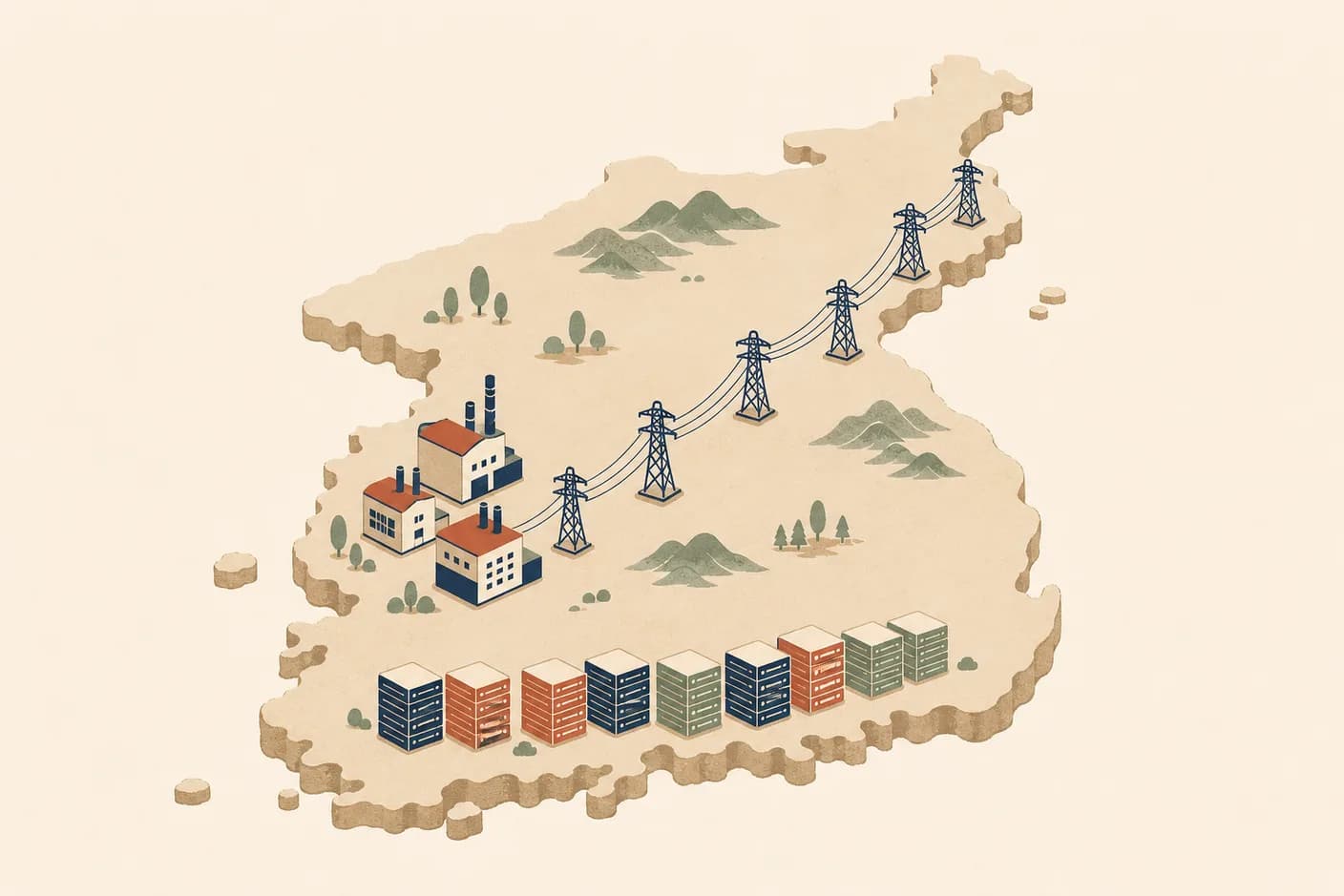
Every constraint from part 4 applies to Korea in a compressed form, because Korea is attempting one of the world's largest industrial buildouts on a small, densely populated peninsula.
The government's own figure is more than 10 gigawatts by 2053, stated identically by the Trade Ministry in 2024 and the Climate and Energy Ministry in 2026. A higher figure of 15 to 16 gigawatts appears in a National Assembly Research Service analysis, which frames it as the cluster's expected total demand under the most recently revised industrial-complex plans, a larger, more recent estimate than the original 10-gigawatt-plus figure rather than a different kind of measurement. Current local supply is around 1.9 gigawatts. For scale, the cluster's eventual draw is a meaningful fraction of the entire Seoul Capital Area's total electricity demand.
Closing that gap means moving electricity from the east coast and the Honam region to Gyeonggi Province. Korea Electric Power is pursuing a long-distance high-voltage transmission network to do it, in three stages running to 2030, 2036 and 2042. The 2036 date is the second stage, not the finish line. Government has committed to completing power supply within the cluster by 2042, pulled forward eleven years from an original 2053. Three liquefied natural gas plants, one gigawatt each, are being built to cover the cluster's first phase to 2030.
The track record is the worrying part. KEPCO's Bukdangjin to Sintangjeong line took 21 years to complete, from starting work in 2003 to entering service in November 2024. Long transmission lines in Korea are not an engineering problem. They are a negotiation with every community along 1,153 kilometres of route, and the "energy expressway" plan has already drawn organised local opposition, with some experts arguing the Yongin project should be reconsidered entirely.
Meanwhile the first Yongin fab has finished civil and structural work and entered cleanroom fit-out. The buildings will arrive well before the power does.
What this means if you live in Korea
Five practical connections, in rough order of how directly they touch daily life.
Your electricity bill sits inside this story. Korean industrial electricity now costs more than household electricity on average. These are average revenue per kilowatt-hour by contract type, not published tariff rates, so a household's actual marginal rate can run higher than the average at high usage. Rates for high-consumption industrial users have risen sharply since 2021, and industrial rates exceeded household rates in 2023, an unusual reversal of the normal pattern. KEPCO ran a large operating loss between 2021 and 2023 under constrained tariffs. Adding more than 10 gigawatts of new industrial demand to that situation creates obvious pressure, and how the cost is divided between industry and households is now an active political question rather than a technical one. Data center operators are already moving toward direct contracts with gas generators rather than the public grid.
The won moves with chip cycles. With semiconductors now over 40 percent of exports, memory prices affect the exchange rate, which affects the cost of imported food and goods, international school fees, and money sent to family abroad. When Korean chip earnings are strong, foreign residents paid in won generally benefit; when the cycle turns, the effect reverses.
Regional development is being redrawn. Yongin, Cheongju, Pyeongtaek and a planned southwestern cluster are absorbing enormous investment, along with the housing, transport and transmission infrastructure that follows. The OpenAI memorandum specifically targets sites outside the Seoul metropolitan area. If you are making a long-term housing decision, these are the corridors where demand is being manufactured deliberately.
The engineering job market is unusual right now. Chip and AI infrastructure demand is strong while much of the rest of the economy is not, and equipment and materials suppliers have reported labour shortages. For foreign residents with relevant technical backgrounds, this is one of the more accessible parts of the Korean labour market. It is also cyclical, and this cycle will turn.
Korea is running its own AI policy, not importing one. The AI Basic Act took effect in January 2026 and applies to services people here actually use. Korea is funding four domestic foundation model teams and building national compute. Whatever you think of the strategy, decisions about AI made in Seoul now affect residents directly rather than arriving second-hand from Brussels or Washington.
The honest summary
Korea occupies a genuinely important position in the AI supply chain, in one layer, which happens to be a layer nobody can route around. That is a better hand than most countries hold.
It is also narrower than the export figures imply, more contested than the record profits imply, and constrained by a physical problem that money does not solve on the required timeline. Micron is closing fast from above. CXMT is building capacity from below. The foundry gap has not narrowed in a decade of trying. And the electricity for the flagship cluster is scheduled to arrive fifteen years after the first fab opens.
The deeper point is the one in the moat section above. Of all the layers Korea could have come to dominate, memory is the one whose leadership has to be re-earned every cycle, because its barrier to entry is capital and execution rather than accumulated engineering that compounds. A country that led lithography would be defended by physics and two decades of tacit knowledge. A country that leads memory is defended by its willingness to keep spending, against competitors who are also willing to keep spending, one of whom does not need to make a profit.
None of that means the strategy is wrong. It means the strategy is a bet, made at scale, on a market that has never in its history stayed favourable for long.