Sooner or later, a Korean friend will tell you they are "going to see saju" before quitting a job, getting married, or starting a business. Roughly 4 in 10 Korean adults have paid for a reading at some point.
사주 (saju) is a centuries-old reading system based on a person's exact birth moment, treated by a sizable share of Koreans as a soft second opinion before major decisions. It is not a religion, not a horoscope, and not the same as the shamanic readings (신점) often confused with it.
Knowing the difference between saju, sinjeom, tarot, gwansang, and the apps everyone has on their phone is the entry point for cultural literacy here. This guide explains what saju actually is, how Koreans use it, and what to know if you find yourself getting a reading.
What saju is
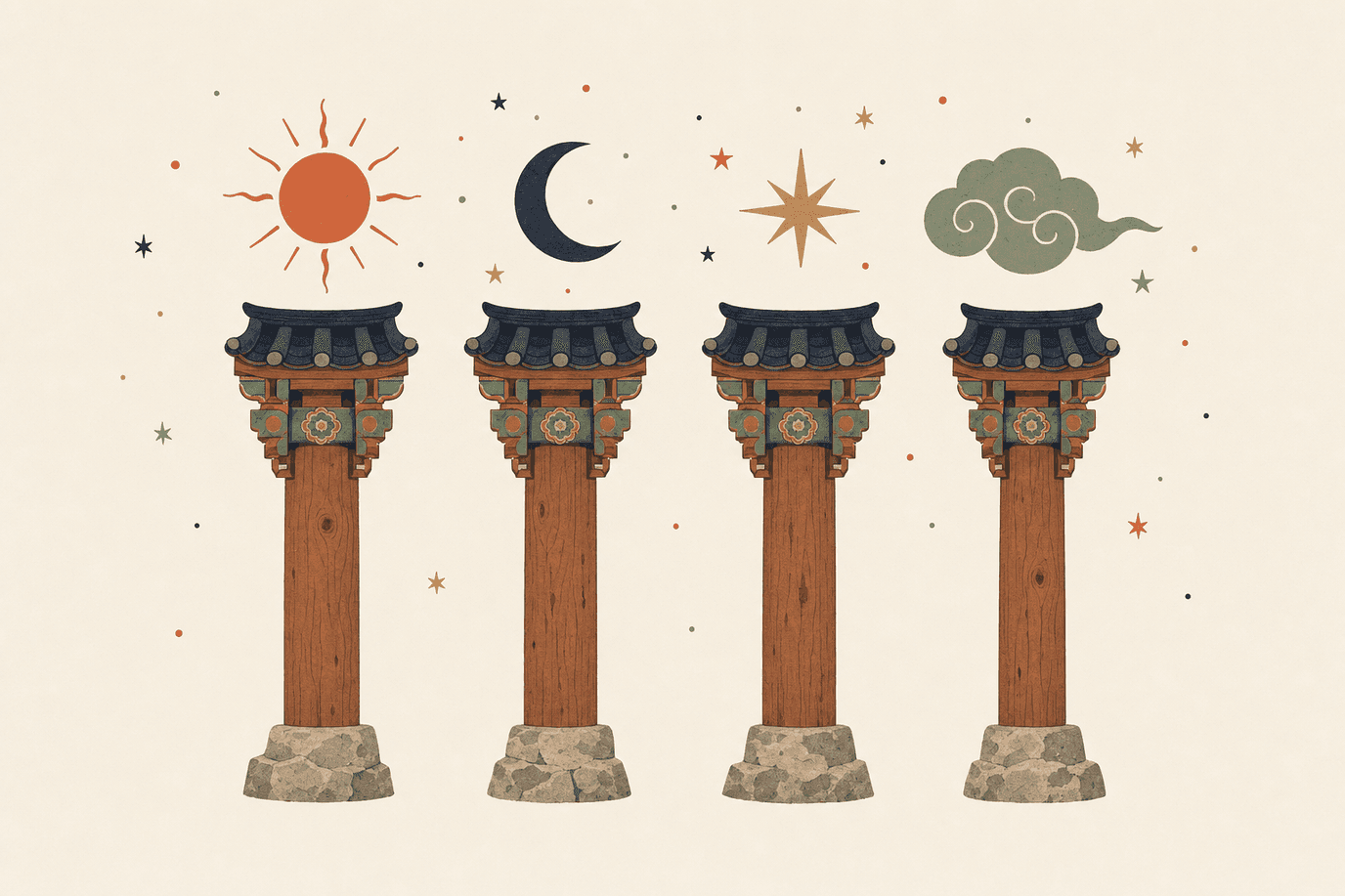
사주 (saju) literally means "four pillars": birth year, birth month, birth day, birth hour. Each pillar gets two characters, one heavenly stem (천간, cheongan) and one earthly branch (지지, jiji). Four pillars times two characters equals eight characters total, hence the longer name 사주팔자 (saju palja, "four pillars eight characters"). The word 팔자 in everyday speech also means "fate" or "the hand you were dealt."
Origin. Chinese Bazi (八字) divination, which Korea absorbed during the Goryeo period (918 to 1392) and refined through the Joseon dynasty (1392 to 1910). Court astronomers and scholars used it for state decisions; it filtered down into folk practice over centuries.
The reading framework. The 8 characters are mapped onto the Five Elements (오행, ohaeng: wood, fire, earth, metal, water) and the Yin-Yang principle (음양, eumyang). A reader interprets the balance and conflicts between the elements in your chart to describe personality, life path, and timing.
대운 (daeun, "great fortune"). 10-year cycles that shift the elemental balance of your chart over time. Readers explain which decade you are entering, what it favors, and what it does not.
Birth-time precision matters. Each "hour pillar" covers a 2-hour block on the traditional sexagenary clock (자시, 축시, 인시, and so on). If you do not know your birth hour to within 2 hours, the fourth pillar is missing and the reading is incomplete. Some readers will work with three pillars; others will not.
Calendar. Traditionally calculated against the lunar calendar (음력) with solar-term adjustments (절기). Modern readers and apps handle the conversion automatically; you give your Western birth date.
Saju is fundamentally distinct from Western astrology. It does not use planets, zodiac signs, or houses. It uses Chinese cosmology: five elements, ten heavenly stems, twelve earthly branches.
Saju vs the other forms
Foreign residents tend to lump these together as "fortune telling." Koreans treat them as separate categories.
사주 (saju). Text-based, formula-based. The reader calculates your chart from birth data and interprets it. Closer to a structured analysis than a mystical experience. No spirits, no possession.
신점 (sinjeom). Shamanic divination. A 무당 (mudang, shaman) channels spirits, often a specific 신령 (deity or ancestor). Sessions can be intense, theatrical, sometimes confrontational. Readers may speak in voices, name dead relatives, deliver warnings. Usually more expensive than saju.
타로 (taro, tarot). Imported Western system, became popular in Korea in the 2000s and exploded among 20s and 30s. Now lives in 타로 카페 (tarot cafes) in Hongdae, Apgujeong, and Sinchon. Casual, low-cost, often pitched as "fun" rather than serious.
관상 (gwansang). Face reading. Based on physiognomy traditions, reads features (forehead, nose, ears, mouth) for character and fortune. Sometimes offered alongside saju.
손금 (songeum). Palm reading. Less central than saju but commonly offered as an add-on.
풀이 (puri) vs 운세 (unse). 풀이 means "interpretation," a full reading session. 운세 means "fortune" in the lighter sense: the daily or monthly horoscope blurbs in newspapers and apps. When a friend says they checked their 오늘의 운세 (today's fortune) on an app, that is not the same as having saju read.
Who goes, and when
Most Koreans have at least a passing relationship with saju. Gallup Korea's 2026 nationwide survey (fieldwork March 13 to 26, 2026, 1,507 adults aged 19 and over) found that about 4 in 10 adults say they believe in practices like fortune-telling, saju, face reading, and naming, and that about 4 in 10 have at some point paid money for a 점 or 사주 reading. That paid-experience share has stayed close to 40 percent across three decades of the same survey. How people answer varies a lot by age, gender, and how the question is framed, so treat any single number as directional rather than exact.
Major life-decision triggers (the moments Koreans actually book a reading):
- 궁합 (gunghap): compatibility reading before marriage, often requested by parents before approving a match.
- Job change or quitting: timing of a career move.
- Starting a business or signing a 사업자 등록 (business registration).
- Buying a house or signing a major lease.
- Choosing or naming a baby (작명).
- Anxious life moments without a specific trigger.
신년운세 (new year fortune) season. The Lunar New Year through February is the peak. Reputable readers book out weeks in advance during this window.
Generational split.
- Older generation (50s and up): traditional 점집 (jeomjip, fortune-telling shops), often visited annually.
- 30s to 40s: mix of traditional 점집 for major decisions and apps for casual checks.
- 20s: 타로 카페 with friends as a social activity, plus apps. Saju literacy is still high but the framing is more casual.
What a reading is like
Length. Roughly half an hour to an hour for a standard saju 풀이. 신점 sessions can run longer.
What it costs. Fortune-telling prices are not government-regulated, and they vary widely by neighborhood, reader reputation, and the type of reading. There is no official price list, so the only reliable number is the one the specific reader quotes you before you start. As a rough sense of the landscape:
- Traditional 점집 saju: the mid-range, in-person standard.
- 신점 (shamanic): typically more than a saju reading, sometimes much more for a famous mudang.
- 타로 카페: the cheapest, usually priced per question or short session.
- App-based saju: free for daily readings, with paid in-depth reports.
- 작명 (naming a newborn): among the pricier services.
- 궁합 (compatibility): usually priced as a saju session for two.
Confirm the fee upfront. A reader who is vague about pricing is a flag.
What to bring. Precise birth date, birth time (down to the hour, ideally with AM/PM clarity), birth location is sometimes asked. For 궁합, bring partner's same data.
What sessions cover. 성격 (personality), 운 (fortune cycles), 직업 (career), 결혼 (marriage), 재물 (wealth), 건강 (health). The reader steers based on what you ask.
Style varies sharply. Some readers are warm and counselor-like. Some are blunt and prescriptive. Some are theatrical, especially mudang. Word-of-mouth referrals are how Koreans find readers they trust.
Where Koreans actually go in Seoul
미아리 점성촌. Historic cluster of 점집 north of the river. Once the largest fortune-telling district in Seoul; declined in recent decades but still operates.
강남. Higher-end traditional readers, often by appointment only, frequently recommended through professional networks.
압구정 / 청담. Trendy 타로 카페 and modernized saju studios catering to young professionals.
이대 / 신촌 / 홍대. Student-friendly tarot cafes, quick walk-in saju, casual price points.
인사동. Tourist-facing readers, mixed reputations. Some are legitimate; others are pitched at travelers and not the same product Koreans seek out.
Apps the rest of the country uses.
- 포스텔러 (Forceteller): one of the largest Korean fortune-telling apps; saju, tarot, 궁합.
- 점신: popular daily saju and 운세.
- 운세닷컴 and similar web portals.
Apps deliver algorithmic readings; many users treat them as a quick check rather than a substitute for an in-person reading on a real decision.
The cultural function (the part foreign residents tend to get wrong)
Most Koreans who consult saju do not describe themselves as believers in the literal sense. Surveys repeatedly show a gap between the share who have visited a reader and the share who say they "believe" the readings. Many treat it as cultural ritual, decision frame, or low-cost therapy.
Common framings Koreans use (in order of how often a foreign resident will actually hear them):
- "재미로 봤어" (I went for fun). Default deflection.
- "한 번 봐야 마음이 편해" (I just need a reading to feel settled).
- "참고만 하는 거지" (It's just a reference point).
- "어머니가 보고 오라고 하셔서" (My mom told me to go).
Functionally: saju acts as a pre-commitment device, a second opinion, and a way to externalize anxiety before high-stakes decisions. A reader who tells you the next two years favor a career change can lower the cost of a decision you were already leaning toward.
Religious overlap. Korea's religious landscape (Christianity, Buddhism, no affiliation, smaller shares of Catholicism, Confucian-influenced practice) does not cleanly predict saju use. Many Christian Koreans visit saju readers; some Buddhist temples offer 신년운세. Confucian ancestor reverence shapes how families weigh 궁합 readings before marriage.
Generational softening. Younger Koreans are less likely to treat readings as binding and more likely to frame them as entertainment or self-reflection. The cultural infrastructure remains intact even as literal belief drops.
작명: naming a newborn
작명 is one of the most enduring uses of saju. The naming professional reads the baby's saju, identifies which of the Five Elements is missing or weak, and selects 한자 (Chinese characters) whose elemental associations balance the chart.
Cost. Among the pricier saju services, and higher for well-known specialists. There is no fixed rate; confirm the fee in advance.
Process. Parents bring birth data. The namer returns 2 to 5 candidate names with the 한자, the elemental rationale, and the meaning. Parents pick.
Many young parents skip this step or do it casually. Many still do it, sometimes at family pressure.
Practical notes for first-timers
Many readers will see foreign clients. A small number, mostly in Itaewon, Hongdae, and 인사동, advertise English-language sessions; quality varies. Most readings can be done with a Korean-speaking friend interpreting.
Western birth dates work fine. The reader (or app) handles lunar conversion internally.
Birth time precision is the actual barrier, not nationality. Many Western birth certificates list time; many do not. If your birth time is unknown, ask whether the reader works with three pillars or recommends another approach.
궁합 with a Korean partner is the most common gateway. If your partner's family asks for a 궁합 reading, treat it as a meet-the-family ritual, not a verdict on the relationship. Many couples whose 궁합 was reportedly poor get married anyway. Many whose 궁합 was reportedly excellent break up. The ritual signals that the family is taking the relationship seriously.
App readings with English support are limited. 포스텔러 and similar apps are Korean-first. Some Western "Bazi calculator" sites give the technical chart but not Korean-style interpretation.
Healthy skepticism: scam patterns to know
The vast majority of readings are uneventful. The patterns below are the reason Korean media occasionally runs warnings.
굿 (gut) recommendation at huge cost. A reader (usually mudang, sometimes saju reader) tells you something is seriously wrong with your fortune and you need a 굿, a shamanic ritual, to fix it. Quoted prices can run from several million won to tens of millions. Reputable practitioners do not pressure-sell rituals.
부적 (talisman) upselling. Paper talismans sold to "ward off" misfortune, often at high markup. A small 부적 from a temple or reader is normal and inexpensive; aggressive multi-talisman packages are not.
Fear-driven framing. "If you don't do X, something terrible will happen to your family." Reputable readers describe tendencies, timing, and elements; they do not issue ultimatums.
Pay-per-question escalation. Starting cheap, then charging incrementally for each follow-up question. Confirm session pricing upfront.
Rule of thumb: if a reading shifts from describing your situation to selling you a product or ritual, leave.
What this is and isn't
Saju is not a religion. It is a divination and interpretation tradition that operates alongside religious practice in Korea. Christians, Buddhists, atheists, and the religiously unaffiliated all consult saju.
Saju is not Korean astrology. Foreign-language coverage often calls it "Korean astrology" for shorthand, but the systems are unrelated. Western astrology uses planets, zodiac, and houses. Saju uses Chinese cosmology, five elements, ten heavenly stems, twelve earthly branches.
Saju is not the same as 신점. Western-language sources frequently confuse the two. Saju is text-based and formula-based; 신점 is shamanic and channels spirits. Distinguishing them is the first step in cultural literacy here.
Korean shamanism is a real, living tradition. Even when noting scam patterns, it would be wrong to treat 무속 (musok, Korean shamanism) dismissively. Serious practitioners exist alongside opportunists, and the academic literature on Korean shamanism (Laurel Kendall's work, among others) takes the tradition seriously.
A practical primer for the first reading
If you decide to get a saju reading for the first time:
- Find a recommendation. Ask a Korean friend or colleague who has visited someone they trust. Word-of-mouth is how Koreans find their readers.
- Confirm the price upfront. Fortune-telling fees are not regulated and vary widely, so ask for the number before you sit down. If the reader is vague about pricing, that is a flag.
- Bring exact birth data. Date, time (with AM/PM clarity), and location if asked. For 궁합, bring partner's same data.
- Bring a Korean-speaking friend if you do not speak Korean. Translation in real time matters more than English-language signage.
- Listen to the framing, not just the predictions. A good reader will describe tendencies, timing, and elemental balance. They will not deliver ultimatums or pitch you on rituals.
- Treat the reading as one input. The Korean cultural framing of saju is "참고" (reference). It is not a verdict, not a prophecy, not a binding plan. It is a frame to think with.
If a Korean colleague returns to the office on Monday saying they "saw saju" on Saturday, they are not telling you they have abandoned reason. They are telling you they consulted a reference point before a decision they were already considering. That is the cultural function. Knowing this lets you participate in the conversation rather than dismiss it.