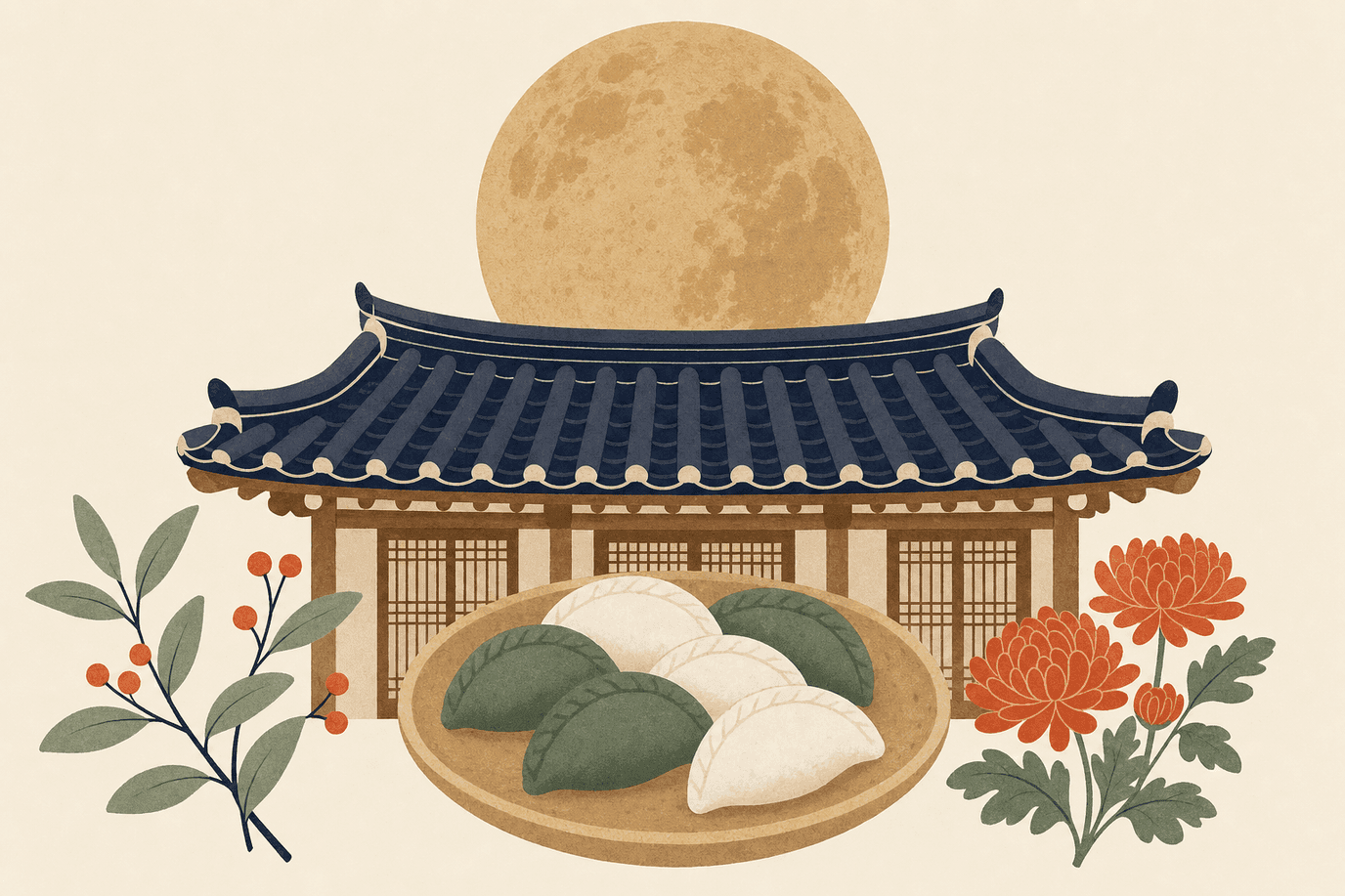
Half the country drives somewhere else for three days.
Twice a year, the country pauses. Streets in Seoul empty. Banks close for three days. KTX tickets sell out months in advance. Highway traffic to and from major regional cities crawls into double-digit hours. Your Korean colleagues message you on the eve of the holiday, then come back to the office visibly drained.
The two holidays are Seollal (설날, Lunar New Year) and Chuseok (추석, the autumn full-moon harvest holiday). Each spans a 3-day government holiday that typically extends to 5 or more consecutive days off via weekends and substitute holidays (대체공휴일).
These are family holidays in the Confucian sense, not long weekends in the Western sense. The default cultural script: travel to your parents' or eldest male relative's home, prepare ritual food, perform ancestral rites, and visit graves. The closest analog for foreign residents is American Thanksgiving, with stronger obligation and more in-law stress.
This guide explains what is happening, the 2026 and 2027 dates, what stays open, the rituals, why colleagues come back tired, and how to handle the holiday as a foreign resident with no family in Korea.
What these holidays are
Seollal (설날) is the lunar new year, observed on the first day of the lunar calendar (음력 1월 1일). The 3-day government holiday covers the eve, Seollal itself, and the day after. Origins trace to the Confucian Joseon dynasty, when ancestral rites became state-supported practice.
Chuseok (추석) is the autumn full-moon harvest holiday, observed on the 15th day of the 8th lunar month (음력 8월 15일). The earliest recorded form (가배, gabae) dates to the Silla dynasty, originally a harvest festival.
Both are protected by Korea's substitute holiday system (대체공휴일): when any of the three official days lands on a Sunday or coincides with another public holiday, the next available weekday becomes a paid substitute. This routinely turns a 3-day block into a longer run of consecutive days off.
2026 and 2027 dates
Seollal 2026. Lunar New Year falls Tuesday, February 17, 2026. Government holiday runs Monday February 16 through Wednesday February 18. With the preceding weekend, this is a 5-day stretch (February 14–18). Many workers extend it using a couple of days of annual leave.
Chuseok 2026. September 25, 2026 (Friday). Holiday runs Thursday September 24 through Saturday September 26. With the following Sunday included, 4 days off; many companies extend with annual leave.
Seollal 2027. Lunar New Year falls Sunday, February 7, 2027. The 3-day cluster (February 6–8) gets a substitute holiday on Tuesday, February 9, creating a 4-day stretch (February 6–9). One day of annual leave on Friday, February 5 extends it to a 5-day block.
Chuseok 2027. Wednesday September 15, 2027. The 3-day government holiday runs Tuesday September 14 through Thursday September 16; no substitute holiday applies. Workers commonly take Friday September 17 as annual leave for a 5-day stretch with the following weekend (September 14–20).
Korean media has already started calling the 2028 Chuseok cluster a potential extended "golden holiday" (황금연휴, hwanggeum-yeonhyu).
What closes, what stays open
Closed all 3 days. Banks, post offices, government offices, most clinics, most small businesses, most independent restaurants, libraries, public schools. Most pharmacies close all 3 days too.
Open with limited or holiday hours. Large hospital emergency rooms (always staffed), department stores and major malls (variable, often closed on the day-of), major chain coffee shops (Starbucks, Mega, Compose run reduced hours), some cinema chains, palaces and museums (free admission for hanbok wearers).
Open as normal. 24-hour convenience stores (CU, GS25, Emart24, 7-Eleven, Ministop), KTX/SRT and intercity buses (high-demand schedules), Incheon and Gimpo airports, subway and city bus (holiday schedule, reduced frequency), 119 emergency, 1339 medical hotline.
Practical rule: call 120 (Seoul Dasan Call Center, English/Chinese/Vietnamese available) or 1330 (Korea Travel Hotline) to find a specific open clinic, pharmacy, or facility. Both run during holidays.
For prescriptions: pick up before the holiday. Hospital ER pharmacies are the fallback but charge ER pricing.
The mass migration (민족대이동)
민족대이동 literally translates as "the great migration of the people," the standard Korean term for the holiday travel surge.
KTX and SRT tickets release in batches roughly one month ahead and sell out in minutes. Advance reservations usually open a few days earlier for senior and disabled travelers than for the general public; the Korail booking site posts the exact dates each year.
Expressway congestion peaks on the eve (going down to hometowns) and the final day (returning). The Seoul-to-Busan drive, normally around four hours off-peak, can stretch to roughly double that on the busiest holiday days, and return trips are often the worst.
The Korea Expressway Corporation's Roadplus service (roadplus.co.kr) and the ITS Korea map (its.go.kr) publish real-time congestion forecasts in Korean.
Domestic flights and intercity buses also book out. Incheon and Gimpo see outbound spikes as families and couples skip the family obligation entirely with overseas trips.
The food (and why it matters)
Seollal: rice cake soup (떡국, tteokguk). Sliced oval rice cakes in a beef or anchovy broth, garnished with egg ribbon, seaweed, and beef. Eating tteokguk is traditionally said to add a year to your age, the basis of the old Korean age system in which everyone aged together at the new year. The age system was legally retired in June 2023 (international age, 만 나이, is now the sole legal standard) but the cultural ritual continues. Other dishes: braised short ribs (갈비찜, galbi-jjim), savory pancakes (전, jeon), glass noodles (잡채, japchae).
Chuseok: half-moon rice cakes (송편, songpyeon). Filled with sesame, honey, mung bean, or chestnut, steamed over pine needles. The defining Chuseok food. Other dishes include newly harvested fruit (Korean pears, apples, jujubes, chestnuts), savory pancakes (전), taro soup (토란국), and full-table charye spreads if the family observes.
차례 (charye): the morning rite
차례 (charye) is the morning ritual on Seollal and Chuseok. The family sets a ceremonial table (차례상) of cooked dishes, fruit, rice wine, and rice cakes, then bows to honor ancestors.
차례 is distinct from 제사 (jesa), the death-anniversary rite. Charye is calendar-based and tied to these two holidays specifically.
Who hosts and who cooks. Traditionally hosted by the eldest son's family. Daughters-in-law (며느리, myeoneuri) prepare the food. The Confucian patrilineal hosting structure is the source of much of the holiday stress that follows. Younger families increasingly distribute the work, eat out, or skip charye entirely.
Religious variation. Catholic families generally observe 차례 (the Vatican lifted the ban on Korean ancestral rites in 1939, recognizing them as civil practice). Protestant families typically do not observe and substitute a memorial worship service (추도예배, chudoyebae). A large share of South Koreans identify as Protestant. Buddhist and non-religious families generally observe.
Participation is declining. Surveys point to a clear drop in Seollal and Chuseok 차례 observance over the past decade, from a clear majority of households to a minority in recent years. Korean outlets now routinely report that most households no longer perform 차례 at all. Seoul National University and the head family (종가) Confucian body Sungkyunkwan announced simplification standards in 2022 (fruit, rice cake, simple side dishes; no requirement for elaborate fried jeon), explicitly responding to the gendered labor burden.
세배 and 세뱃돈
세배 (sebae) is the Seollal morning bow. Younger family members perform a deep formal bow to elders, who respond with a blessing (덕담, deokdam, "words of wisdom for the year ahead").
세뱃돈 (sebaetdon) is the cash gift given by elders to children and unmarried younger relatives in return.
Typical amount norms (drawn from Korean media surveys, which shift year to year):
- Preschool and early elementary: 10,000 to 30,000 won
- Late elementary: 30,000 to 50,000 won
- Middle and high school: 50,000 to 100,000 won (50K is the giver-side common answer; 100K is the receiver-side preferred answer in surveys)
- University students and young adults: 100,000 won, sometimes higher for close family
The amount families prepare per child has trended upward in recent years, driven by inflation and the social pressure of "100K is the new 50K." Most surveyed adults say they prepare 세뱃돈 each Seollal.
Crisp new bills are conventional. White envelopes or fortune pouches (복주머니) are common. Most banks run pre-Seollal new-bill exchange events; queue 1 to 2 weeks ahead.
성묘: visiting graves
Many families visit ancestral grave sites during Chuseok, often combined with clearing weeds and tidying the grave plot (벌초, beolcho). The visit can happen on Chuseok itself or in the weeks before. The grave visit includes a brief offering of food and rice wine and bowing.
Cremation has shifted the landscape. The cremation rate in Korea has climbed well above 90% and keeps rising, and families increasingly visit a columbarium (봉안당, bongandang) or a natural burial site (수목장, sumokjang) rather than the open burial mounds the older generation grew up with.
한복 (Hanbok)
한복 was once standard holiday wear. It is now declining sharply in casual family settings. Most families wear hanbok only for posed photos, for formal 차례 if they still observe, or for very young children.
For foreign residents: do not wear hanbok to a Korean colleague's home unless explicitly invited and the family is wearing it themselves. The garment carries family and in-law significance.
Major palaces (Gyeongbokgung, Changdeokgung) waive admission for hanbok wearers year-round and run special holiday programming.
Traditional games
윷놀이 (yutnori). A four-stick board game played in teams. The most-played holiday game, especially at Seollal. Still genuinely played in many family settings, especially with children.
제기차기 (jegichagi). Shuttlecock kicking game. Mostly children.
강강술래 (ganggangsullae). Circle dance traditionally performed at Chuseok under the full moon, by women in hanbok. Survives mainly as performance and at cultural centers; not played casually in most modern households. UNESCO Intangible Cultural Heritage (2009).
투호 (tuho). Arrow-throwing into a vessel. Mostly performance and palace exhibitions.
Why colleagues come back exhausted: 명절 증후군
Holiday stress syndrome (명절 증후군, myeongjeol-jeunghugun) is a recognized stress pattern, named in Korean media in 1993 with the original term 며느리증후군 (myeoneuri-jeunghugun, daughter-in-law syndrome).
Recent surveys of women aged 30 to 54 consistently report that a large majority experience stress preparing for the holiday and physical and mental fatigue afterward. The most-cited stressors are the economic burden of gifts and food, excessive cooking, and time pressure.
Daughters-in-law historically bore the food-prep burden at the eldest-son's in-law's home. Recent shifts have added conflict between sisters-in-law, mothers-in-law also reporting stress, and unmarried adults stressed by "when are you getting married" and "how much are you earning" interrogations from relatives.
Court statistics and police data: Korean media reports each year that divorce filings tend to rise in the period after Chuseok and Seollal, and that domestic-violence reports run above the non-holiday baseline during the holiday window. This is the unspoken half of holiday culture in Korea. Most Korean families experience some version of it. The decline of 차례 and the rise of hotel staycations are partly a response.
명절 상여금: the holiday bonus
Many Korean employers pay a holiday bonus before Seollal and Chuseok. Not legally required, but customary at most large companies and government agencies. Smaller companies often skip or reduce it.
Employer surveys each year show that around half of companies plan to distribute a holiday bonus, with larger companies paying more than SMEs on average. Many bonus-paying companies also give a physical gift set, most often a ham, Spam, or tuna set, a fruit set, or a beef set.
Foreign workers on standard Korean employment contracts at large firms typically receive the bonus on the same terms as Korean colleagues. Worth asking HR before the holiday, not after.
명절 선물세트: the gift culture
The standard professional and family gift exchange. Pre-packaged sets shipped by department stores, supermarkets, and CJ direct.
Most popular categories:
- Spam gift sets. Ubiquitous. Introduced post-Korean War, scaled by CJ CheilJedang's 1986 Hormel licensing. Now the single most recognizable Korean holiday gift.
- Premium Korean beef (한우) gift sets. Nonghyup-grade and prime-cut sets, in the higher price tiers. The prestige gift.
- Fruit boxes. Korean pears (배), apples, mixed. Ritual-use fruits double as gifts.
- Red ginseng (홍삼) sets. Cheong Kwan Jang and KGC are the dominant brands.
- Seafood sets. Dried fish, anchovy, seaweed (Gwangcheon).
- Olive oil, processed-food assortments, tea (Osulloc).
A fruit box or a mid-range Spam set is a safe, well-received gift to a Korean colleague, business partner, or landlord, delivered before the holiday. Avoid alcohol unless you know the recipient drinks. Avoid anything overtly extravagant in business contexts.
The anti-graft law (김영란법) caps gifts to public officials. During the Seollal and Chuseok windows, agricultural, livestock, and fishery products can go up to 300,000 won (the standard non-holiday cap is 150,000 won). Non-agricultural gifts (anything from chocolates to electronics) cap at 50,000 won. Cash and vouchers are largely off the table. If you are gifting anyone in government or a public-affiliated role, stay clearly under whichever cap applies.
Recent shifts
"차례 안 지내요" (we do not do charye) is now a mainstream answer in many friend groups, especially under 40.
Hotel and restaurant holiday packages (호캉스, hocance) marketed as escape from family obligation. Holiday-window bookings at some hotel chains have risen sharply year on year.
Outbound international travel during holiday windows now competes with hometown travel as the default for younger families.
Holiday divorce (명절 이혼, myeongjeol-ihon) is a reported phenomenon and a media trope, supported by court filing patterns.
Younger families with no in-laws in Korea, or whose parents have explicitly waived charye, may simply stay home, eat tteokguk or songpyeon casually, and treat the holiday as time off.
Seoul Metropolitan Government and other local authorities now run "alone-on-Seollal" and "alone-on-Chuseok" programs for solo residents and foreign residents, including community meals and free palace events.
For foreign residents without family in Korea
Plan ahead. Banks, clinics, and most restaurants close. ATMs and convenience stores cover the basics; everything else needs the prior week's prep.
Travel options. Domestic flight or KTX out of Seoul (book 1 to 2 months ahead). International trip (Japan and Southeast Asia are heavily booked but still possible). Seoul staycation (palaces, museums, free admission for hanbok wearers).
Empty Seoul is genuinely pleasant. Major neighborhoods (Hongdae, Gangnam, Itaewon) are noticeably quieter; some restaurants run holiday menus.
If invited to a Korean colleague's family meal: bring a fruit box or Spam set, dress neatly (no hanbok), expect to be addressed in Korean, do not ask about marriage or income status of anyone present, eat what is offered, and accept that you will be the curiosity of the meal.
The pre-holiday text. Korean friends and colleagues most appreciate a brief message before the holiday: "즐거운 명절 보내세요" (jeulgeoun myeongjeol bonaeseyo, "have a happy holiday"). Reply to messages you receive in kind.
What to actually do during the holiday
For a working foreign resident with no family obligation in Korea, these holidays are some of the best windows of the year. Empty city. Free palace admission for anyone in hanbok. Reduced subway crowds. Restaurants that do stay open run special holiday menus. Many hotel staycation packages.
The cultural weight that makes Korean colleagues exhausted is also the weight that makes the country quiet for three days. As a guest in that quiet, you have permission to treat it as time off, send a polite text to your Korean contacts, and enjoy the city without the weekday noise.