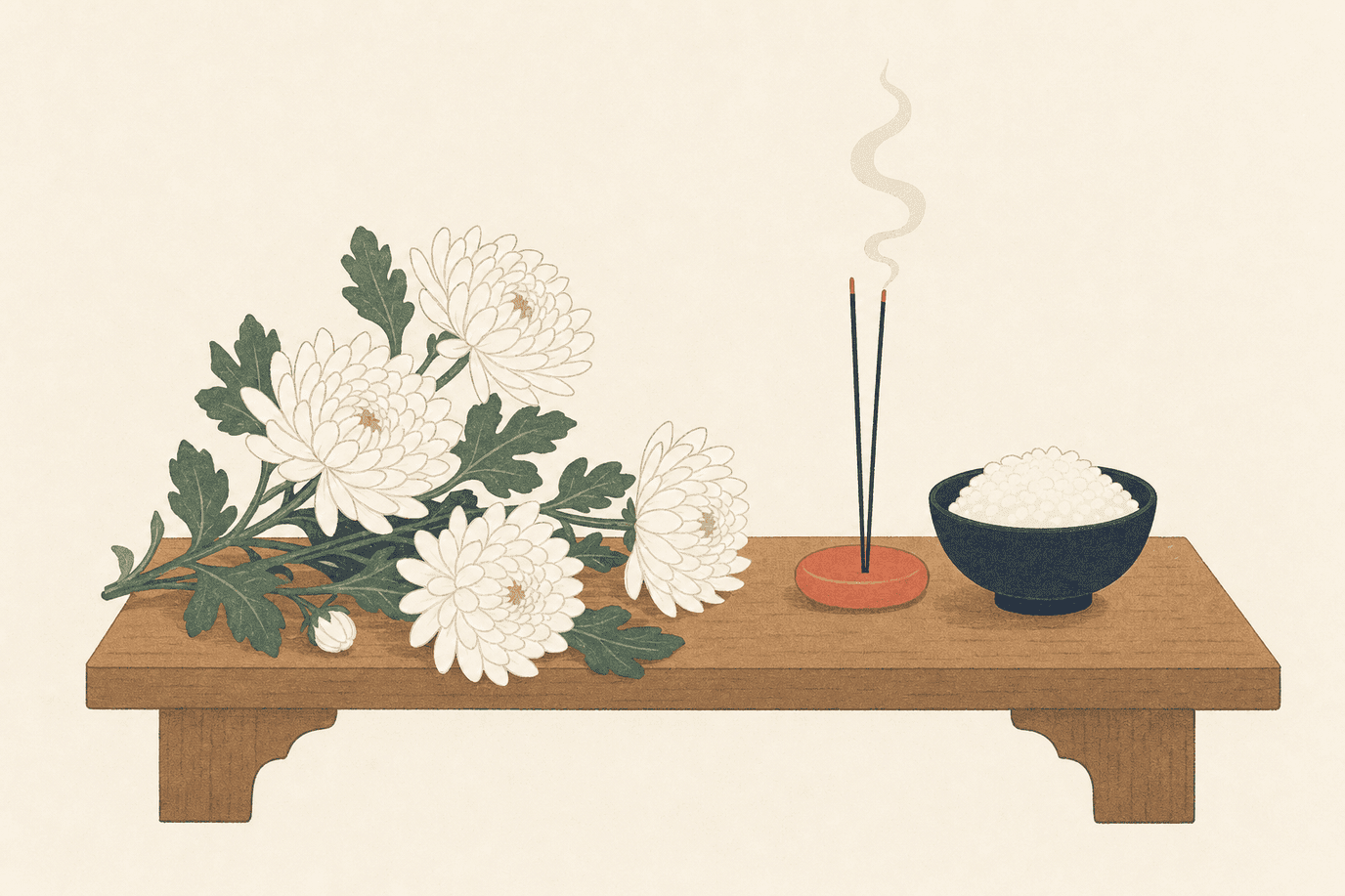
Your colleague's father died last night. You have 24 hours.
The message arrives by KakaoTalk, often late at night, with the address of a hospital funeral hall and a mourning room (빈소, binso) number. Sometimes there is no explanation beyond that. You are expected to come.
In Korean culture, a funeral is treated more seriously than a wedding. Attendance is a non-negotiable obligation for direct colleagues, managers, and family-side relations. The whole event takes three days. Most non-family guests come on Day 2 evening. The visit itself is short: 30 to 45 minutes, including the bows, the cash envelope, and a quick meal.
This guide walks through the practical mechanics: what to bring, what to wear, what to say, and what to absolutely not do. Foreign residents are forgiven for getting parts of the choreography wrong. They are not forgiven for skipping.
The 3-day format: how a Korean funeral unfolds
Korean funerals follow a near-universal three-day structure called three-day funeral (3일장, samiljang).
Day 1: the family receives the body, sets up the 빈소, and begins receiving guests in the evening.
Day 2 is the main visitation day. Coworkers, distant relatives, and acquaintances typically come during this window, usually in the evening after work.
Day 3 is encoffining ceremony (입관, ipgwan, often Day 2 evening or Day 3 morning), then body departure (발인, barin) early Day 3, followed by cremation (화장, hwajang) or burial (매장, maejang), then a memorial meal for the family and immediate guests.
The family stays at the funeral hall throughout, often sleeping in adjacent rooms. Visitors come and go. The family is continuously present.
A 2026 wrinkle worth knowing: cremation facility supply in Seoul, Busan, and other large cities has tightened, and Korean media has begun discussing the possibility of four-day funerals (4일장) when a Day 3 cremation slot is unavailable. Cremation is now the overwhelming default: the national cremation rate has climbed from a minority of deaths a generation ago to the large majority today, with recent Ministry of Health and Welfare figures putting it at roughly nine in ten.
Where to go: the 빈소 at a hospital funeral hall
The default Korean funeral venue is a funeral hall (장례식장, jangnyesikjang) attached to a major hospital, not a church, temple, or family home. This is true even when the deceased was not a patient at that hospital.
Each family rents a 빈소 numbered like a hotel room. Larger Seoul hospitals run dozens of 빈소 simultaneously. The most prominent in Seoul: Severance Hospital (Yonsei Funeral Home), Seoul Asan Medical Center, Samsung Medical Center, and Seoul National University Hospital.
The 빈소 has three zones:
- The reception desk (접수대) at the entrance, where you hand in your envelope and sign the guest book.
- The mourning room itself, with the deceased's portrait on a black-ribboned altar and incense burning.
- The dining area, where 육개장 and side dishes are served around the clock.
The hospital handles the body care, the ceremony logistics, and often the catering. Sometimes a prepaid funeral service company (상조회사, sangjohoesa) coordinates the family's side. The market is large: as of the end of March 2026, more than 11 million Koreans held a prepaid funeral-and-service (선불식 할부거래, which is mostly 상조) subscription, according to the Korea Fair Trade Commission.
The cash gift (부의금)
Condolence cash (부의금, bu-ui-geum) is a mandatory gift given at the reception desk on entry. There is no card, no flowers, no physical gift. Cash is the gift.
The amount is a social convention, not a fixed schedule, and it scales with how close you are to the family:
- Coworker, casual acquaintance, distant relative: an amount in the tens of thousands of won. Treated as "showing up."
- Close colleague, friend, regular contact: meaningfully more, the level people read as "a real relationship."
- Direct manager's parent, close friend's parent, in-law side: higher again.
- Immediate family, lifelong friend, mentor: highest, sometimes much higher.
Funeral 부의금 often runs slightly higher than the equivalent wedding congratulatory cash (축의금, chugeuigeum) for the same relationship. Two reasons: wedding gifts cover ceremony costs the couple chose to incur, while funeral costs were forced on a grieving family; and you cannot make up for missing a funeral the way you can a wedding.
A note on the bills: older etiquette says to avoid crisp brand-new bills (the suggestion being that brand-new cash anticipates the death). Contemporary etiquette is more relaxed. If in doubt, use clean bills that are not straight from the bank. If you are unsure how much to give, quietly ask a Korean coworker what the team is giving; people coordinate this all the time.
Reciprocity is real and tracked. Many Korean families maintain a condolence ledger (부조록, bujorok) of who gave how much. When the giver later loses a parent, that record shapes what comes back. This is multi-decade social credit.
The envelope
A plain white envelope. The funeral hall typically stocks pre-printed envelopes at the reception desk if you arrived without one.
Front of the envelope: written vertically in the center, carries one of these expressions in Hanja, Korean, or both:
- 부의 (賻儀) means "money offered to the bereaved." The safe default.
- 조의 (弔意) means "condolences."
- 근조 (謹弔) means "respectful condolences."
Back of the envelope: lower-right corner, write your full name vertically. If you are giving on behalf of a workplace team, write the company or team name above your name.
Seal the envelope. Never use red ink on a funeral envelope. In Korean tradition, red ink on a name signifies the deceased. Use black ink only.
If the funeral hall provides pre-inscribed envelopes, you only need to add your name. This is the easiest path for foreign guests.
Dress code
Black, conservative, plain.
Men: black or very dark navy/charcoal suit, white shirt, black tie, dark socks, black leather shoes.
Women: black dress, black skirt-and-blouse, or black pantsuit. Covered shoulders. Minimal accessories. Dark stockings if wearing a skirt. Hair tied back if long.
What to avoid: white-only outfits (white is mourning color in Korean tradition, but it reads wrong for guests; family wears it, guests do not), bright colors, patterns, flashy jewelry, statement bags, bare legs in cold months, sneakers, sandals.
Makeup: minimal. No bold lipstick.
If you do not own black formal wear, the closest dark, plain, conservative outfit you have. Foreign guests get some grace, but trying matters. Hospital funeral halls in Seoul have rental shops nearby for last-minute black suits if needed.
The 조문 procedure: what happens inside the 빈소
The choreography, in order:
1. Reception desk (접수대). Hand the sealed envelope to the attendant. They will register your name in the guest book (방명록).
2. Enter the mourning room. Remove your coat. Bow your head briefly upon entering.
3. Approach the altar. Light one stick of incense from the existing flame. Do not blow on it; wave gently with your hand to extinguish, then place it upright in the incense holder.
4. Step back, stand straight, hands folded. Men: right hand over left. Women: left over right. (This is the mourning-direction reversal of regular ceremonial bowing.)
5. Two full deep bows (큰절). Kneel, bend forward until your forehead nears the floor, rise, repeat. Then a brief standing half-bow (반절).
6. Turn to the family. The chief mourners stand to the side of the altar, identifiable by their armbands. Make one half-bow to them. They will return the bow.
7. Brief words of condolence. "삼가 고인의 명복을 빕니다" (samga goin-ui myeongbok-eul bimnida, meaning "I respectfully pray for the peace of the deceased"). Or the shorter "조의를 표합니다" (joeu-reul pyohamnida, "I offer my condolences"). For foreign guests, "I'm so sorry for your loss" in English is also fine. Sincerity reads.
8. Exit to the dining area. Sit briefly, eat, leave.
The whole sequence takes 5 to 10 minutes for the bows and condolences, then 15 to 20 minutes at the meal. Foreign guests are not expected to perform the bows perfectly. Following the lead of the person ahead of you in line is fine.
Religious differences (read the altar)
Look at the altar before you act. The cue is what is on it.
Secular or Confucian (the default majority). Incense, two deep bows, the standard 조문 procedure described above.
Christian / Protestant. No incense and no deep bows to the deceased (Protestant doctrine treats the deep bow as ancestor worship). Instead, place a single white chrysanthemum on the altar with the flower head (bloom) facing the portrait, then a moment of silent prayer or a brief bowed head. The 빈소 may have a Christian cross or hymns playing. The half-bow to the family proceeds normally.
Catholic. Closer to Protestant in protocol: a flower instead of incense, prayer in place of bows. Some Catholic families do permit the bow as cultural rather than religious.
Buddhist. Incense and bows are central. The 49-day memorial (49재, sasipgujae) follows. May be held at a temple instead of a hospital hall in some cases, though hospital halls remain common.
If you see incense burning and a portrait with a black ribbon, follow the standard procedure. If you see flowers and no incense (or a clear cross), it is a Christian funeral and you place a flower instead. If unsure, watch the person in front of you and copy.
What to say and not say
Stick to one short phrase. Short is better than elaborate.
Say: "삼가 고인의 명복을 빕니다" or "I'm so sorry for your loss."
Do not say: "He's in a better place." "At least it was peaceful." "How did it happen?" Anything cheerful. Anything about your own losses. Anything that requires the family to comfort you.
Do not smile in the 빈소. Reserve smiling for the dining area, if you greet a coworker you know.
Do not ask the cause of death. If they want to tell you, they will.
Do not take photos. Ever. Not of the altar, not of the family, not of the food, not of anything. This is a common foreign-resident mistake.
The meal: 육개장 and the dining-area protocol
After paying respects, you sit in the dining area for a brief meal. Eating is expected. Refusing is rude.
The signature funeral meal is spicy beef and vegetable soup (육개장, yukgaejang) with rice. The reasons are practical: it travels well, holds heat in big pots over multiple days, and the spice signals respect (mourners traditionally avoid sweet or light food).
Side dishes typically include boiled pork slices (수육, suyuk), savory pancakes (전, jeon), rice cake (떡, tteok, often white), kimchi, and various seasoned vegetables (나물, namul).
Soju and beer are usually provided. Drinking is fine in moderation, but never clink glasses and never say cheers (건배, geonbae). In a house of mourning, celebratory gestures are inappropriate. Lift the glass slightly, drink quietly.
The food is provided by the funeral hall around the clock. There is no awkwardness about eating "their" food. The family expects it. A typical guest visit is 30 to 45 minutes total. Stay longer only if you are close to the family or have come from far away.
Identifying the family: 상주 and 완장
The chief mourner (상주, sangju) is traditionally the eldest son or grandson. In modern practice, multiple co-mourners share the role.
The armband (완장, wanjang) on the upper left arm signals family role:
- Two black stripes: chief mourner.
- One stripe: married close relative.
- No stripe: unmarried or extended family.
Black ribbon on the chest is another marker.
For a guest, the practical use of this is simple: the people in armbands and ribbons standing at the side of the altar are the people you bow to. You do not need to identify the chief mourner specifically. The half-bow goes to all of them.
Bereavement leave
Korean labor law does not mandate bereavement leave. The Labor Standards Act has no specific provision; the Ministry of Employment and Labor treats family-event leave (경조사 휴가) as a contractual leave (약정휴가) set by each company, not a statutory one. (This surprises foreign residents from countries where it is statutory.)
In practice, almost all medium and large Korean companies offer congratulatory and condolence leave (경조사 휴가, gyeongsosa hyuga) as a company policy, separate from annual paid leave. Typical company policy:
- Death of spouse, parent, or child: around 5 days paid.
- Death of grandparent, parent-in-law, sibling: around 3 days paid.
- Death of aunt, uncle, or grandparent-in-law: 1 to 2 days paid.
Smaller companies and contract workers may have less. Foreign residents on E-7 or other employment visas should check their contract.
For foreign residents losing a family member overseas: most companies grant the same leave, plus often allow combining with annual leave for travel. Discuss with HR immediately. Do not assume.
What "expected to attend" means
For a coworker's parent: yes, attend. Even if you have worked together six months.
For your direct manager's parent: yes, definitely attend.
For a colleague from a different team: gauge by your relationship. Minimum is sending 부의금 via a coworker who is going.
For an in-law's parent (your spouse's aunt or uncle): yes, attend with your spouse.
For a friend's parent: depends on closeness. If you have met the parent, yes.
For a coworker's grandparent, sibling, or in-law: 부의금 only is usually acceptable; attendance optional.
"I didn't know them" is not a reason to skip. You are showing up for the living family member.
If you genuinely cannot attend (out of country, sick, conflict), send 부의금 via a coworker who is going, with a brief written note. A condolence message later is appreciated. Skipping for casual reasons is remembered.
What NOT to do
- Do not bring flowers. The family arranges flower wreaths through sponsors (화환, hwahwan, logos and senders' names appear on banners outside the 빈소). Bringing your own flowers is incorrect and creates awkwardness.
- Do not bring food, fruit, alcohol, or any physical gift. Cash only.
- Do not wear bright colors, jeans, sneakers, or anything casual.
- Do not write your name in red ink on the envelope.
- Do not photograph anything in the 빈소 or the dining area.
- Do not say cheers (건배) when drinking. Do not clink glasses.
- Do not smile in photos with the family. (Avoid taking photos at all.)
- Do not ask about the cause of death.
- Do not stay long. 30 to 45 minutes is the norm for a non-family guest.
- Do not skip if you are expected.
A few specifics that surprise foreign residents
There is no eulogy from family or friends. The portrait and altar speak for the deceased.
There is no religious sermon unless it is an explicitly Christian, Catholic, or Buddhist funeral with clergy present.
There is no music other than possibly hymns at a Christian funeral.
There is no casket viewing for guests. The body is in a separate prepared space; only family see it during 입관.
There is no procession through public streets. The 발인 happens at the funeral hall, then the family travels privately to the cremation or burial site.
There is no reception line of the deceased's friends. The bowing to the family at the altar is the entire interaction.
After the funeral: 49재 and 제사
The 49-day Buddhist memorial (49재, sasipgujae) is held every 7 days for 49 days after death, with the major rite on the 49th day. Buddhist doctrine holds that the deceased's spirit moves through an intermediate state during this period before rebirth.
Even non-Buddhist families sometimes observe a 49재 privately. The Korean Catholic Church does not officially adopt the Buddhist doctrine but permits a 49-day Mass at the family's request. Most Protestant families do not observe it.
The annual ancestor memorial (제사, jesa) is held on the death anniversary (기제사, giijesa) and on certain holidays. Foreign residents are essentially never invited to 제사. It is family-only.
You will not be expected at the 49재 unless you were close family or a close friend.
Why this matters
Korean funeral culture runs on social credit. Attending the funeral of a coworker's parent today is what makes that coworker show up to yours later, to your parent's funeral, to your in-law's funeral. The condolence ledger (부조록, bujorok) is multi-decade.
For foreign residents, this can feel like a heavy obligation for someone you barely knew. The framing that helps: you are not attending for the deceased. You are attending for the living family member who will remember whether you came. In a country where the social fabric is woven in long threads, that memory carries weight.
Show up. Wear black. Bring a clean envelope of cash. Bow twice. Eat the soup. Leave quietly.