Your new coworker asks: '무슨 띠야?' You have no idea what to say.
You are three weeks into your new job in Seoul. At lunch, a Korean colleague turns to you and asks: "무슨 띠야?" (casual) or "무슨 띠예요?" (polite). Everyone at the table looks at you. Your brain runs through its Korean vocabulary and finds nothing useful.
The question is not mystical. It is a practical age check. Korea has a 12-year animal cycle called the zodiac animal sign (띠) system. Knowing which animal year you were born in tells your colleague roughly where you fall in the age hierarchy, which in turn shapes how they speak to you. The 띠 question is a softer, less direct way to figure out your age than asking "몇 살이에요?" outright.
This guide walks through the 12 animals, how to find yours, why the question gets asked, and a few things worth knowing about the 60-year cycle underneath it all.
The 12 animals: find your 띠
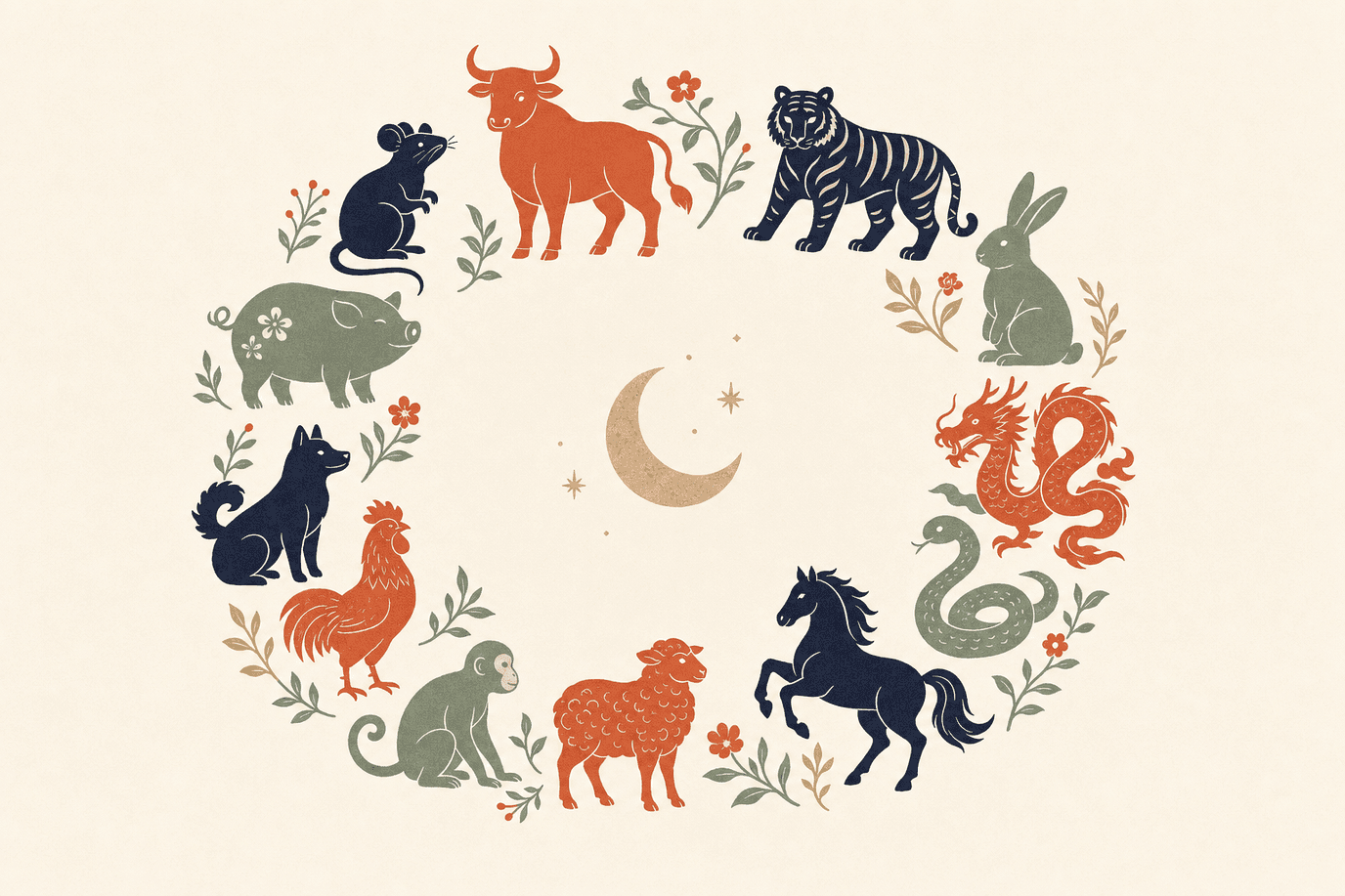
The 12-animal system follows a fixed cycle tied to birth year. The table below covers birth years from the 1950s onward.
| Animal | Korean name | Hanja | Recent birth years |
|---|---|---|---|
| Rat | 쥐띠 | 子 | 1960, 1972, 1984, 1996, 2008, 2020 |
| Ox | 소띠 | 丑 | 1961, 1973, 1985, 1997, 2009, 2021 |
| Tiger | 호랑이띠 | 寅 | 1962, 1974, 1986, 1998, 2010, 2022 |
| Rabbit | 토끼띠 | 卯 | 1963, 1975, 1987, 1999, 2011, 2023 |
| Dragon | 용띠 | 辰 | 1964, 1976, 1988, 2000, 2012, 2024 |
| Snake | 뱀띠 | 巳 | 1965, 1977, 1989, 2001, 2013, 2025 |
| Horse | 말띠 | 午 | 1966, 1978, 1990, 2002, 2014, 2026 |
| Goat | 양띠 | 未 | 1967, 1979, 1991, 2003, 2015, 2027 |
| Monkey | 원숭이띠 | 申 | 1968, 1980, 1992, 2004, 2016, 2028 |
| Rooster | 닭띠 | 酉 | 1969, 1981, 1993, 2005, 2017, 2029 |
| Dog | 개띠 | 戌 | 1970, 1982, 1994, 2006, 2018, 2030 |
| Pig | 돼지띠 | 亥 | 1971, 1983, 1995, 2007, 2019, 2031 |
Two animal names you may hear for the same sign. Tiger띠 is sometimes called 범띠 in older or regional usage. Monkey띠 appears as 잔나비띠 in older texts and in some dialects; the modern everyday term is 원숭이띠. If an older Korean uses 범 or 잔나비, they mean the same animals.
Korea uses 양 (goat/sheep) for the eighth sign. In Chinese tradition the eighth animal is also often translated as sheep or ram. Korean usage settles on 양, which covers both goat and sheep. This is a minor source of confusion for foreign residents from countries that use a different creature for that slot in their own zodiac tradition (Vietnam, for example, uses the cat for the fourth position rather than the rabbit).
The Lunar New Year edge case
If you were born in January or the first days of February, read this section before deciding on your 띠.
The zodiac animal year (띠) does not change on January 1. Two reference points exist.
Everyday Korean usage treats Lunar New Year (설날, seollal) as the boundary. 설날 falls on different dates each year based on the lunar calendar, usually somewhere between late January and late February.
Formal saju (四柱) practice uses the Start of Spring (입춘, ipchun) as the boundary instead. 입춘 falls around February 4 on the solar calendar each year. Traditional fortune tellers and astrologers use 입춘 as the precise cut point.
For everyday conversation, the practical result is: if you were born in January or before 설날 in February of a given year, you may belong to the previous zodiac year by common reckoning. If you are ever unsure, the safest move in conversation is simply to give your birth year: "95년생이에요." The person asking will have a sense of where the 설날 boundary falls and can work it out.
Why Koreans actually ask '무슨 띠예요?'
Korean speech requires choosing an appropriate register: formal or informal, older-sibling address forms or peer forms. That choice depends on relative age. The most useful shortcut is the birth year, but asking someone's exact birth year directly can feel abrupt to people who have just met.
The 띠 question splits the difference. Knowing someone is a horse sign (말띠) tells you they were born in one of a 12-year range of horse years: 1966, 1978, 1990, 2002, 2014, and so on. Within a typical workplace age range, that usually narrows to one or two possibilities, which is enough context to calibrate speech level. If the result is still ambiguous (the gap between the nearest two horse years in a plausible range is 12 years, which could flip hierarchy), the follow-up question is: "몇 년생이에요?" (which year were you born in?).
Two terms you will hear in these conversations:
Same year (동갑): born in the same calendar year. In Korean social logic, 동갑 is the strongest tie of equality. Two people who are 동갑 frequently shift to informal speech (반말) quickly.
Same-animal, different-generation (띠동갑): same zodiac animal but 12 years apart in age. Recorded in the National Institute of Korean Language's open dictionary (우리말샘). Two people who are 띠동갑 still observe the 12-year age gap in speech and hierarchy. Sharing an animal does not create the social equality that sharing a birth year does.
Phrases worth knowing:
- "저는 말띠예요." (I am horse-year.) A direct, natural answer.
- "무슨 띠세요?" (What is your zodiac animal? Polite form.)
- "저는 [birth year]년생이에요." (I was born in [year].) The all-purpose fallback.
The 60-year cycle and why 환갑 matters
Behind the 12-animal zodiac is a larger structure: the sexagenary cycle (육십갑자).
The system combines two sets of signs: 10 heavenly stems (천간, 天干) and 12 earthly branches (십이지, 十二支). Because 10 and 12 share a lowest common multiple of 60, combining them produces exactly 60 unique year-name pairs before the sequence repeats.
Each year name is two syllables: a heavenly stem character plus an earthly branch character. 2026 is 병오년: 병 (丙, the third heavenly stem, associated with fire and the color red) plus 오 (午, the seventh earthly branch, the horse). The previous 병오년 was 1966; the next will be 2086.
This is why the 60th birthday (환갑) is a significant celebration in Korea. Reaching your 환갑 means your exact stem-branch birth year has returned in the cycle for the first time. Your birth year combination comes back once every 60 years. Traditionally calculated in Korean age (한국식 나이), so the party usually falls on the 59th international birthday. The milestone carries enough cultural weight that it typically brings the whole extended family together.
The age system guide on this site covers how 환갑 interacts with the three Korean age systems in more detail.
2026: 병오년, the Year of the Red Horse
2026 is 병오년, a fire/red horse year. Children born in 2026 will carry the horse sign (말띠). The most recent horse years before this one were 2014 (갑오년, wood/green horse) and 2002 (임오년, water horse).
The heavenly stem 병 corresponds to fire and the color red, which is why 2026 is sometimes called the Red Horse year in English-language coverage of Korean new year traditions. Each horse year has its own stem, so each is slightly distinct: 1966 was 병오년 (fire horse), 1978 was 무오년 (earth horse), 1990 was 경오년 (metal/white horse), 2002 was 임오년 (water horse), 2014 was 갑오년 (wood horse).
You will still see horse-year language in seasonal articles, public culture writing, and New Year conversation. Treat it as a cultural calendar reference first, not as a binding prediction about someone's personality or future.
사주팔자: what your 띠 has to do with it
You may hear the term Four Pillars of Destiny (사주팔자) in Korean conversation. It comes up when people mention getting a 사주 reading, checking compatibility (궁합) before a marriage, or consulting an astrologer for an auspicious date.
The system works like this: your birth year, month, day, and hour each receive a heavenly stem and an earthly branch. That gives you eight characters total (사주 = four pillars, 팔자 = eight characters). A trained practitioner reads those eight characters together to assess personality, life trajectory, and compatibility.
Your 띠 is the animal from the year pillar alone. It is one of eight characters in the full reading, not a summary of the whole thing. If someone says they had their 사주 read and got interesting results, they are describing a full eight-character analysis, not just their birth year animal.
Modern uses for saju in Korea include compatibility readings for couples before marriage (궁합), choosing auspicious dates for weddings, business openings, or moving (택일), and naming newborns based on auspicious character combinations (작명). Most younger Koreans treat these as cultural rituals or a form of self-reflection rather than literal prediction, though the practice remains genuinely widespread.
백말띠 and the 1990 birth-year story
Background. 1990 was 경오년, a metal/white horse year. In everyday Korean, people born that year are often called 백말띠, literally "white horse sign."
What happened in 1990. Statistics Korea birth-statistics materials list the 1990 total sex ratio at birth as 116.5 males per 100 females. This guide treats the 1990 number as demographic context, not as proof of a single cause.
The key distinction. 1966 was 병오년, fire horse year. 1990 was 경오년, metal/white horse year. Both are horse years but they carry different heavenly stems and different names.
How to read it now. Foreign residents will most likely encounter 백말띠 as a cohort label for people born in 1990, and sometimes as a prompt for broader conversation about zodiac belief and demographic history.
삼재: three inauspicious years
One more term you will hear, especially around Lunar New Year: the three-year inauspicious cycle (삼재).
Every 12 years, three consecutive years become 삼재 years for specific zodiac animals. The middle year is considered the most difficult and is called 눌삼재. In 2026 (the horse year), rabbit-year people, goat-year people, and pig-year people are in their 눌삼재. You will see this mentioned in New Year horoscope articles, discussed casually over 떡국, and occasionally cited when someone explains why they had a rough year.
For most foreign residents, recognizing the term and understanding roughly what it means is enough.
A brief history
The 12-animal zodiac originated in Han dynasty China and entered the Korean peninsula during the Three Kingdoms period (approximately the 4th to 7th century CE). The system was not simply a folk calendar: it carried cosmological, administrative, and ritual significance.
The clearest physical evidence of how deeply the system embedded in Korean culture is in the royal tombs of the Silla kingdom. Stone guardian figures representing the 12 zodiac animals appear around Unified Silla tombs, with the mature tomb-encircling form documented in the 8th century. The tomb of General Kim Yu-sin (김유신묘) in Gyeongju, designated National Historic Site (사적) No. 21 by the Cultural Heritage Administration, has zodiac stone figures. So does the Tomb of King Seongdeok (성덕왕릉), National Historic Site No. 28. These are not decorative: each figure stands at a directional post corresponding to its animal's position in the cosmological map.
The Goryeo and Joseon dynasties continued to use the twelve earthly branches (십이지) system in official calendars, court rituals, and administrative record-keeping. The Buddhist tradition added another layer: the Twelve Divine Generals of the Medicine Buddha (약사십이신장) are iconographically linked to the 12 earthly branches, which is why zodiac animals appear in some Korean Buddhist temple art.
How the 띠 system connects to the age system guide
If you read the Korean age system guide on this site, some of this will feel familiar.
Both systems are built on birth-year cohort thinking rather than individual birthdays. In Korean age (한국식 나이), everyone in a birth year advances together on January 1. In the 띠 system, everyone in a birth year shares the same animal and a new animal cohort begins at the lunar or spring boundary. Neither system makes the individual birthday the primary social reference point.
Both systems have pre-modern lunar calendar roots. The collective new-year rollover in Korean age parallels the 설날 boundary in everyday 띠 reckoning. Both reflect a world organized around shared-year transitions rather than individual milestones.
환갑 connects the two directly. The 60th birthday marks the return of the full 육십갑자 stem-branch pair. That calculation is grounded in both the zodiac year-name system and the age-counting logic discussed in the age system guide. The two guides are meant to be read together.
The practical result: foreign residents who understand the 띠 system will catch a layer of casual conversation that would otherwise pass them by. When a Korean colleague says they are 띠동갑 with someone 12 years older, or explains that their parent is in 삼재 this year, or mentions checking 궁합 before a wedding, the reference makes sense. That context is harder to look up in the moment than it is to know in advance.
Your answer to "무슨 띠야?" is now straightforward. Find your birth year in the table above, note the animal, and say "저는 [animal]띠예요." Then wait to see whether you just acquired a new 형, 누나, 오빠, 언니, or 친구.