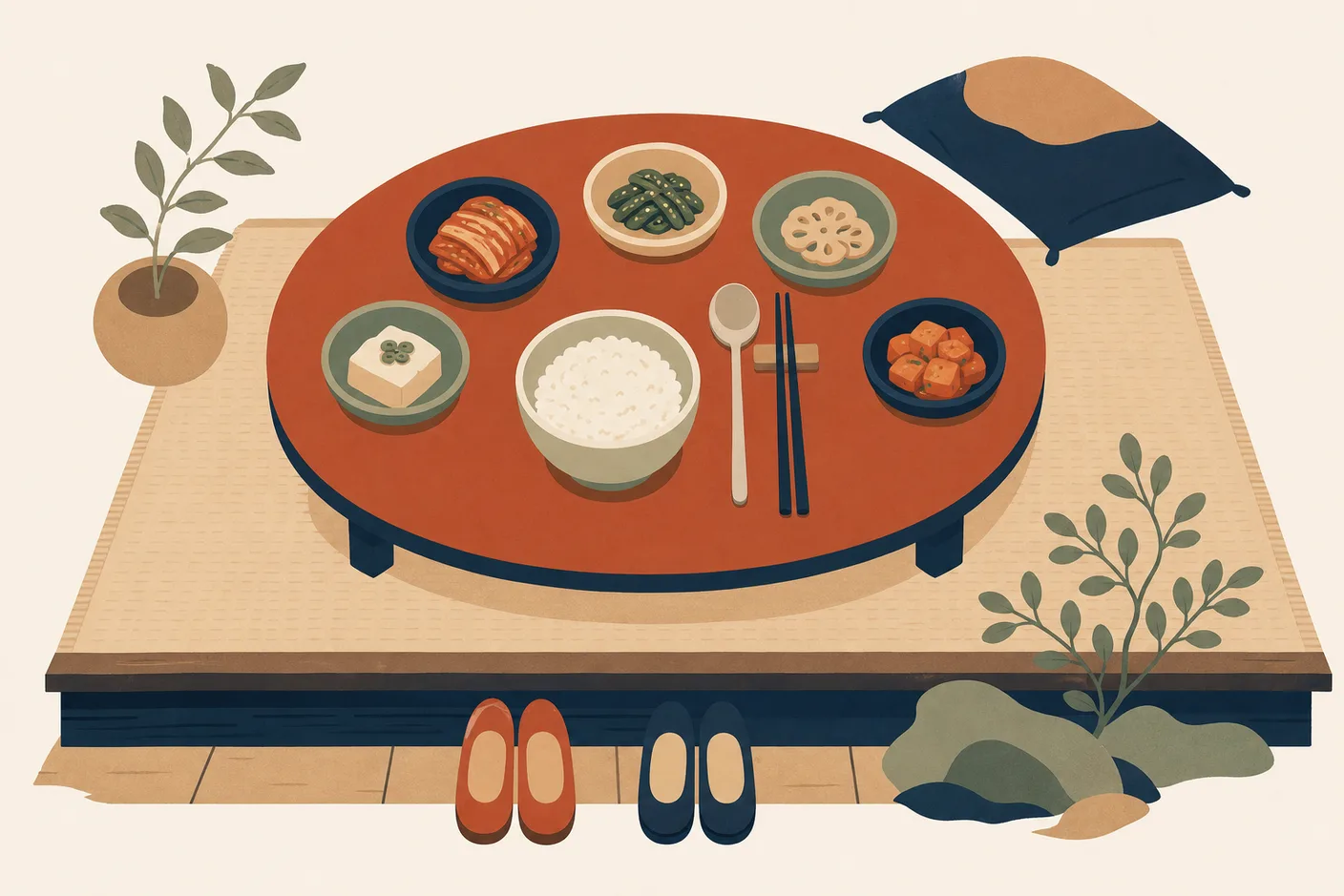
Korean etiquette is not a list of a hundred rules. It is two questions, asked fast, every time.
The two questions: how old are you relative to the person in front of you, and what are you to each other. Colleague, stranger, friend of a friend, customer, neighbor. Almost every rule that follows is one of those two answers applied to a specific situation. Who speaks first, who sits where, who pours, who pays, which verb ending you use.
This is why Korean etiquette feels overwhelming from outside and obvious from inside. Nobody is memorizing a hundred rules. They are answering two questions and letting the answers do the work.
The good news for a foreign resident: you get a wide margin. Nobody expects you to have the age hierarchy pre-loaded, and attempting a rule imperfectly reads far better than not attempting it. What people notice is effort, not precision.
This guide covers the everyday social code, table manners in detail, drinking protocol, home visits, public space, and gifts. For the deep versions of specific situations, see the guides on Korean BBQ etiquette, drinking culture, speech levels, and office hierarchy.
The operating system: age and relationship
Age is not small talk
Being asked your age early in a conversation is not nosiness. Korean has no neutral register: the speaker has to choose between honorific speech (존댓말, jondaenmal) and casual speech (반말, banmal) in the first sentence, and age is the input that decides. Someone asking your birth year is asking which language to speak to you.
The same question sorts out who pours first, who sits where, and who is expected to pay. Answering it plainly is the cooperative move. See the Korean age system guide for how the counting works, since Korea uses more than one method depending on context.
The register does not reset downward
Once two people settle into honorific speech, dropping to casual speech is a negotiated step, usually proposed by the older person with a phrase like 말 놓을까요 (should we drop the formality). Switching unilaterally, especially downward toward someone older, is a real misstep. The safe default as a foreign resident is to stay in honorific speech with everyone until someone invites you out of it.
Nunchi is the actual skill
Nunchi (눈치) is the read-the-room sense: noticing that the senior person's glass is empty, that the group is ready to leave, that a question was actually a soft refusal. Koreans describe someone as 눈치가 빠르다 (quick on the read) or 눈치가 없다 (oblivious) as a genuine character assessment.
You do not need perfect nunchi. You need to be visibly watching. Looking around before you act is itself the behavior. The full picture is in the nunchi and jeong guide.
Greetings, hands, and names
The bow
Three usable levels:
The nod, about 15 degrees. Everyday. Greeting a colleague in the hallway, thanking a cashier, passing a neighbor in the elevator, acknowledging someone across a room. This is the one you will use dozens of times a day.
The bow, about 30 degrees. First meeting with someone clearly senior, a job interview, meeting a partner's parents, a formal thank-you, an apology.
The deep bow. Ceremonial. Holidays, memorial rites, weddings. You will be told when it applies.
Do not overthink the angle. A nod with eye contact, then a slight break of eye contact as your head goes down, is correct in nearly every situation a foreign resident encounters.
Two hands is the highest-value habit you can build
If you take one thing from this guide, take this. Give and receive with two hands, or with your right hand while your left hand touches your right forearm or wrist. It applies to:
- Business cards
- Money, payment cards, and receipts
- Gifts
- Documents at a bank, clinic, or government office
- Drinks, both pouring and receiving
- Anything handed to someone older or senior
One-handed giving is not shocking, but two-handed giving is noticed and appreciated every single time. It is the cheapest respect signal in the language.
The handshake variant. Korean handshakes are often two-handed, or right hand shaking with the left hand supporting the right forearm. A light bow usually accompanies it. Grip is generally softer than the Western business standard, and a crushing handshake is not read as confidence.
Business cards
Present with two hands, Korean side up and facing the recipient. Receive with two hands, then actually read it for a beat before putting it away. Place it on the table in front of you during a meeting rather than pocketing it immediately, and never write on someone's card in front of them or shove it into a back pocket.
Names and titles
The bare first name is close to unusable with anyone who is not a close friend or clearly younger. Options in ascending formality:
- Full name plus 씨 (ssi), as in 김민수 씨. Peer-level, polite, safe with a colleague of similar rank. Do not attach 씨 to a first name alone with someone senior.
- Job title plus 님 (nim), as in 팀장님 (team leader), 과장님 (manager), 교수님 (professor). The workplace default. Titles outrank names in Korean offices.
- 선생님 (seonsaengnim), literally teacher, but usable as a general respectful term for almost any adult whose title you do not know.
- 사장님 (sajangnim), literally company president, the standard way to address any shop owner, restaurant proprietor, or taxi driver.
Family terms get used with non-family constantly: 이모 (auntie) for a woman running a restaurant, 언니 (older sister) between women, 형 (older brother) between men. Wait until these are offered to you rather than deploying them first.
Small physical things
- Beckon palm-down, fingers waving toward yourself. The Western palm-up curled finger is how you call a dog.
- Point with an open hand, not an index finger, and never with chopsticks.
- Do not blow your nose at the table or in a meeting. This reads considerably worse in Korea than quiet sniffing does. Step out to a bathroom.
- Receive change and cards with two hands, or at least with a hand rather than letting them be set down.
- Physical contact between friends of the same gender is normal, arms linked, hands on shoulders. It does not carry the reading it might elsewhere.
Table manners
This is where visitors and new residents get watched most closely, and also where the rules are most learnable.
Before the food arrives
Seating. The seat furthest from the door, or the one facing the entrance, is the seat of honor. It goes to the oldest or most senior person. If someone gestures you toward a seat, take that one rather than choosing your own.
Setting the table. The youngest person (막내, maknae) distributes the spoons and chopsticks, pours the water, and sets out cups. If you are junior at the table and the utensils are still in the caddy, that is your job and doing it unprompted earns real credit.
Waiting. Do not start eating until the oldest person at the table has picked up their spoon. This is the rule most commonly broken by new arrivals and it is genuinely noticed. The polite opener before your first bite is 잘 먹겠습니다 (jal meokgetseumnida), roughly "I will eat well."
Spoon and chopsticks
The pair is called 수저 (sujeo), and the division of labor is strict:
The spoon (숟가락, sutgarak) is for rice and soup. Rice is eaten with the spoon, not chopsticks. Soup and stew are eaten with the spoon.
The chopsticks (젓가락, jeotgarak) are for side dishes. Anything on a shared plate, anything grilled, anything you are picking up.
Use one at a time. Holding the spoon in one hand and chopsticks in the other simultaneously is a visible beginner marker. Set one down before picking up the other.
Do not lift the rice bowl. Unlike in China or Japan, Korean rice and soup bowls stay on the table. Bring the spoon to your mouth, not the bowl. Korean rice and soup bowls are usually heavy metal or stoneware, which is part of why the custom settled this way.
Never stand chopsticks upright in rice. Upright chopsticks in a rice bowl replicate the incense offering at a memorial rite for the dead. This is not a minor faux pas; it visibly unsettles people. Rest chopsticks across the rim of a dish or on the rest provided.
Do not stab food with chopsticks, do not use them to point or gesture, and do not pick through a shared dish looking for the piece you want. Take the piece nearest to you.
Shared dishes
Korean meals are shared by default. Side dishes (반찬, banchan) are communal, and so is the stew in the middle of the table.
Take from the near side. Reaching across the table or digging through a plate for a better piece is the actual rule being enforced, not the sharing itself.
On double-dipping into the shared stew. The traditional table has everyone spooning from one pot. Since 2020 many restaurants have shifted toward serving individual portions or providing a serving spoon (앞접시 for a small plate, 국자 for a ladle). Read the table: if a serving spoon appeared, use it. If you are eating with people you do not know well, using a serving spoon is always the safer read.
Refills are free. Banchan refills cost nothing at almost any Korean restaurant. Ask with 반찬 좀 더 주세요 (banchan jom deo juseyo). The counterpart obligation is not to over-order and leave food untouched, which is read as wasteful.
Serve others before yourself. If a fresh dish lands, putting a piece on a senior person's plate before your own is a small, well-received move.
While eating
Slurping is acceptable, especially noodles and soup. Chewing with your mouth open is not.
Match the pace of the table. Finishing dramatically ahead of everyone or lagging far behind both draw attention. The junior members of a table watch the seniors and adjust.
Do not blow your nose. Korean food is frequently spicy enough to make this urgent. Step away from the table.
Keep your free hand visible, resting on the table or your lap. Eating one-handed with the other arm hanging is read as slouchy in formal company.
Do not eat while walking on the street. Standing at the shop where you bought it is normal, walking down the sidewalk with it is not, though this convention is loosening among younger people.
Calling staff and paying
Calling staff. Many restaurants have a call button on the table; press it. Otherwise, 여기요 (yeogiyo) or 저기요 (jeogiyo) said clearly across the room is completely normal and not rude, which surprises people from cultures where raising your voice in a restaurant is a faux pas. 사장님 (sajangnim) and 이모님 (imonim) also work depending on who is working.
Who pays. At a work dinner, the senior person or the company pays, and reaching for the bill is not expected of you. Among friends, splitting n ways (n빵, n-ppang) is the default under about forty: one person pays the whole bill and sends KakaoPay requests to everyone else. Between two people, the older person often pays, and the younger is expected to cover the next round, the coffee after, or the following meal. Offering to pay and being refused is part of the ritual; offer once, then accept graciously.
Paying happens at the counter, not at the table, in most Korean restaurants. Take the check slip with you.
Do not tip. Tipping is not part of the system in restaurants, cafes, taxis, hotels, salons, or delivery. Leaving cash typically triggers staff following you out to return it. Some upmarket venues add a service charge to the bill, and that is the whole amount expected.
Leaving. 잘 먹었습니다 (jal meogeotseumnida), "I ate well," on the way out. Said to the host who paid, and also often to the staff. It is the single most useful phrase in this guide.
Drinking manners
Alcohol has its own layer of rules because it involves pouring, which means it involves hierarchy on every single refill. The condensed version is here; the full treatment, including how work dinners escalate through rounds and how to opt out, is in the Korean drinking culture guide.
Do not pour your own drink. This is the one rule that matters most. Pour for the people around you, watch for empty glasses, and someone will pour for yours. Pouring your own in front of a senior person is the single most-noticed slip a foreign resident makes.
Pour with two hands, or right hand pouring with left hand touching your forearm. Receive with two hands on the glass. Among close peers of the same age this relaxes to one hand, but default to two.
Refill empty glasses, not partial ones. Topping up a half-full glass is not the custom. Watch for the empty one, especially the senior person's, and offer.
Turn away slightly when drinking in front of someone much older. Body angled away, glass shielded with your free hand. Younger Koreans do this less, but it is still standard with parents, in-laws, and much older colleagues.
Clink with your glass lower than the senior person's. A small, easy signal of deference.
How to decline without friction. Accept the first pour and at least touch it to your lips. Then keep the glass partly full so there is nothing to refill, which quietly removes you from the cycle. If you need to state it: driving, medication, antibiotics, or a health reason all close the subject immediately and none of them will be challenged.
Forced drinking is not something you have to absorb. Pressure to drink at a work dinner falls under workplace harassment provisions in the Labor Standards Act, and both attitudes and policies have moved considerably in recent years. Younger colleagues decline routinely.
Never drive after any amount. Korea's blood alcohol limit is 0.03 percent, among the strictest anywhere, and a single drink can put an average adult over it. Use a designated-driver service (대리운전, daeri-unjeon) or a taxi.
Shoes, homes, and being a guest
Shoes come off
Always: private homes, temple halls, guesthouses and hanok stays, traditional floor-seating restaurant rooms, changing rooms.
Often: clinics and small hospitals, some schools and offices, fitting areas in some clothing shops, some cafes with raised seating platforms, study rooms.
The physical cue is a raised floor, a step up, or a shoe rack at the entrance. If shoes are lined up by the door, yours join them.
Point your shoes toward the door after removing them, so they are ready to step into on the way out. Doing this unprompted is a small, noticed courtesy.
Slippers. House slippers are usually offered. Bathroom slippers usually sit just inside the bathroom door and stay in the bathroom; wearing them back into the living room is a genuine mistake. Socks matter here, so socks with holes are a real anxiety and not just a joke.
Being a guest
Do not arrive empty-handed. Fruit boxes, a bakery cake, a coffee or tea set, and good snacks are all standard. Present the gift with two hands, and expect a small ritual of the host declining before accepting.
A housewarming (집들이, jipdeuri) has its own traditional gifts: laundry detergent and toilet paper. The wordplay is about a household bubbling up and unrolling smoothly. They sound like joke gifts and are entirely sincere.
Floor seating. Many homes and traditional restaurants seat guests on floor cushions at low tables. Cross-legged is standard for men, legs folded to one side is common for women, and stretching your legs out toward other people, particularly toward someone senior, is impolite. If your knees cannot manage it, say so; nobody wants you in pain and most places can find a chair.
Do not wander. Bedrooms and closed doors are private in a way that is stricter than in many Western homes.
Expect to be fed a lot, and expect refusals to be overridden. Declining a second helping once, then accepting, is a normal rhythm rather than a contradiction.
What not to give
- Shoes to a romantic partner. The superstition is that they will walk away from you.
- Knives or scissors. Cutting the relationship.
- A clock as a primary gift. Associations with counting down time.
- Sets of four. The number four sounds like the word for death, which is why many buildings label the fourth floor F.
- Writing someone's name in red ink. Red is used for the names of the deceased in some registers.
- Anything green for a man's head, meaning a green hat, carries an infidelity joke imported from Chinese usage.
None of these will cause a scene if you get one wrong, but all are easy to avoid.
Public space
The subway
Priority seats (교통약자석, gyotong-yakja-seok) sit at both ends of each car. The Act on Promotion of Transportation Convenience for Mobility Disadvantaged Persons defines the protected group as people with disabilities, older people, pregnant people, people accompanying infants and toddlers, and children, and it requires priority seating as a mandatory mobility-convenience facility on buses and trains. At least one tenth of a subway car is designated as a dedicated area for these passengers.
No fine attaches to sitting in one, so this is enforced socially rather than legally, and the social enforcement is strong. The seats stay empty even on a packed train, and a healthy adult sitting in one, even briefly, will often draw open comment from other passengers.
The pink pregnancy seat (임산부 배려석, imsanbu baeryeoseok) is separate. It is an operator initiative from Seoul Metro and other transit authorities rather than a requirement of the national statute, and it is also left empty, because early pregnancy is not visible. Do not sit in it.
Regular seats and elderly passengers. Giving up a regular seat to a visibly older passenger is standard, and many people stand up before being asked.
Phone calls. Speaking quietly is expected; long loud calls draw stares. Text instead. Watching video without headphones is a genuine social offense.
Backpacks come off on a crowded train and get held in front of you or at your feet.
Let passengers off before boarding, stand to the sides of the doors, and expect pushing during rush hour that is not personal.
Eating on the subway is not illegal but is strongly frowned on, especially anything with a smell.
Escalators, queues, and doors
Escalators. This one is genuinely in flux. A civic stand-on-one-side campaign took hold around the 2002 World Cup, the government replaced it with a stand-on-both-sides campaign in 2007 on safety and equipment-wear grounds, and then dropped that campaign in 2015 after public pushback. In 2026 the Ministry of the Interior and Safety and the Korea Elevator Safety Agency began reviving the two-line campaign, and it is written into the first Elevator Safety Management Master Plan covering 2026 to 2030.
On the ground, one-line standing on the right is still the entrenched habit in busy stations. Standing on the right, holding the handrail, and letting people pass on the left is the pragmatic read today, with the caveat that signage is shifting back toward asking you to stand still on both sides.
Queueing is orderly and taken seriously, with floor markings at subway platforms and bus stops that people actually use.
Doors and elevators. Holding a door is normal. In an elevator, the person nearest the panel operates it, and letting older people enter and exit first is standard.
Smoking
Under the National Health Promotion Act, smoking in a designated no-smoking area carries a fine of up to ₩100,000. The mandatory no-smoking list covers every restaurant, snack bar, and bakery, along with medical facilities, daycare centers, libraries, transport waiting areas and platforms, office buildings over 1,000 square meters, accommodation, and indoor sports facilities. Venues can install a separate enclosed smoking room, which is why some buildings still have one.
Two things worth knowing. Licensed drinking establishments in the entertainment categories (유흥주점, 단란주점) are not part of that blanket designation, though most ordinary Korean bars are licensed as general restaurants and therefore are no-smoking. And local governments may designate the area within 30 meters of the boundary of any kindergarten, daycare center, or school as no-smoking, so the pavement outside a school gate is often a fineable zone.
Look for designated smoking areas (흡연구역, heubyeon-guyeok), common near station exits and office buildings. Smoking while walking on a busy street is legal in many places and socially disliked.
Do not smoke in front of someone clearly older without asking. This is a real convention, not a legal one.
Trash
General waste goes out in your district's official volume-based bag (종량제 봉투, jongnyangje bongtu), bought at any convenience store. The bags are district-specific and a bag from the wrong district will not be collected.
Food waste is separated into a designated bin or bag, and in many apartment complexes into a card-metered container.
Recycling is separated aggressively by paper, plastic, glass, cans, and film plastic, usually on set days in apartment buildings.
Public bins are scarce. Carrying your trash home, or leaving a coffee cup with the cafe that made it, is normal.
Noise at home
Inter-floor noise (층간소음, cheunggan-soeum) is a serious and frequently disputed issue in Korean apartments. The standard sits in a rule jointly issued by the Ministry of Land, Infrastructure and Transport and the Ministry of Environment. For direct impact noise, the kind from walking and running, the limits are 39 decibels by day and 34 decibels at night as a one-minute equivalent level, with peak levels of 57 and 52 decibels. Airborne noise from televisions and speakers is set at 45 by day and 40 at night over five minutes. Day runs 06:00 to 22:00 and night runs 22:00 to 06:00.
Two limits on what the standard actually covers. Residents are legally required to make an effort to stay under these numbers rather than being fined for exceeding them, so the figures function as the yardstick in a dispute rather than as a police matter. And human voices are explicitly excluded: arguing, shouting, and loud singing fall outside the inter-floor noise rule, though extreme cases can be handled under the Minor Offenses Act. Renovation noise is also outside it and is governed by your building's management rules.
Practically: no running or heavy walking after 10 PM, no laundry or vacuuming late at night, no drilling on a Sunday without warning neighbors, and floor mats if you have small children. Complaints usually arrive first as a knock or a note, and escalate to the building management office (관리사무소) rather than the police.
Money, envelopes, and gifts
Weddings and funerals
Cash in an envelope is the standard gift at both, and both have specific conventions covered in detail in the Korean wedding culture and Korean funeral culture guides. The short version: white envelope, crisp bills, your name written on the envelope, handed over at the reception desk at the entrance, and the amount scaled to how close you are to the person.
If you deal with public officials, teachers, or journalists
The Improper Solicitation and Graft Act (부정청탁 및 금품등 수수의 금지에 관한 법률), commonly called the Kim Young-ran Act, sets hard legal ceilings on what public officials, schoolteachers at both public and private schools, and journalists may accept. The enforcement decree fixes the value ranges at:
- Meals: ₩50,000. Raised from ₩30,000 in 2024, so older guides and even some official summary pages still quote the old figure.
- Congratulatory and condolence money: ₩50,000, with wreaths substituting for cash capped at ₩100,000. Giving both together is capped at ₩100,000 combined, and the cash portion still has to stay at or under ₩50,000.
- Gifts: ₩50,000, except agricultural and fishery products and processed goods made more than 50 percent from them, which go up to ₩150,000, rising to ₩300,000 during the Lunar New Year and Chuseok windows. Those windows run from 24 days before the holiday to 5 days after.
Delivery charges do not count toward a gift's value.
This matters more than it sounds for foreign residents, because it covers your child's schoolteacher and any professor you work with. A cheap coffee is fine, a gift basket may not be. When in doubt, the answer is a card.
Everyday gift-giving
Gifts are wrapped, presented with two hands, and often not opened in front of the giver. Do not be discouraged if a gift is set aside rather than unwrapped. A host declining a gift once or twice before accepting is expected politeness rather than reluctance.
Sending a small KakaoTalk gift, a coffee voucher or a cake, is now the standard low-effort thank-you and is used constantly for birthdays and favors. See the KakaoTalk culture guide for the mechanics.
At work
Office etiquette deserves its own treatment, and the Korean office hierarchy and working at a Korean company guides cover it properly. The compressed version:
- Titles, not names. 팀장님, 과장님, 대리님.
- Greet the room on arrival and say something on departure, even a simple 먼저 가보겠습니다 (I will head out first).
- Do not leave before your manager without acknowledging it, though this norm has weakened considerably.
- The junior person pours at dinners, presses elevator buttons, and handles logistics.
- Messages from a manager get a fast acknowledgment. 넵 is the universal one-word upward reply.
What actually gets noticed, ranked
If you are optimizing effort, this is the order:
- Pouring your own drink. The most-noticed slip, every time.
- Starting to eat before the oldest person. Second most-noticed.
- One-handed giving or receiving with someone senior. Constantly visible because it happens all day.
- Holding spoon and chopsticks together. Marks you as new at every meal.
- Sitting in a priority seat on the subway. Draws public comment rather than a quiet judgment.
- Blowing your nose at the table. Reads worse than most people expect.
- Chopsticks upright in rice. Rare, but genuinely unsettling when it happens.
And what is forgiven almost entirely: getting the bow angle wrong, mixing up speech levels, not knowing a title, misjudging who pays, being unable to sit cross-legged on the floor, not drinking. Foreign residents are given a wide margin on all of these, and the margin gets wider the more visible your effort is.
The short version
If you remember nothing else:
- Two hands for giving, receiving, and pouring.
- Wait for the eldest to start eating.
- Spoon for rice and soup, chopsticks for side dishes, one at a time.
- Do not pour your own drink.
- Shoes off where there is a raised floor or a shoe rack.
- Do not tip.
- Watch first, then act. The nunchi habit covers everything this guide does not.