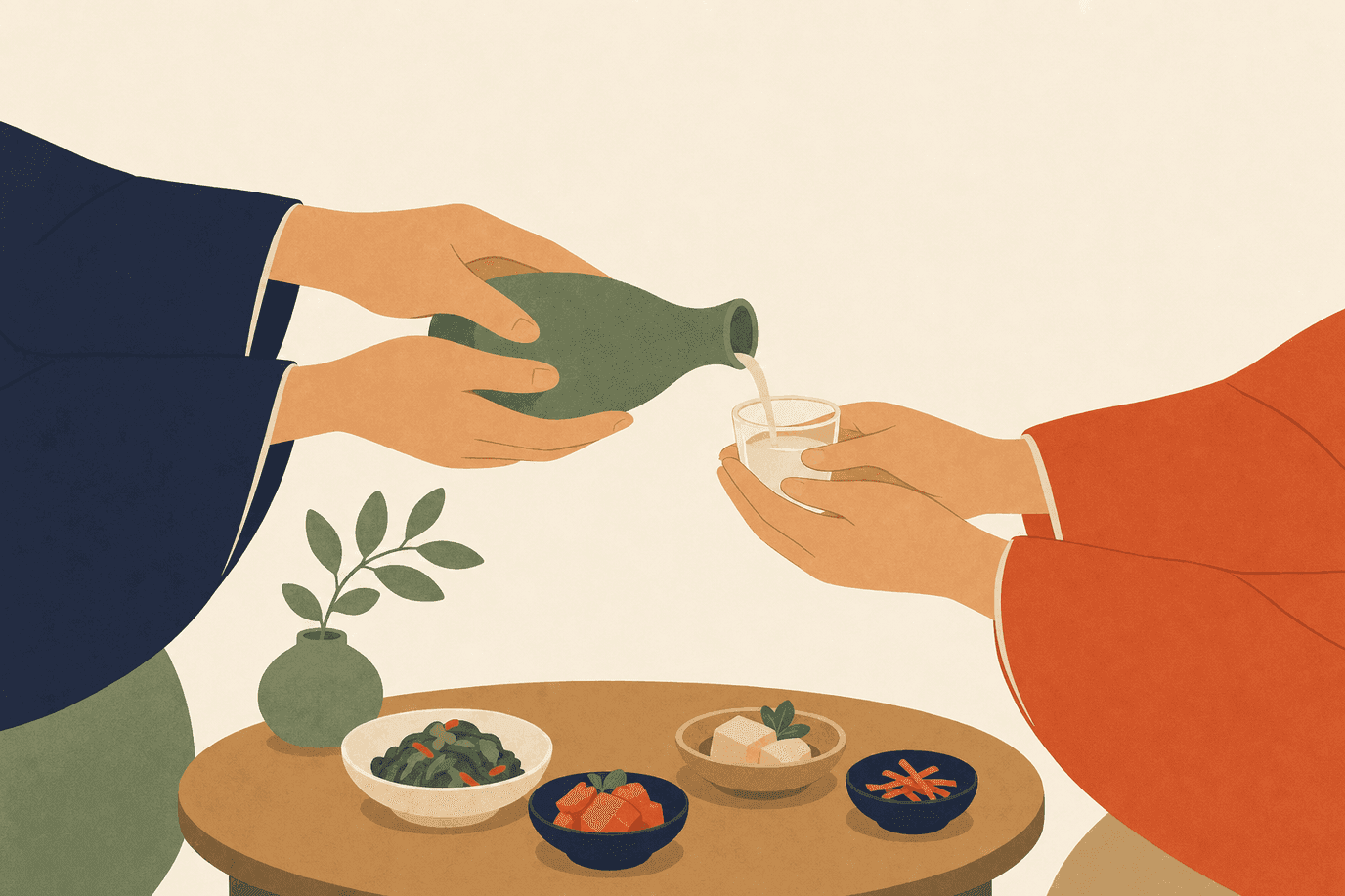
Three rounds, two-handed pours, one rule that matters most.
If a Korean colleague invites you to a 회식 (hoesik), the team dinner you have heard about, you walk into a setting governed by hierarchy, near-choreographed pouring, and a structure that can run from a 7 p.m. dinner straight through to 2 a.m. karaoke.
The good news: there is exactly one rule that matters more than any other. Never pour your own drink. Pour for someone else, and they will pour back.
The longer answer involves rounds, two-handed pours, glass heights, the head-turn, and a graceful way to opt out. None of it is mysterious once you have seen it.
How a hoesik actually unfolds
The Korean word 회식 literally means "eating together." In a corporate context it is an after-work gathering organized by the team or company, treated as something close to an extension of work even though it is unpaid time.
The structure runs in rounds. The Korean word for round, 차 (cha), counts the venues you move through.
1차 (il-cha) is dinner. Almost always a Korean BBQ restaurant (삼겹살집, samgyeopsalip) or a stew place. Soju and beer flow from the start. This is the main event, and it is where the most social weight sits. Runs roughly 7 to 9 p.m.
2차 (i-cha) is the bar round. The group moves to a 호프집 (hopjip, beer pub) or a 포장마차 (pojangmacha, the orange-tent street bars), and sometimes to a whiskey bar. The drinks intensify here. 폭탄주 (poktanju, "bomb shots") often appear. Runs roughly 9 to 11 p.m.
3차 (sam-cha) is usually 노래방 (noraebang, private karaoke). Singing, more drinks, late hours. Past midnight if it happens.
A rare 4차 (sa-cha) sometimes appears at dawn, traditionally 해장국 (haejangguk, hangover soup) at a 24-hour place.
Not every hoesik runs all three rounds. Smaller teams, weeknights, and younger managers often stop at 1차. 2차 and 3차 are increasingly opt-in. At many modern Korean companies in 2026, leaving after 1차 is socially safe.
The senior person at the table (the team leader or manager) typically pays for 1차, often on the company card. Do not fight for the bill at 1차. The gesture is expected, not negotiated. 2차 is sometimes split, sometimes paid by the next-most-senior person.
Soju etiquette: the rules that actually matter
These rules are Confucian in origin, near-universal in Korean practice, and forgiven for foreign residents but noticed when followed.
Never pour your own drink. This is the rule. Pouring your own is associated with bad luck and signals to the table that no one is looking after you. If your glass is empty, wait. Someone will pour for you. If you want a drink, pour for someone else first; they will return the gesture.
Pour with two hands. Right hand on the bottle, left hand lightly touching your right forearm or supporting the bottle's base. This applies when serving anyone older or more senior. Among close peers of equal status, one hand is acceptable.
Receive with two hands. Hold the glass with your right hand, support the bottom or your right wrist with your left. Lift the glass slightly off the table when receiving a pour.
The senior pours first. If the most senior person has not been poured for, fix that before anything else. After that, refill seniors' glasses when they are low, without being asked.
Turn your face away when drinking in front of a senior. Rotate slightly to the side, typically away from the most senior person at the table, and drink without showing your full face. The gesture acknowledges hierarchy.
Hold your glass lower than a senior's when clinking. When the toast happens, the rim of your glass should be slightly below the rim of any senior's glass at the moment of contact.
Wait until everyone is poured before drinking. The toast happens together. Drinking before the toast reads as either oblivious or impatient.
The empty-bottle convention. Do not stand bottles back upright if they are empty. Lay them on the side or place them off the main table. An upright empty bottle is sometimes read as a request for more.
A note on the first glass: traditionally it is drained in one (원샷, wonshot), especially after a 위하여 toast. Younger crowds and progressive workplaces have softened this expectation. A sip is increasingly accepted, particularly if you are pacing yourself or do not drink heavily.
How to toast
There are three toasts you will hear constantly.
건배 (geonbae) is the standard "cheers." Default in casual settings. Clink and drink.
짠 (jjan) is the casual onomatopoeic version. Used among close friends. Same protocol.
위하여 (wihayeo) is the formal call-and-response toast used at company dinners and ceremonies. The senior says "[something] 을 위하여" ("for [something]"), and the table responds "위하여!" then drinks. The "something" is usually the team, the project, the year ahead, or a person being celebrated.
Newer playful chants exist (a popular one breaks down the word 청바지 as an initialism for "stay young forever"), but stick with 건배 or 위하여 unless someone invites you into a specific group's chant.
Somaek: the national cocktail (소맥)
소맥 (somaek) is soju and beer combined in a beer glass. It is the canonical Korean drinking-table drink. The mix is everywhere at hoesik.
The conventional ratio is 3 parts soju to 7 parts beer. The mix lands lighter than straight soju, which many drinkers find smoother. Office variants run from a gentle 1:9 to a brutal 5:5.
The method: pour the soju into the beer, drop in a chopstick or spoon, give one quick swirl. At a hoesik, one person at the table often becomes the designated 소맥 제조자 (somaek-jejojaja, "somaek maker") for the night, mixing the same recipe for everyone.
폭탄주 (poktanju) translates literally as "bomb liquor": a shot glass of soju (or sometimes whiskey) dropped into a pint of beer and drained in one. After draining, the empty glass is often shaken so the shot glass clinks, signaling the empty.
회오리주 (hoeori-ju, "tornado shot") is a flourish more than a separate drink. The mixer spins a chopstick in the glass to create a vortex before serving. Performance, mostly, but a popular one.
Drinking games: ask before you assume the rules
If you go out drinking with Korean friends or attend the later rounds of a hoesik, games will appear. The rules are local. They differ by region, generation, and friend group. Treat every set of rules you have learned as one variant.
The common formats:
타이타닉 (Titanic): float an empty shot glass in a half-full pint of beer. Players take turns pouring soju into the floating shot glass. Whoever sinks it drinks the whole pint.
아파트 (Apart, "apartment"): players stack their hands in a column on the table. The leader calls a number; players in that "floor" pull their hand out one at a time according to a counted rhythm. A mistake means you drink. Many local variants.
3-6-9: players count around the table. Any number containing 3, 6, or 9 (3, 13, 23, 30s, 36, 39, and so on) is replaced with a clap. A mistake means you drink.
베스킨라빈스 31 (Baskin Robbins 31): players count from 1 to 31, each taking 1 to 3 numbers in sequence. Whoever says "31" drinks.
이미지 게임 (Image game): the leader poses a "who at this table is most likely to..." question. Everyone points simultaneously at one person. The most-pointed person drinks.
If a game starts, play one round politely. Foreign residents are not expected to know the rules, and most groups will explain happily. After your round, stepping out is fine.
Anju: what you eat while drinking (안주)
안주 (anju) is food eaten with alcohol. It is not optional in Korean drinking culture. Ordering drinks without anju is unusual and read as a warning sign about the drinker.
The conventional pairings:
- 소주 + 삼겹살 (soju + grilled pork belly) is the canonical hoesik combination. The fat cuts the burn, the soju cuts the fat.
- 소주 + 찌개 (soju + stew) covers kimchi-jjigae, budae-jjigae, and sundubu.
- 소주 + 회 (soju + raw fish) is standard in coastal districts.
- 맥주 + 치킨 is so common it has its own name: 치맥 (chimaek). Fried chicken and beer, a cultural phenomenon.
- 막걸리 + 파전 (makgeolli + scallion pancake) is the rainy-day pairing, and the association is near-superstitious.
- 소맥 + 곱창/막창 (somaek + grilled offal) is a late-night staple.
Bars usually provide simple 기본안주 (gibon-anju, basic snack) such as peanuts, popcorn, or dried squid alongside drink orders. Some venues bundle it free, some charge a small cover.
The brand landscape
The legal drinking age in Korea is 19 in calendar-year terms (연 나이): you can buy and drink alcohol from January 1 of the year you turn 19, under the Youth Protection Act (청소년 보호법). This is one of the carve-outs that kept calendar-year age even after Korea unified to international age (만 나이) for most purposes in 2023.
Soju. Chamisul (참이슬) by HiteJinro is the market leader, and HiteJinro's combined brands hold the largest share of the national soju market. The two main Chamisul variants are Fresh (the green-bottle, lower-strength version that dominates today) and Original (the classic, higher-strength version). Chum-Churum (처음처럼) by Lotte Chilsung is the main challenger and has a slightly softer profile. Saero (새로) by Lotte, launched in 2022, captured share among younger drinkers with a zero-sugar formulation. Jinro Is Back (진로이즈백), the retro blue bottle relaunched in 2019, is strong with millennials. Chamisul Zero is the zero-sugar response and has grown steadily.
A standard soju bottle is 360ml and lands in the mid-to-high teens to around 20 percent ABV depending on the variant. It is one of the cheapest drinks at a convenience store, and a few times that price at a restaurant.
Beer. Cass (카스) by Oriental Brewery is the most common beer at hoesik and consistently the top-selling brand. Terra (테라) by HiteJinro, launched in 2019, is a strong second and is often the beer used in 소맥. Hite (하이트) skews older. Newer entries include Kelly (켈리, HiteJinro) and Kloud (클라우드, Lotte Chilsung).
Makgeolli. Cloudy unfiltered rice wine, roughly single-digit ABV. Long associated with farmers and older drinkers, it is currently rebranding as "K-liquor" for the MZ generation, and purchases by younger consumers have risen sharply. The "halmaennial" trend (a portmanteau of 할매 grandma and millennial) has younger Koreans embracing grandma aesthetics, including makgeolli, jeon, and traditional cafes. Flavored variants (strawberry, peach, lychee, chestnut) at convenience stores drive entry-level demand.
How to opt out without losing face
This is the most-asked question from foreign residents, so it gets the longest section.
At younger or progressive workplaces: declining alcohol is increasingly fine. Order 사이다 (Sprite or lemon-lime), 콜라 (Coke), or 무알콜 (mu-alkol, non-alcoholic) and join the toasts with that. No explanation is needed at most modern teams.
At traditional or older-skewing workplaces: hard refusal on the first hoesik is harder. The graceful tactics:
- Health. "약 먹고 있어서요" (I'm on medication) or "건강검진 앞두고 있어서요" (I have a health check-up coming up). Difficult to argue with.
- Religion. Widely respected. No explanation needed beyond the citation.
- Driving. "운전해야 해서요" (I have to drive). Korea's 0.03% blood alcohol limit makes this airtight. Nobody pushes.
- Pace, do not refuse. Accept the first pour, sip slowly, leave half full. An empty glass invites a refill; a half-full glass is a soft pause.
- "한 잔만요" (just one glass). Acknowledge the social offer, accept one, hold there for the night.
The social cost varies wildly by company, manager, generation, and industry. Tech firms, foreign companies, the public sector, and most large modern corporates in 2026 will not penalize a non-drinker. Traditional manufacturing, sales-heavy firms, and small owner-led businesses can still apply soft pressure.
The Labor Standards Act classifies forced drinking as workplace harassment under Article 76-2. Employers must investigate complaints and take corrective action. Retaliation against an employee who reports harassment carries up to three years imprisonment or a ₩30 million fine under Article 109. Civil damages are a separate route: Korean courts have awarded compensation to workers pressured into drinking, and recent rulings have broadened workplace-harassment definitions further.
The decline of mandatory hoesik
The cultural shift is real and measurable.
Workplace surveys over the past several years point the same way: most workers now say they can decline a hoesik invitation without real consequences, only a small minority consider attendance mandatory, and a clear majority of workers in their 20s and 30s say they would rather have a no-alcohol gathering, or a daytime lunch, than an evening of drinking.
Government health data tells the same story. The Korea Disease Control and Prevention Agency's National Health and Nutrition Examination Survey, which tracks the monthly drinking rate (the share of adults who drank at least once in the past month), shows that drinking among Koreans in their 20s has fallen and that a large share of young adults now abstain or drink rarely.
The pandemic accelerated the decline. Many Koreans in their 20s entered the workforce or university during COVID and never built a drinking habit around group events.
DUI and 대리운전
Korea has one of the strictest drink-driving regimes in the world. The legal blood alcohol limit is 0.03 percent under Article 44 of the Road Traffic Act (도로교통법). The limit was lowered from 0.05 to 0.03 percent following the 2018 Yoon Chang-ho case (a college student killed by a drunk driver in Busan), in what is now widely called the "Yoon Chang-ho law" (2019 amendment).
The penalties:
- 0.03 to 0.08 percent BAC: up to 1 year imprisonment or a fine up to ₩5 million. License suspension.
- 0.08 to 0.2 percent BAC: 1 to 2 years imprisonment or ₩5 million to ₩10 million. License revocation.
- Above 0.2 percent BAC: 2 to 5 years imprisonment or ₩10 million to ₩20 million. License revocation.
- Refusing the breathalyzer: penalties equivalent to top-tier BAC violations.
Police checkpoints are common, especially Thursday through Saturday nights and around hoesik districts. You must comply with breathalyzer requests. Even one drink can put you over 0.03 percent. Treat any drinking as incompatible with driving.
The standard alternative is 대리운전 (daeri unjeon), a "replacement-driver" service that came into being in the late 1990s for businessmen post-hoesik. The driver meets you at the bar, drives your car home, and you pay a fare. It is now a large, established industry with thousands of firms and a fleet of drivers nationwide.
Fares are modest for a short trip and rise for longer distances, late-night surge times, or bad weather. The major apps are 카카오 T 대리, 마카롱, and 로지 대리. If you drove to the hoesik and drank anything, take a taxi home and pick up the car the next day, or call a 대리. Do not gamble.
A few practical notes
Hoesik is not mandatory at every Korean company. Tech firms, foreign companies, the public sector, and most modern Korean corporates in 2026 will not punish non-attendance or non-drinking. Traditional manufacturing, small owner-led firms, and sales-heavy industries vary. If you are joining a new team, watch what happens at the first hoesik before deciding what to expect.
Generation matters more than nationality. A hoesik with a 55-year-old team lead in a manufacturing firm is a fundamentally different event than one with a 32-year-old team lead at a Pangyo tech company. Calibrate based on who is at the table, not on what you have read about Korean drinking culture in general.
Etiquette compliance is forgiven for foreign residents. Most Korean colleagues do not expect a foreign hire to nail the head-turn or the two-handed pour on the first try. The signal of trying matters more than perfect execution. Watch what your peers do, mirror it, and ask afterward if you noticed something you did not understand.
You do not have to like soju. Korea has beer, makgeolli, traditional fruit wines, Korean whisky (a small but serious category), and increasingly accepted non-alcoholic options at most hoesik venues. Drinking what you actually enjoy is a perfectly valid path through the evening.