Most foreign residents in Korea use the phrase "Korean spa" to mean two different things without knowing they are different. One is a gender-segregated bathhouse where you strip down, shower, and soak. The other is a 24-hour social complex where families come to eat roasted eggs, sleep on heated floors, and watch TV in matching cotton uniforms. Conflating them is why people show up to a neighborhood bathhouse expecting kiln sauna rooms, or turn up at a jjimjilbang dressed for a spa day.
This guide decodes both, covers the full vocabulary, and walks you through your first visit, including the body-scrub ritual that most foreign residents are curious about but unsure how to approach.
Two venues, one confusing name
The neighborhood bathhouse (목욕탕, mokyoktang)
The neighborhood bathhouse (목욕탕) is a gender-segregated wet-bathing venue. That is all it is. You pay at the desk, split into the men's section (남탕, namtang) or women's section (여탕, yeotang), undress in the changing room (탈의실, taryisil), shower, and soak in communal tubs at various temperatures. Then you leave.
No sleeping area. Usually not 24 hours. The footprint is compact. Many are tucked into apartment-building basements or older neighborhood buildings. The formal name is 대중목욕탕 (daejung mokyoktang). The prefix 대중 (大衆) means "the public" or "the masses," though 목욕탕 and 대중목욕탕 are used interchangeably in everyday speech.
Under the Public Health Control Act (공중위생관리법), this falls under the legal category of 목욕장업 (bathhouse business), one of the regulated public hygiene businesses. The law defines the category broadly: any venue providing either (a) water-based bathing facilities or (b) heat/far-infrared facilities using materials such as loess, jade, or magnesite. Both the wet bathhouse and the dry kiln sauna room qualify.
The jjimjilbang (찜질방)
The jjimjilbang (찜질방) includes the wet bathing area of a 목욕탕 and adds a second, larger space on top of it. After bathing, you change into the provided jjimjilbang uniform (찜질복, jjimjilbok), a loose cotton T-shirt and shorts, and enter the clothed unisex common area where men and women mix freely.
That common area is where most of the experience happens. It typically contains:
- Kiln sauna rooms (한증막, hanjeungmak / 불가마, bulgama) themed by material: jade (옥), loess (황토), salt (소금), charcoal (숯), far-infrared (원적외선). Temperatures typically range from around 15°C in ice rooms up to 80–90°C in the hottest kiln rooms.
- An ondol-heated sleeping floor where guests lay out mats and sleep. The ondol (온돌) underfloor heating system is the same traditional Korean heated-floor technology found in homes.
- A snack bar or restaurant.
- TV lounges, exercise rooms, sometimes a coin-operated PC room or karaoke booth.
Most jjimjilbang operate 24 hours. Guests can, and do, stay overnight. The entry fee buys unlimited use.
The word 찜질방 breaks down as 찜질 (heat treatment/poultice) plus 방 (room). It is not the same as 목욕탕, and it is not accurately described as just a "sauna," though 사우나 (sauna) is often used colloquially in Korean to refer to the whole facility.
A brief history: from royal hot springs to apartment-building fixtures
Koreans have been bathing communally for a long time. Hot spring use (온천, oncheon) by royalty and nobility is documented from at least the 15th century. King Sejong of the Joseon dynasty made documented visits to the hot springs at Onyang, a warm palace (온궁) was built there for his medical stays. The traditional kiln sauna (한증막, hanjeungmak) appears in the Annals of King Sejong (세종실록), where Buddhist monks maintained hanjeungmak clinics to treat sick poor people, with gender-segregated facilities mandated from 1429.
The modern neighborhood bathhouse arrived during the Japanese colonial period and spread through rapid urbanization in the postwar decades. As apartment construction accelerated in the 1970s and 1980s, many units lacked individual bathrooms. The neighborhood 목욕탕 was the primary bathing option for urban working families. The bathhouse was not a luxury; it was infrastructure.
The industry hit its all-time peak in 2003 with 9,919 licensed bathhouses nationwide. Then the decline began. From 2004 onward, closures consistently exceeded new openings:
| Year | Licensed bathhouses | Note |
|---|---|---|
| 2003 | 9,919 | Peak |
| 2008 | 8,795 | Fell below 9,000 |
| 2013 | below 8,000 | Continued decline |
| 2018 | below 7,000 | Continued decline |
| 2022 | 6,012 | Most recent confirmed government figure |
Source: 행정안전부 (Ministry of the Interior and Safety) local administrative licensing data, reported by Hankook Ilbo (2023-01-11). These are the most recent government-derived figures available, current as of 2022.
Seoul experienced the sharpest proportional decline: only 704 of the 3,885 bathhouses ever licensed in the city were still operating as of the report date, an 81.9% closure rate. Drivers: home bathrooms became standard in new apartments, bathing habits shifted toward home showers, commercial rents rose, and pandemic-era closures (730 facilities shuttered in 2020–2022 alone) accelerated the trend.
The jjimjilbang emerged in the early 1990s. The first Seoul-based facilities appeared around 1992, though exact founding dates from primary sources are difficult to pin down. They expanded rapidly through the late 1990s and 2000s, evolving from bathhouse add-ons into standalone leisure destinations. Jjimjilbang held up better than 목욕탕 through the decline period because their multi-function format (sleep, eat, bathe, socialize) gave them more reasons to exist in one visit.
Your first visit: how it actually works
At a neighborhood bathhouse (목욕탕)
Pay at the desk. Entry typically costs ₩5,000–₩8,000. You receive a locker key on a rubber wristband. Many smaller facilities are cash-only.
Split at the entrance. Men's (남탕) and women's (여탕) sections have separate entrances. There is no crossover.
Shoes first. Inside the section entrance, remove your shoes and put them in the shoe locker. The wristband key often covers both the shoe locker and the body locker inside.
Undress fully. In the changing room (탈의실), remove everything and store it in your locker. The bathing area requires full nudity. Swimwear is not permitted, this is both a hygiene standard and a cultural norm.
Shower before anything else. This is the most important rule. Use one of the individual shower stations (each has a stool, showerhead, and mirror) to wash thoroughly with soap before you touch any communal tub. Entering the water without showering is a serious breach that other bathers will notice.
Choose your tub. The communal soaking tubs are typically offered at three temperatures:
| Tub | Korean | Temp (approx.) |
|---|---|---|
| Hot bath | 열탕 (yeoltang) | ~42–45°C |
| Warm bath | 온탕 (ontang) | ~38–40°C |
| Cold plunge | 냉탕 (naengtang) | ~15–20°C |
Some facilities add a medicinal herb bath, jacuzzi tub, or charcoal-infused tub. A steam room (증기탕 or 스팀사우나) is usually on the bathing floor as well.
Keep your towel out of the water. Small modesty towels, if provided, are for walking between areas, not for dipping into the communal tubs.
Loud noise is not the norm. Low-volume conversation with a companion is fine. The communal tubs are for soaking, not socializing at volume.
At a jjimjilbang (찜질방)
The wet bathing section works the same way as above. After bathing, collect your jjimjilbang uniform (찜질복), usually included with entry or available to rent for a small fee, change into it, and enter the common area.
Named venues and typical Seoul prices (2025–2026):
| Venue | Day entry | Night entry | Notes |
|---|---|---|---|
| Sparex Dongmyo | ₩13,000 | ₩16,000 | Towel rental ₩3,000 extra |
| Sparex Goodmorning City | ₩13,000 | ₩16,000 | Jjimjil uniform included |
| Venusji Aqua 24 | ₩11,000 | ₩13,000 | Jjimjil uniform included |
| Sseolala Jjimjilbang | ₩10,000 (weekend) | n/a | Uniform rental ₩5,000 extra |
Source: Trip.com Korea Seoul sauna guide (2026). Prices are set by individual venues and change.
In the common area, you can try the kiln sauna rooms at different temperatures, rest on the heated ondol floor, eat, or sleep. There is no time limit as long as you paid for entry.
The body scrub (세신, sesin): what actually happens
The Korea-specific body-scrub ritual intimidates most first-time foreign visitors for three reasons: the nudity, the public setting, and the uncertainty about what to expect on the table.
Here is what actually happens.
The setup. A 세신사 (sesinsa, scrub master) works at a vinyl-padded massage table inside the gender-segregated bathing area. Their tool is the Italy towel (이태리타올), a green-striped exfoliating cloth made from viscose rayon, worn over the hand like a rough mitt.
Step 1: Soak first. Get into the hot tub (열탕) for at least 20–30 minutes before approaching the 세신사. The skin needs to soften for the scrub to work properly. Scrub masters may decline or give poor results if you arrive with dry, un-soaked skin.
Step 2: Book your session. At many bathhouses you walk up to the 세신사 directly. Busier venues may have a queue system. Ask or gesture at the table; they will tell you the wait.
Step 3: Get on the table. The 세신사 scrubs systematically from head to foot using the 이태리타올. They are thorough. The visible rolls of grey dead skin that come off are called 때 (ttae), and yes, the amount is often surprising to first-timers. This is the point of the service.
Step 4: Optional add-ons. Shampoo and hair wash, oil massage, or a face pack are often available for additional fees. You can decline all of them.
Pay the stated price. Do not tip. The fee is fixed and quoted before the service. Tipping is not practiced and can cause awkwardness.
What it costs:
| Service | Setting | Typical price |
|---|---|---|
| Back scrub only | Traditional 목욕탕 | around ₩15,000 |
| Full body scrub | Traditional 목욕탕 | ₩20,000–₩35,000 |
| Full body scrub | 1인 세신숍 (private scrub shop) | ₩50,000–₩80,000 |
| Scrub + massage | 1인 세신숍 | ₩80,000–₩100,000+ |
Source: Hankook Ilbo (2023-01-16); Bizhankook.com (2023). Individual facilities set their own rates; no official price list exists. Frame these as typical ranges.
The 1인 세신숍 (one-person private scrub shops) are a newer format: enclosed individual rooms, higher prices, and a more clinical setting. They have grown as bathhouse numbers declined and some customers prefer privacy.
Where the Italy towel came from
The Italy towel (이태리타올) is the most recognizable object in Korean bathing culture. Its origin is a distinctly practical story.
In the 1960s, a Busan-based inventor named Kim Pil-gon (김필곤) obtained a shipment of viscose rayon fabric imported from Italy. The fabric was too rough and coarse for use as a conventional towel. But when applied to skin that had been softened by a long soak in hot water, it proved highly effective at removing dead skin cells. Kim filed multiple utility model patents with the Korean Patent Office between 1966 and 1969, including a classification called "Multiple Friction Cloth" (다중접찰포), and registered the product name "이태리타올" as a trademark.
The utility model's 14-year protection expired in 1976, opening the design to all manufacturers. Kim died in 2001. The cloth he patented is now found in every bathhouse in Korea and exported to Korean communities worldwide.
There is a disputed inventor claim in secondary sources, another figure is cited by some accounts as the original developer. The Hanil Textile and viscose rayon origin story is consistent across sources, but the specific inventor attribution has not been resolved through primary patent registry records.
Tattoos: the real picture
No national law prohibits tattooed guests from entering bathhouses or jjimjilbang. Restrictions are individual facility policy, typically phrased as a ban on "tattoos that displease others" (타인에게 불쾌감을 주는 문신). Enforcement is inconsistent and has become increasingly relaxed, particularly at newer and larger jjimjilbang.
Context matters: over 13 million Koreans, roughly one in four adults, now have at least one tattoo, according to a figure cited by the Korea Herald in October 2022. That cultural shift is visible in how 목욕탕 and jjimjilbang operators approach the rule in practice.
Small, discreet tattoos are frequently ignored even where a notice is posted. Extensive tattoo coverage is more likely to draw attention or trigger a request to leave.
Separately: the National Assembly passed the Tattooist Act in September 2025 (195 votes in favor), legalizing tattooing by nonmedical professionals. The law does not take effect until two years after promulgation, approximately 2027. This legislation governs tattooing as a profession and does not affect bathhouse admissions policies.
If you have tattoos, the practical approach is to check a specific venue's posted policy, ask at the desk, or go to a larger modern jjimjilbang where policies tend to be more relaxed.
The food counter
The snack bar (매점 or 식당) in a jjimjilbang is part of the experience, not an afterthought. Typical items and price ranges from Seoul jjimjilbang menus:
| Item | Korean | Price range |
|---|---|---|
| Roasted egg | 구운 계란 | ₩1,000–₩2,000 per egg |
| Sweet rice punch | 식혜 | ₩3,000–₩4,000 |
| Instant noodles | 라면 | ₩4,000–₩6,000 |
| Dumplings | 만두 | ₩2,000–₩3,000 |
| Seaweed soup | 미역국 | ₩8,000–₩10,000 |
| Bibimbap | 비빔밥 | ₩10,000–₩12,000 |
Source: letseoul.com Seoul jjimjilbang food guide (2025).
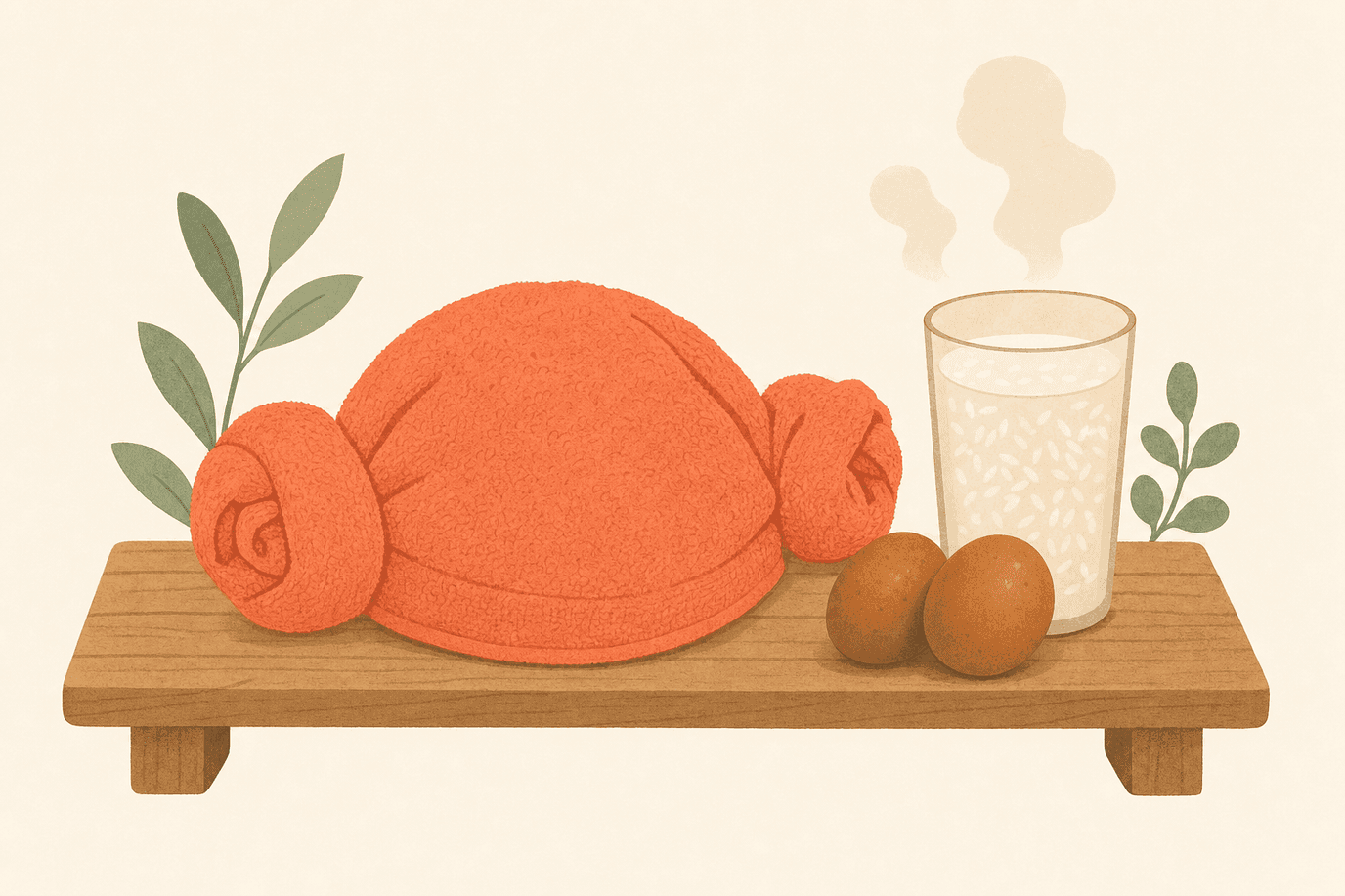
The roasted eggs (구운 계란, guwun gyeran) are slow-cooked in the heat of the kiln sauna rooms, which gives the shells a brown tinge and the yolks a richer, slightly caramelized flavor. Eating them with 식혜 (sikhye), a cold, lightly sweet fermented rice drink, is the canonical jjimjilbang snack pairing.
The post-bath tradition of drinking cold banana milk (바나나우유, banana uyu), specifically Binggrae's squat yellow bottle, predates the jjimjilbang era and is tied to the neighborhood 목욕탕. The cold sweetness after a long hot soak is the point. It is a folk custom, not a commercial invention.
What the jjimjilbang actually is in Korean life
The jjimjilbang occupies a different social position than a Western spa. It is not primarily a luxury wellness product. It is infrastructure with wellness built in.
At ₩10,000–₩16,000 for all-night access, it is the cheapest legal place to sleep in most Korean cities. Workers who miss the last train, people between housing situations, or anyone who just needs a horizontal surface and a hot bath use it without stigma. The ondol floor is the point.
The same venue functions as a family day out. A Saturday at the jjimjilbang means the kids eat eggs and watch TV while the adults do the wet-zone circuit and the grandparents soak in the warm tub. It is multi-generational in a way that a gym sauna is not.
The 때밀이 body scrub has its own family dimension. Parents scrubbing a child's back, or adult children scrubbing an elderly parent's back, is a recognized act of care, something that disappears when everyone moves to home showers. The communal bathhouse was a site of physical intimacy between family members that privatized bathing has gradually eroded.
Jjimjilbang also appear frequently in Korean dramas. The 2005 drama "My Name Is Kim Sam-soon" (내 이름은 김삼순) is most often cited for popularizing the 양머리 수건 (yangmeori suwon) sheep-head towel style internationally: the rolled towel worn on the head with the ends curled outward like a ram's horns. The style existed before the drama but became iconically associated with jjimjilbang culture after it. It is functional, it keeps sweat out of your eyes in the dry sauna rooms, and it became a visual shorthand for the whole experience.
If you know "Korean spas" from the US
The term "Korean spa" in the United States primarily refers to jjimjilbang-style facilities built by the Korean immigrant community from the 1990s onward. Los Angeles has more Korean-style spa facilities than any city outside Korea.
The core architecture is preserved in the US format: gender-segregated wet areas, clothed unisex common area, themed dry sauna rooms, snack bar. The adaptations are in the details: US facilities often permit swimwear in co-ed wet areas (unlike Korea), and the food menu reflects local supply chains. Venues like Wi Spa in LA Koreatown, King Spa across several East Coast and Texas locations, and Spa Castle in Texas offer a recognizable approximation of the Seoul jjimjilbang format.
If you have used one of those, you already have the frame. The jjimjilbang you find in Korea is where that format came from. The neighborhood 목욕탕 is the older, simpler thing that preceded it.
The body scrub profession: a note on change
At the peak of the bathhouse industry in the early 2000s, a skilled 세신사 (scrub master) could earn ₩3–₩4.5 million per month, exceeding entry-level corporate salaries at the time, which were roughly ₩2 million per month. The profession had high demand and no formal training requirement beyond craft skill.
The Statistics Korea reclassification in 2007, from the earlier title 욕실종사원 (bathroom worker) to 목욕관리사 (bath manager), was a legitimization of the occupation. But the industry it depended on was already contracting. Post-pandemic, one major bath-management training academy (중앙목욕관리교육원) saw enrollment fall from around 20 to roughly 5 students.
The newer 1인 세신숍 (private scrub shops) represent a partial reinvention: individual enclosed rooms, higher prices (₩50,000–₩80,000 for a full-body scrub), and a private-appointment format. They pull customers who want the service without the communal setting. Whether they stabilize the profession or simply shift it to a different market segment is unclear.
FAQ
What is the difference between a 목욕탕 and a 찜질방?
A 목욕탕 (neighborhood bathhouse) is a gender-segregated wet-bathing venue: showers, soaking tubs at multiple temperatures, steam room. You go in, bathe, and leave. A 찜질방 includes all of that plus a clothed unisex common area with kiln sauna rooms, a sleeping floor, a snack counter, and often a TV lounge. Most jjimjilbang operate 24 hours. The wet bathing zone is one part of a jjimjilbang; it is the entire venue at a 목욕탕.
Do I have to be fully naked?
Yes, in the wet bathing area. Both 목욕탕 and the gender-segregated bathing floors of jjimjilbang require full nudity. Swimwear is not permitted. This is a hygiene rule, not a performance. Nobody watches; other bathers are focused on their own visit. In the clothed unisex common area of a jjimjilbang, you wear the provided jjimjilbang uniform (찜질복).
What is a 세신 body scrub and how does it work?
A 세신 is a professional dead-skin removal service performed on a vinyl-padded table inside the bathing area. You soak in the hot tub for at least 20–30 minutes first to soften the skin, then approach the 세신사 (scrub master) at their station. They scrub from head to foot using the Italy towel (이태리타올), a textured viscose rayon mitt. The visible rolls of dead skin that come off are called 때 (ttae). The full-body version typically costs ₩20,000–₩35,000 at a traditional bathhouse. No tipping.
Can I go if I have tattoos?
It depends on the facility, not the law. No national law bans tattooed guests from bathhouses. Restrictions are individual facility policy. Enforcement has become increasingly relaxed, particularly at newer or larger jjimjilbang. Small, discreet tattoos are frequently ignored even where a notice is posted. Extensive coverage is more likely to draw attention. If a facility has a posted restriction and asks you to leave, accept it and try elsewhere.
How much does it cost?
A neighborhood 목욕탕 typically charges ₩5,000–₩8,000 for entry. A Seoul jjimjilbang typically costs ₩10,000–₩16,000 for daytime entry, with the nighttime rate slightly higher. Entry usually includes the jjimjilbang uniform. A professional body scrub (세신) at a traditional bathhouse typically adds ₩20,000–₩35,000. Prices vary by facility and are set individually. There is no national standard.
Can I sleep there overnight?
Yes, at most jjimjilbang. The ondol-heated sleeping floor in the common area is part of the venue. You lay out a mat and sleep. This is socially unremarkable. At ₩10,000–₩16,000 for all-night access, jjimjilbang are the cheapest legal overnight option in most Korean cities. Some people use them regularly when working late or after missing the last train.
Do I tip the staff or the scrub master?
No. Tipping is not practiced at Korean bathhouses or jjimjilbang. The 세신사 (scrub master) charges a fixed price, paid at or before the service. Attempting to tip can cause awkwardness. Pay the stated price and that is the end of it.