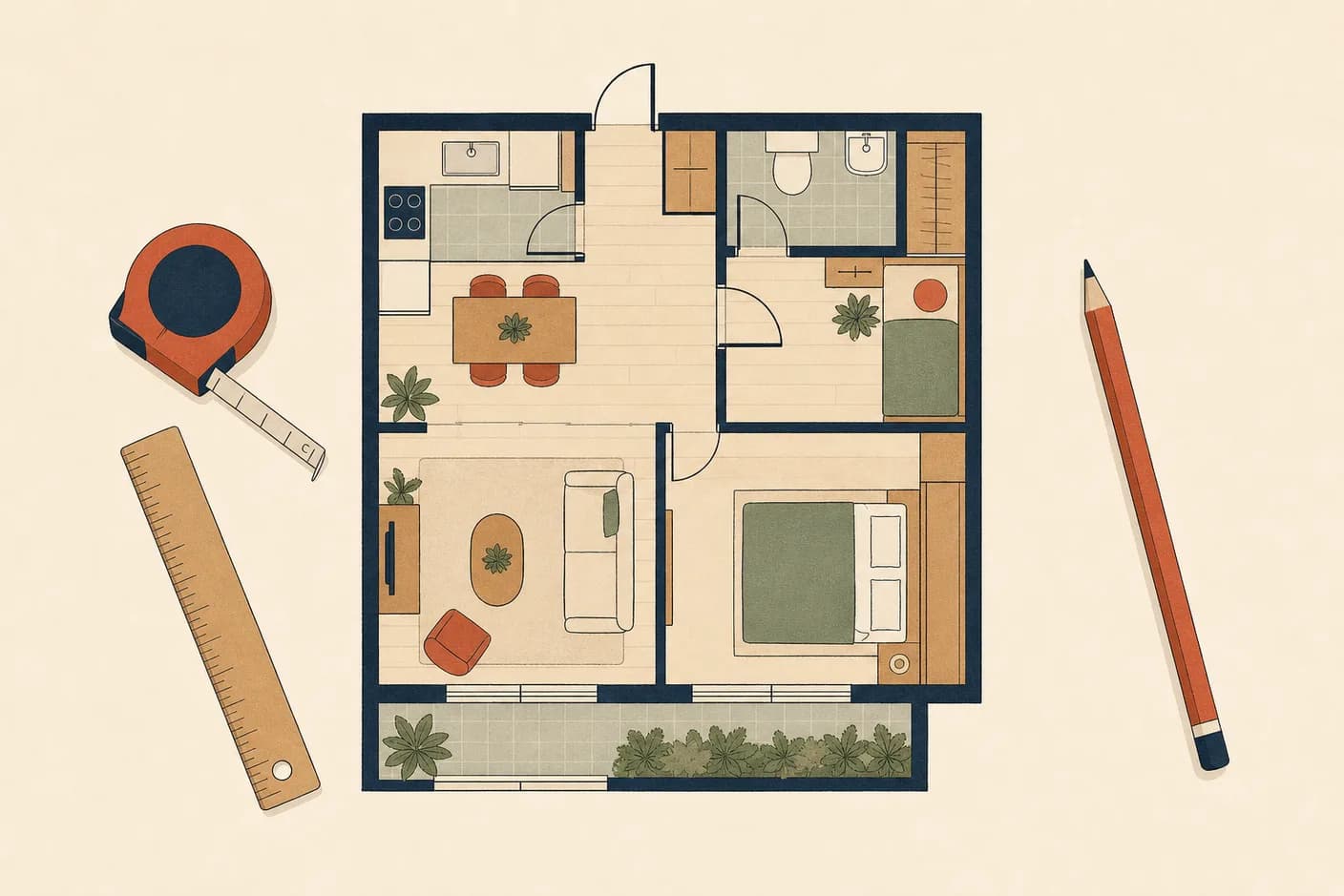
A listing says "84" and your Korean friend says "25 pyeong." Your agent says "33 pyeong." All three can describe the same home. What differs is the area each number counts.
The short answer
One pyeong (평) is about 3.3 square meters (㎡). The number that matters most in a listing is exclusive area (전용면적), the floor area inside your unit's walls. An 84 ㎡ exclusive area is about 25.4 pyeong. An ad may also give a pyeong "type" (평형) label that counts shared areas, so it can be bigger. Ask what a label counts.
Quick conversion table
The figures below are derived from 1 pyeong = 400/121 ㎡, which is about 3.3058 ㎡. They are arithmetic, not a legal definition.
| Square meters (㎡) | Pyeong (평) |
|---|---|
| 20 | 6.1 |
| 33 | 10.0 |
| 49 | 14.8 |
| 59 | 17.8 |
| 74 | 22.4 |
| 84 | 25.4 |
| 114 | 34.5 |
| Pyeong (평) | Square meters (㎡) |
|---|---|
| 10 | 33.1 |
| 18 | 59.5 |
| 25 | 82.6 |
| 32 | 105.8 |
| 34 | 112.4 |
Rule of thumb: divide ㎡ by 3.3 to get pyeong, and multiply pyeong by 3.3 to get ㎡. In Korean search, this is the "평 계산" (pyeong calculation) you will see on many converter sites.
The areas on a listing
Korean sizes use several areas. The names differ by what they count.
| Area | Korean | What it counts |
|---|---|---|
| Exclusive area | 전용면적 | Rooms, living room, bathroom, entrance and kitchen: the space inside your unit |
| Shared residential area | 주거공용면적 | Above-ground stairs, corridors, elevator and entrance hall that several households use |
| Supply area | 공급면적 | Exclusive area plus shared residential area |
| Other shared area | 기타공용면적 | Basement, management office and senior hall |
| Contract area | 계약면적 | Exclusive area plus shared residential area plus other shared area |
| Service area | 서비스면적 | The balcony (발코니) |
The area definitions above follow a Ministry of Land, Infrastructure and Transport (MOLIT) card. In plain terms:
- Exclusive area is what you live in.
- Shared residential area is the hallway and stairwell you share with neighbors.
- Supply area is exclusive area plus your share of that hallway and stairwell.
- Contract area adds the basement and management office on top.
The law measures exclusive area in a set way. For an apartment, it uses the inside line of the exterior walls. It leaves out the areas that two or more households use together, such as above-ground corridors, stairs and the entrance hall.
The statute is worded differently. It defines supplied housing area (주택공급면적) only as the floor area the developer supplies, measured to the centre lines of walls and columns. The "exclusive plus shared residential" formula comes from the MOLIT card. When two numbers disagree, ask which area each one counts.
The balcony
A balcony is an add-on space on the outer wall. The law allows a compliant balcony in a home to be used as a living room, bedroom or storage. The MOLIT card lists the balcony as service area, apart from the supply area. A home can feel bigger than its listed number because of the balcony. Ask whether a figure includes it.
Why 59 and 84 are everywhere
The Housing Act defines national housing size (국민주택규모) as housing with an exclusive area of 85 ㎡ or less per unit. In non-urban towns and counties outside the capital region, the limit is 100 ㎡. A likely reason many apartments are listed at 84 ㎡ and not 85 ㎡ is that line.
Neither the Housing Act nor the Housing Supply Rule names 59 ㎡ or 84 ㎡. But housing rules draw lines at 85 ㎡ (national housing size) and at 60 ㎡ (for example, the Housing Supply Rule (주택공급에 관한 규칙 제28조) splits private-home allocation at 60 ㎡ and 85 ㎡), and building just under those lines is a likely reason for 59 and 84.
Newcomers often get caught here:
- A 59 ㎡ exclusive home is about 17.8 pyeong of exclusive area. An ad may give a bigger pyeong type (평형) label that counts shared areas.
- An 84 ㎡ exclusive home is about 25.4 pyeong of exclusive area. An ad may give a bigger pyeong type (평형) label that counts shared areas.
The gap is the shared area. Type labels are not legal sizes, so do not use them to compare homes. Compare exclusive area in ㎡.
The pyeong ban, and what a listing must show
The Measurement Act (계량에 관한 법률) says nobody may use a non-statutory unit in measuring or advertising. There are listed exceptions, such as export goods, ships, aircraft, military use and research. The same Act allows a non-statutory unit to be shown beside a legal unit if the ministry's display rules are met. The fine for breaking the ban is up to ₩2,000,000.
The Ministry named the pyeong as one of these units in a 2013 enforcement notice. It extended checks from newspaper ads to the internet, real estate agencies, banners and model homes. That notice is old, and we have not checked how strictly it is enforced today. The statute is the current basis.
This is why you will often see a pyeong number in conversation but a ㎡ number in official papers. Floor plans and registries use ㎡.
What a listing must show:
- Agent ads online. A licensed agent's internet ad must state items such as the location, area, price, property type and transaction type (공인중개사법 제18조의2). A MOLIT notice says the area must be the exclusive area (전용면적) in square meters. If an ad gives another number, ask which area it is.
- New-apartment sale notices (입주자모집공고). The area per unit must be shown as exclusive residential area. Shared residential area and other shared area may be shown separately.
- Officetel sale contracts. They show exclusive area, shared area and contract area. For an officetel, check whether a number is exclusive area or contract area.
Typical sizes by home type
Here are the typical sizes of homes that were rented recently in Seoul, from real contracts reported to the government. The figures come from Seoulstart's monthly MOLIT data and describe August 2026.
| Home type | Monthly rent | Deposit | Jeonse deposit | Typical size |
|---|---|---|---|---|
| Apartment | ₩1,000,000 | ₩100m | ₩630m | 58.1 m² |
| Officetel | ₩700,000 | ₩10m | ₩230m | 23.1 m² |
| Villa or row house | ₩550,000 | ₩40m | ₩230m | 30 m² |
Medians of contracts reported in August 2026. Rent figures are for new leases, the price someone moving in signs; where fewer than 10 new leases were reported, all leases are used. Source: Ministry of Land, Infrastructure and Transport real transaction records (국토교통부 실거래가), processed by Seoulstart. Updated monthly.
In August 2026, the typical officetel rented in Seoul was 23.1 m², the typical villa was 30 m², and the typical apartment was 58.1 m². The government report form tells people to enter the exclusive area for apartments and other multi-unit buildings, so read these as exclusive-area sizes.
Treat these as a yardstick. Your district may differ a lot. See the typical size and rent in your district on a page such as rent in Seoul, or open a district page such as Gangnam-gu or Mapo-gu. For the home types themselves, read apartment, villa and officetel types in Korea and goshiwon vs officetel vs one-room. For rent levels, see rent in Seoul.
Reading a listing, step by step
Take this example listing: "Apartment, 33 pyeong, 84 ㎡, 12th floor, monthly rent."
- Find the label. Look for the words exclusive (전용), supply (공급) or contract (계약) next to each number. If there is none, ask the agent.
- Find the ㎡ number. Square meters are the official unit. Ignore the pyeong type label for comparing.
- Convert it. 84 ㎡ divided by 3.3 is about 25.5 pyeong (25.4 with the exact factor). If 84 ㎡ is the exclusive area and the ad shows a bigger pyeong number, that number is likely a type label that includes shared areas.
- Check the balcony. Ask whether the number includes the balcony (발코니). A balcony is listed as service area.
- Compare with reported contracts. Government transaction reports use exclusive area for apartments. Open Seoulstart's price explorer or reported contracts with their exclusive area and compare homes of the same ㎡ in the same building or district.
- Check the cost of moving in. A bigger home means a bigger deposit and monthly rent. Use the move-in cost tool before you sign. For the lease itself, read renting an apartment in Korea.
If you are choosing where to live, where to live in Seoul compares areas. If you want to know what a home costs to buy, see Seoul apartment prices.
Common mistakes
- Comparing a pyeong type label with an exclusive area in pyeong. A type label may count shared areas, so the home can be smaller inside.
- Treating 84 as the same size in every listing. Ask whether it is exclusive, supply or contract area.
- Reading an officetel figure as exclusive area without asking. Officetel sale contracts list exclusive, shared and contract areas.
- Assuming the balcony is part of the number. Ask.