Seoulstart Korea Weekly
MSCI refused to upgrade Korea to developed-market status for a 12th straight year, the same morning the KOSPI crashed 9.99%.
MSCI's 12th consecutive rejection reveals the structural frictions behind Korea's market volatility, not just another bad day. Plus: Lee Jae-myung hits a new low in Gallup, North Korea commissions its first destroyer, South Korea crashes out of the World Cup, and the won at 1,543 makes the July 16 Bank of Korea meeting genuinely live.
MSCI refused to upgrade Korea to developed-market status for a 12th straight year, the same morning the KOSPI crashed 9.99%.
MSCI's 2026 Annual Market Classification Review, released June 23, kept Korea in Emerging Markets for a 12th straight year and declined to add it to the Developed Markets watchlist, citing offshore-won trading restrictions and omnibus-account burdens, the same morning the KOSPI (Korea Composite Stock Price Index) fell 9.99% and triggered a circuit-breaker halt.
Why this matters. The rejection and the crash are one story. The same structural barriers MSCI cited, restrictions on trading the won offshore and burdens on foreign-investor account infrastructure, also amplified the sell-off by limiting how fast foreign capital can move in and out. Korea's market is structurally more fragile than its developed-market peers for specific, documented reasons, and June 23 was both the diagnosis and the demonstration.
What changed. Under MSCI rules a country must sit on the watchlist for at least a year before inclusion, so the earliest realistic upgrade is now around 2029, per Korea Herald and KED Global. On June 23 the KOSPI breached the -8% circuit-breaker threshold and halted for 20 minutes; Samsung Electronics and SK hynix both fell more than 12%, and foreign investors offloaded close to 5 trillion won ($3.2 billion) in a single session, per Benzinga. Before the crash, retail margin debt (신용융자) had hit a record 38.48 trillion won, per Seoul Economic Daily. Leveraged single-stock ETFs approved in May turned an index drop of roughly 9% into ETF losses near 18%, triggering cascading liquidations.
One complication. Korea's main reform commitment to MSCI is the 24-hour foreign-exchange market, with a bank trial June 29 and full launch July 6. MSCI Chief Executive Henry Fernandez told CNBC on June 25 he remained skeptical about overnight-won liquidity. Reform is moving, but MSCI's bar is higher than a trial launch.
The last time. Korea was placed on the watchlist in 2008 and removed in 2014 over won-convertibility concerns, a decision that set the upgrade campaign back more than a decade, per Korea Herald. The barriers cited then, offshore-won restrictions and account-level burdens on foreign investors, are the same ones cited now.
What's next. The 24-hour FX trial begins June 29 and the full market opens July 6: the first real test of whether the reform delivers the overnight liquidity MSCI wants. The Bank of Korea (BoK, 한국은행) Monetary Policy Board then meets July 16. For anyone remitting money home or holding won savings, the won at roughly 1,543 per dollar is what turns this from a market story into a household one.
Korea This Week
Gallup confirms Lee Jae-myung's slide: 51% approval, disapproval above 40% for the first time
A Gallup Korea poll of 1,000 voters conducted June 23 to 25 put President Lee Jae-myung's job approval at 51%, his lowest since taking office, with disapproval up six points to 41%, the first time it has crossed 40% in Gallup's series, per Korea Times, Korea Herald, and OhmyNews.
What changed. Realmeter's automated polling on June 15 to 19 already showed Lee falling below 50%. The new signal is cross-house confirmation: Gallup uses live interviewers and a different sample, and still reads his lowest since he took office in June 2025. Respondents cited the economy (crash week), housing costs, and National Election Commission (NEC) irregularities.
One complication. Gallup and Realmeter are not directly comparable; Gallup's live-interviewer method runs steadier than Realmeter's automated one. Both trend down, but neither is the other's clean confirmation.
The KOSPI recovered 3.26% on June 24 after Samsung signaled a possible 90-trillion-won buyback
The KOSPI rebounded 3.26% to close at 8,471.02 on June 24, still roughly 7% below its June 22 close, after Samsung Electronics disclosed it was reviewing a share buyback of as much as 90 trillion won ($58.6 billion), per The Elec and Korea Times. Samsung rose 9.84% on the day.
One complication. The buyback is "under review," not confirmed; Samsung said it will update the market within a month of the June 24 filing and tied it to a DS-division stock-bonus program. Analysts read the recovery as technical, short-covering and sentiment, not a reversal of the structural pressures the crash exposed.
SK hynix's board approved a $29 billion Nasdaq ADR, targeting a July 10 listing
SK hynix's board resolved on June 24 to issue 17.79 million new American Depositary Receipts on the Nasdaq, seeking up to 45.45 trillion won ($29 billion), among the largest ADR offerings on record, per CNBC and KED Global. Proceeds are intended to fund HBM (high-bandwidth memory) and AI-chip capacity, deepening its position as the main supplier for Nvidia's HBM stack.
What's next. Target listing is July 10, subscription and payment July 14, and new Korean shares list July 29, all subject to regulatory approval. Samsung's buyback and SK hynix's raise show Korea's two chip giants taking opposite routes to manage the same pressure.
North Korea commissioned its first destroyer, a soldier defected across the DMZ, and Kim called for a "destructive" military posture
North Korea commissioned its first guided-missile destroyer, the 5,000-ton Choe Hyon, at Nampho on June 23 with Kim Jong Un present, per USNI News, CNN, and OhmyNews. The same week, a North Korean soldier crossed the demilitarized zone (DMZ) into the South on June 24, the first soldier defection since October 2025, with armed troops briefly crossing the military demarcation line (MDL) in apparent pursuit before withdrawing, per UPI. On June 25 Kim observed weapons tests and ordered a "deadly and destructive offensive posture," per Al Jazeera; Seoul's Defence Ministry responded with a plan to train its 500,000-strong army as "drone warriors." On June 25, President Lee marked the 76th anniversary of the Korean War with a call for a "peaceful peninsula."
What this means for you. This is hardware and rhetoric, not a change in the daily-life risk environment. Inter-Korean tension moves in cycles tied to North Korean weapons tests, and this week's cluster fits that pattern.
South Korea crashed out of the World Cup group stage, and the story at home is now the coach
South Korea exited the 2026 World Cup at the group stage for the first time since 2018. After opening with a 2-1 win over the Czech Republic on June 11, the team lost 1-0 to co-host Mexico on June 18 and 1-0 to South Africa on June 24, finishing third in Group A on three points. The exit was sealed on June 28, when the Democratic Republic of Congo beat Uzbekistan 3-1 and pushed Korea to ninth among third-place teams, one place short of the eight wild-card spots into the round of 32, per Korea Herald and Yonhap.
What changed. The fallout has turned on head coach Hong Myung-bo (홍명보). He benched captain Son Heung-min for the must-win South Africa match, a decision widely criticized after the loss, and a public petition demanding his dismissal was filed within hours, alongside renewed scrutiny of the Korea Football Association's 2024 decision to appoint him, per Korea Times. Hong's contract runs into 2027, so the federation has to actively decide his future rather than accept an automatic resignation.
What's next. The squad holds a closing press conference on June 30 before flying home; the Korea Football Association has not said whether Hong will stay.
The won slid to about 1,543 per dollar as crash-week outflows extended currency pressure
The won traded around 1,543 per US dollar on June 27, roughly 8% weaker than the 1,420 level earlier in the year, as foreign investors kept pulling capital from Korean equities, per Macrotrends and Federal Reserve H.10. For anyone remitting money home, paying a foreign-currency bill, or holding won savings, the rate is a live cost, and timing a transfer around the July 16 BoK meeting is a real decision.
Watch This Week
-
June 29 (Monday). Korean banks begin the trial of the near-24-hour FX trading system, ahead of the July 6 full launch. Hours extend earlier and later, though liquidity stays thinner than at full launch. For residents with a remittance or won transaction pending, it is the first read on whether the overnight-won market actually functions, the exact thing MSCI said it needed to see.
-
Around July 1. Korea's Ministry of Trade, Industry and Energy (MOTIE) is expected to release June final trade data around the first business day of the month. The June 1 to 20 preliminary figure showed export growth; the final number confirms or revises it. Confirm the date at motie.go.kr first, and do not treat the preliminary figure as final.
In Conversation
Record margin debt and the "ant army" of retail investors became Korea's dominant financial conversation this week, across Naver (네이버) Finance forums and Korean finance YouTube, after 38.48 trillion won in leveraged positions amplified the June 23 crash.
Worth knowing. Korea has roughly 14.5 million retail stock investors, per Al Jazeera. Debt investing (빚투, bit-tu), borrowing against existing positions to buy more, became widespread after the 2020 to 2021 surge, so when the index fell 9.99%, forced liquidations (반대매매) turned a steep drop into a cascading one. The conversation landed less on whether retail investors should invest than on whether the leveraged-ETF products approved in May arrived at exactly the wrong moment. The National Pension Service (NPS), which holds part of its 1,000-plus trillion won fund in the KOSPI, lost value the same day, so the crash reached every contributing worker indirectly.
Korea Decoded
Konglish (콩글리시): the English-sounding words that mean something else in Korean
This week's crash vocabulary was a live Konglish lesson: terms like "margin" (마진) and "circuit breaker" (서킷브레이커) sit in Korean financial talk, but many everyday loanwords have shifted enough in meaning to trip up any native English speaker who assumes they work the same way.
Worth knowing. Korean has thousands of English-derived loanwords (외래어, wae-rae-eo). Most carried over cleanly: computer (컴퓨터), bus (버스). But a slice shifted, often via Japanese. The word for working out is "health" (헬스), so a gym is a "health place" (헬스장). A group blind date is a "meeting" (미팅), while a business meeting is a "hoeui" (회의). A freebie from a shopkeeper is "service" (서비스). Cheating on a test is "cunning" (컨닝). A mobile phone is a "hand phone" (핸드폰). And "fighting" (화이팅) is encouragement, "you got this," not a challenge. The rule, per the National Institute of Korean Language: Konglish is Korean vocabulary, not broken English, so treating it as a mistake is the foreign speaker's error. See Seoulstart's Konglish guide for the full list.
Why this matters. The crash talk was full of words that sound English and aren't: debt investing (빚투), ant investors (개미, "ants," for retail), forced liquidation (반대매매). Knowing which terms are Konglish helps a foreign resident follow Korean conversations without assuming a shared vocabulary that isn't there.
Festivals worth checking out
A quieter stretch on the festival calendar this week. One worth booking ahead for:
- July 24 to August 9 (book accommodation now). Boryeong Mud Festival: Korea's largest summer festival, in its 29th year, at Daecheon Beach in Boryeong, South Chungcheong Province. It is among the most foreigner-accessible festivals in Korea: no Korean needed, free admission to the outdoor mud pools and slides, and clear signage. The reason to flag it now is accommodation, since Daecheon Beach guesthouses and pensions book out weeks ahead. If you are considering going, the planning window is this week, not July.
See the full festivals calendar for what's running across the country.
Good Reads
-
ESPN. "South Korea's Son Heung-min gamble backfires spectacularly." The analytical read behind this week's elimination: why Hong Myung-bo dropped his captain for the decisive match, the case for and against the call, and what the fallout says about how Korean football is run. (link)
-
Seoulstart. Saju Decoded: a plain-language guide for when a Korean colleague or partner mentions seeing saju (사주) and you have no idea what it is. Covers what saju is, how it differs from shamanic divination (신점), what a session costs, and what a compatibility reading (궁합) is. Peak season is summer, a lighter read after a heavy news week.
-
Nikkei Asia. "South Korea's AI chip boom spills into the property market." Draws the line most residents feel but rarely see explained: how semiconductor-sector wealth is pushing up apartment prices, especially around the chip belt south of Seoul. Useful context if you are renting or buying. (link) (subscription)
-
Carnegie Endowment. "Governing Aging Economies: South Korea." The clearest English read on how Korea became a super-aged society in about 25 years, and what that means for the pension, health-insurance, and eldercare systems residents pay into and rely on. (link)
Featured on Seoulstart
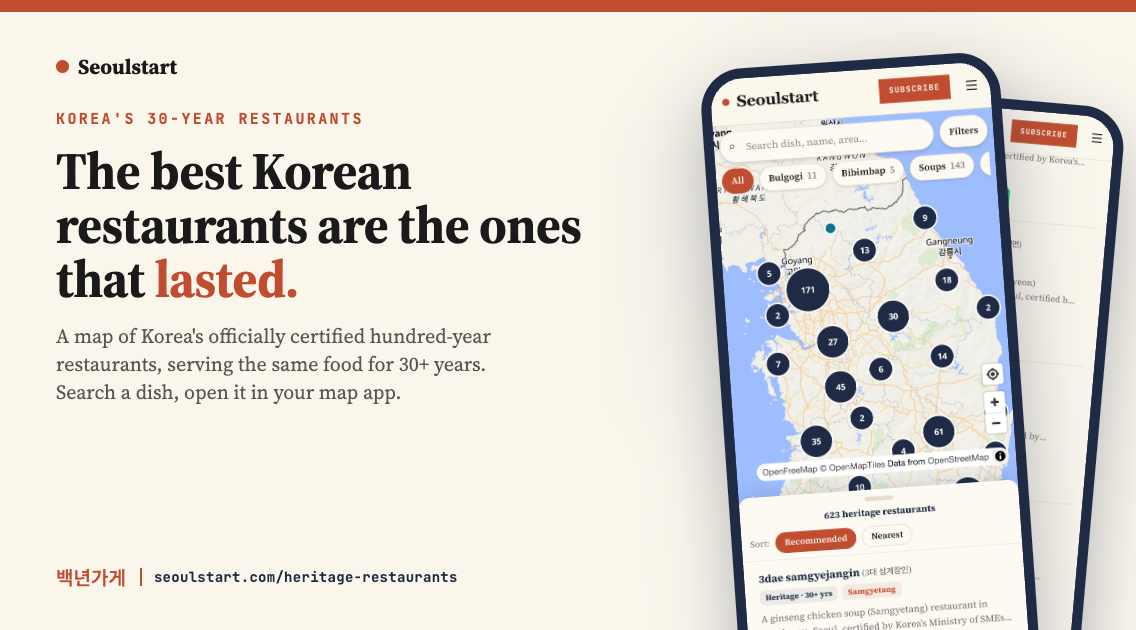
Heritage Restaurants maps Korea's government-certified Hundred-Year Stores (백년가게): restaurants that have served the same signature dish for 30 years or more. Find the definitive ginseng chicken soup (삼계탕), cold noodles (냉면), or grilled short ribs (갈비) near you, browse by dish, and tap to open any of them straight in Google Maps, Kakao, or Naver.
That's the Korea Brief for this week. If you remit money home, hold won savings, or are timing a large won-denominated transaction, reply and tell me how you are reading the won at 1,543 and what you are doing about the July 16 Bank of Korea meeting. The most common questions become a guide. See you next week.
Sources cited in this issue · 21 publishers, 29 links
korean.go.kr
motie.go.kr
aljazeera.com
asia.nikkei.com
benzinga.com
carnegieendowment.org
cnbc.com
cnn.com
espn.com
federalreserve.gov
kedglobal.com
Korea Herald
Korea Times
macrotrends.net
newneek.co
news.usni.org
ohmynews.com
Seoul Economic Daily (English)
thelec.net
upi.com
v.daum.net
Seoulstart curates and interprets; original reporting belongs to the outlets above.