Seoulstart Korea Weekly
Samsung's 18-day strike starts May 21. The market has already priced it.
Samsung Electronics' chip-division union confirmed an 18-day strike from May 21 after wage talks collapsed; the KOSPI touched 8,000 then shed 6% in a single session as foreign investors sold 5.56 trillion won. Plus the June 3 election field locks in, Seoul apartments go green in all 25 districts, and Na Hong-jin's Hope premieres at Cannes this morning.
Samsung's 18-day strike starts May 21. The market has already priced it.
Samsung Electronics' chip-division union will strike 18 days from May 21 after wage talks collapsed May 12, per Korea Herald and MBC News.
Why this matters. Samsung and SK hynix together hold roughly 42% of the Korea Composite Stock Price Index (KOSPI). When the dominant name in that pair strikes for 18 days, a market trading at an AI-boom premium has to reprice "Korea is booming" for the next three weeks.
What changed. The union, covering 40,000 to 61,000 chip workers, demanded scrapping the 50% performance-bonus cap, a 15% operating-profit bonus pool, and a 7% base raise. Management rejected the bonus pool. Labor Minister Kim Young-hoon requested last-minute talks; Samsung offered dialogue without conditions; the union refused until the strike begins, per Korea Times. The government's emergency adjustment authority (긴급조정권, a 30-day cooling-off power under the Trade Union Act) was debated but not invoked.
Worth knowing. The KOSPI touched 8,046 intraday May 15, its first time above 8,000, then closed down 6.12% at 7,493 as foreign investors sold a net 5.56 trillion won and Samsung Electronics fell 8.6%, per Korea Herald. JPMorgan estimated the dispute could shave up to 40 trillion won off Samsung's annual operating profit.
The last time. This is Samsung Electronics' first multi-day general strike in 57 years. Samsung enforced a no-union policy from founder Lee Byung-chul's death in 1987 until Vice-Chairman Lee Jae-yong renounced it in 2020, after a Seoul court exposed years of illegal union-busting, per Labor Notes. The same year that ended Lee's no-union era, 1987, also produced the Great Labor Offensive (노동자 대투쟁) that built Korea's current labor law framework.
What's next. The strike window (May 21 to June 7) overlaps the June 3 local elections, making this a political story as well as a labor one. If you hold a variable-rate mortgage, won savings, or a dollar-won remittance plan, watch the May 21 open.
What Changed for Residents
No new rule took effect this week. The July 1 switch to mandatory online HiKorea employment reporting (all E-1 to E-10, F-2, F-4, F-6, H-2 visas; paper ends June 30; no grace period) is now 45 days away. If you haven't registered the online account yet, do it this month. Full process, scope, and source links in issue #2.
Korea This Week
June 3 elections: field locked, Seoul tightens, Jeonbuk surprises
Candidate registration for Korea's June 3 local elections closed May 15: Seoul is tightening, Busan is a dead heat, and an independent has surged in Jeonbuk, per Korea Herald and Korea Times.
What changed. Sixteen governor and metro-mayor races plus 14 National Assembly by-elections. In Seoul, Democratic Party of Korea (DPK) candidate Jung Won-oh leads People Power Party (PPP) incumbent Mayor Oh Se-hoon 43% to 32% (Hankook Research/KBS, May 11-14, n=800), per Seoul Economic Daily. Busan is within margin of error. In Jeonbuk, traditionally DPK-dominant, independent Kim Kwan-young leads DPK's Lee Won-taek 43.2% to 39.7% (Zowon C&I/News1, May 9-10), per Seoul Economic Daily. Gallup Korea (May 13-15, n=1,011) puts the DPK-PPP approval gap at 22 points (45% vs 23%), down from 28 in late April, per Korea Times.
What's next. Early voting May 29-30; election day June 3. The Samsung strike (May 21 to June 7) overlaps the campaign's final stretch.
Seoul apartments: all 25 districts turn positive as Gangnam rebounds
Seoul apartment prices rose 0.28% week-on-week in the second week of May, putting all 25 Seoul districts in positive territory for the first time in 2026, per Korea Real Estate Board (한국부동산원) data via Seoul Economic Daily.
What changed. Gangnam-gu turned positive for the first time in 12 weeks after the May 9 capital-gains-tax moratorium expired; remaining multi-home owners are holding instead of discounting, and Seoul listings fell 6% in the four days following. Jeonse (전세) also rose 0.28% week-on-week; cumulative 2026 jeonse is +2.89%, five times the 2025 pace.
What this means for you. No further government relief is planned through June 3. Jeonse renewals this summer face both rising prices and shrinking supply.
MOLIT opens fraud probe into 25,000 "perfect score" apartment subscriptions
The Ministry of Land, Infrastructure and Transport (MOLIT) opened a probe May 11 into fraudulent winners in Korea's apartment subscription (청약) system, covering 43 complexes and ~25,000 units, per Seoul Economic Daily and Korea Times.
What changed. The probe covers every regulated-area complex sold since July 2025 plus popular complexes elsewhere. Trigger: "perfect score" winners (점수 만점자) are mathematically rare given shrinking household sizes but have appeared at suspicious frequency. Joint with the Office for Government Policy Coordination, per MOLIT.
The numbers.
- 43 complexes, ~25,000 units under investigation
- Penalties for confirmed fraud: up to three years in prison, 30 million won in fines, contract cancellation, forfeiture of the 10% down payment, 10-year subscription ban
April ICT exports jump 125.9%; semiconductors hit a record $31.9 billion
Korea's information-and-communications-technology (ICT) exports jumped 125.9% year-on-year (YoY) in April to $42.71 billion, the sector's record growth rate, per Ministry of Trade, Industry and Energy (MOTIE) data released May 14.
The numbers.
- ICT exports: $42.71 billion (+125.9% YoY, a record)
- Semiconductor exports: $31.9 billion (+173.3% YoY, highest-ever April figure for any single category)
- Total exports: $85.89 billion (+48% YoY)
- Trade surplus: $26.55 billion (third consecutive month above $20 billion, no prior precedent)
- ICT share of total goods exports: 49.7%
- Source: Korea Times, MOTIE primary
Worth knowing. At 49.7% ICT share, the Samsung strike isn't just a labor dispute; it's a national trade-balance event.
Watch This Week
- May 21. Samsung Electronics' 18-day strike begins. Watch for production-line impact disclosures, management's response to the 69.3% public disapproval, and any emergency mediation call from the Ministry of Employment and Labor (MOEL).
- May 28. First Monetary Policy Board meeting under new Bank of Korea (BoK) Governor Shin Hyun-song. April consumer price index (CPI) ran 2.6%, a 21-month high (per Statistics Korea, reported in issue #2); rate-direction language in the post-meeting statement will move the won-dollar rate within hours.
- May 29-30. Early voting opens for the June 3 local elections, including overseas polling for Korean citizens abroad.
- June 3 (18 days out). Election day: 17 governor and metro-mayor seats plus 14 National Assembly by-elections.
One Chart Explained
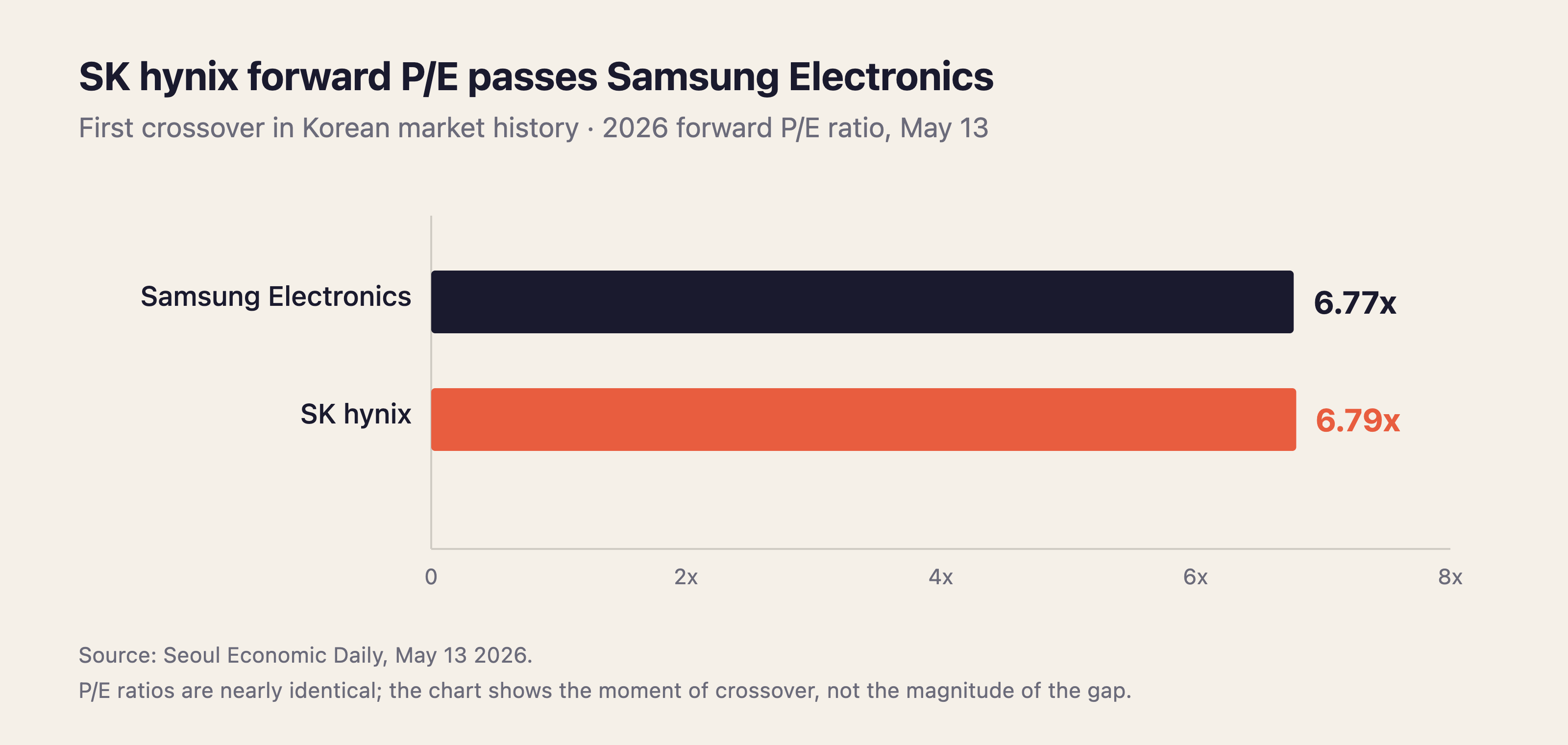
SK hynix is now worth more than Samsung Electronics on every forward earnings dollar, a first. For decades, Samsung traded at a higher price-to-earnings (P/E) multiple than SK hynix, reflecting its diversified products and brand premium. This week, SK hynix's 2026 forward P/E hit 6.79x, passing Samsung's 6.77x for the first time in Korean market history, per Seoul Economic Daily. The market is pricing SK hynix's high-bandwidth memory (HBM) business, the chips inside NVIDIA's AI GPUs, as structurally more valuable than Samsung's full portfolio. For non-investor residents: this is the week Korea's stock market stopped treating Samsung as the default heavyweight. The KOSPI's same-day round-trip to 8,000 reflects that uncertainty, not a fundamental economic reversal.
In Conversation
A leaked "blacklist" (블랙리스트) of Samsung Electronics employees who refused to join the strike, with their personal information attached, drove that tag to the top of Naver (네이버) and Nate (네이트) trending all week, per Seoul Economic Daily and Newsis.
Worth knowing. Samsung filed a police complaint under the Personal Information Protection Act; Gyeonggi-Nambu Police raided the Giheung facility's internal-site servers on May 8 and identified IPs with hundreds of access attempts. This is the first major Korean labor dispute in years where public opinion has moved structurally against the union: a Realmeter poll conducted April 27-28 (n=1,000) found 69.3% of respondents called the strike "inappropriate" over unreasonable demands and industrial-competitiveness concerns; 18.5% called it a legitimate exercise of workers' rights, per Korea Herald.
If You're in Korea This Week
- Today (May 17), Jogyesa Temple. Lotus Lantern Festival (연등회): UNESCO-inscribed Buddhist lantern festival running through Buddha's Birthday (부처님 오신 날), the May 24 national public holiday. Sunday programs at Jogyesa Temple in central Seoul include English-language information booths, lantern-making workshops, and free temple food. Free. Anguk Station (line 3) or Jonggak Station (line 1). Banks, post offices, and most government services close May 24.
See the full festivals calendar for what's running across the country.
Good Reads
-
Bloomberg. "Korea's Kospi Races From 7,000 to Record 8,000 in Seven Sessions." The clearest single-article account of the week's market trajectory and its same-day reversal. The Manulife data on Samsung and SK hynix at 42% of the index is the structural argument underneath the milestone headline. (link) (subscriber)
-
CNBC. "TSMC, Samsung, SK hynix's South Korea, Taiwan stocks: AI chipmakers concentration risk." The free-to-read companion to the Bloomberg piece. Maps why Korea's market is now an AI proxy with two-name concentration, parallel to TSMC's 40% share of the Taiex. The macro context for this week's Samsung strike. (link)
-
Korea Herald. "Looming Samsung walkout raises economic, political stakes." The best single piece connecting the Samsung strike to the June 3 election environment and Lee Jae-myung's political positioning. Maps the dynamic the Labor Minister's intervention reflects. (link)
-
Stimson Center. "Survival in the New Age of Trade: What the Aftermath of the Supreme Court Ruling on IEEPA Tariffs Means for South Korea." The most rigorous analytical treatment of Korea's tariff exposure under the International Emergency Economic Powers Act (IEEPA) and the $350 billion pledge, for the week when the Korea-US investment implementation story remains unresolved. (link)
-
Seoulstart. "Korea's chaebol families, decoded." If this week's Samsung and SK hynix coverage left you wondering who actually controls these companies, why the founding families still matter, and how labor disputes inside a chaebol look different from a Western corporate strike, this is the context piece that makes the rest of the news legible. (link)
That's the brief for this week. The thread holding it all together: when one company is 22% of the index, a labor dispute becomes everyone's macro story. If you're managing money, signing a lease, or watching the elections, the May 21-28 window is worth a calendar mark. Replies welcome on any of it. See you next week.
New on Seoulstart this week
- TOPIK study hub: three tools for anyone preparing for the TOPIK test (registration tracker, study planner, score-outcome lookup).
- Pet ownership in Korea: new hub with 8 spokes covering import quarantine, vet care, housing rules, and end-of-life options.
- Getting married in Korea: new hub with 4 spokes covering marriage registration, home-country document apostille, small-wedding city programs, and 2025 cost data.
Sources cited in this issue · 13 publishers, 25 links
Ministry of Land, Infrastructure and Transport
motie.go.kr
Statistics Korea
bloomberg.com
cnbc.com
Korea Herald
Korea Times
labornotes.org
MBC News
Newsis
Seoul Economic Daily
Seoul Economic Daily (English)
stimson.org
Seoulstart curates and interprets; original reporting belongs to the outlets above.