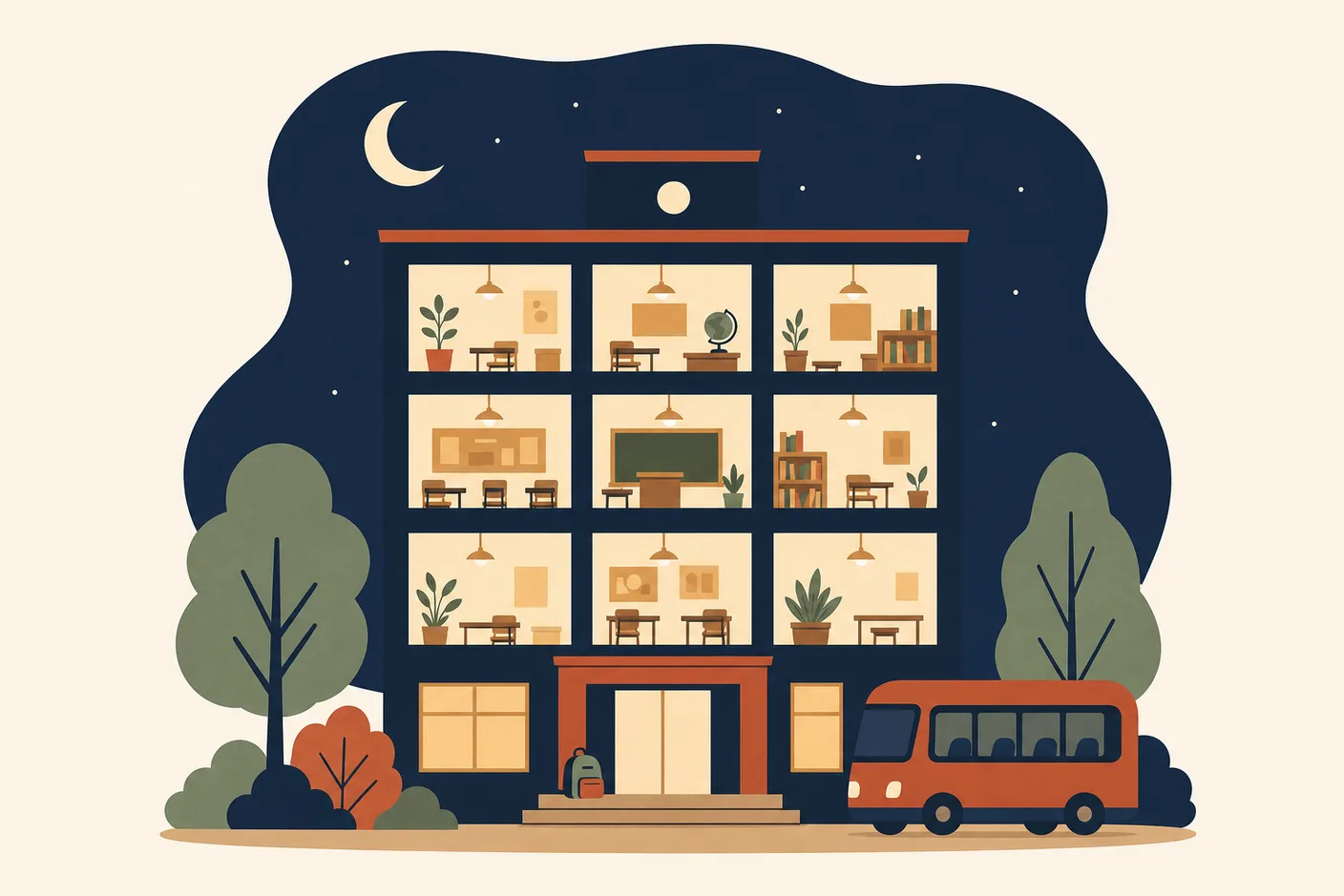
At around 10 PM on any weeknight in Seoul, Busan, or Daejeon, something happens on the streets near large apartment complexes. Children in school uniforms start appearing: elementary students, middle schoolers, a few high schoolers. Academy buses idle at the curb. Parents wait on foot or on scooters. The children are just finishing their second round of classes for the day.
This is private education (사교육) in its most visible form. It is one of the most distinctive features of Korean society, and one of the most discussed. Understanding what you are actually seeing takes more than noticing that kids are up late. It requires understanding a school system, an exam, a labor market, and a 40-year policy history.
What you are seeing
The evening-street scene is the surface. Underneath it is an industry that generated 27.5 trillion won in spending in 2025 alone.
Korean families spent that sum on private academies (학원), individual tutoring, and online courses for their children in primary and secondary school. The spending covers math, English, Korean language, science, music, coding, art, swimming, and more. Three out of four students participate: in 2025, 75.7% of all elementary, middle, and high school students attended some form of private education, according to a Statistics Korea and Ministry of Education joint survey released in March 2026.
The per-student costs are notable. Among families who used private education in 2025, the average monthly spending per student was 604,000 won, a record high in the current survey series. High school students cost their families the most: 793,000 won per month on average, per participating student. These are averages. In Seoul, the city-wide average across all students regardless of participation was 663,000 won per month.
The district of Daechi-dong in Gangnam is the best-known example: a neighborhood where private academies fill entire buildings, stacked floor above floor on narrow streets. Walking through Daechi-dong on a weekday evening looks like a small city organizing itself entirely around children's academic schedules.
This is not a marginal activity. It is what the majority of Korean families with school-age children do.
The numbers in context
The 27.5 trillion won total for 2025 was actually the first decline in five years, down 5.7% from 2024's record of 29.2 trillion won. That sounds like good news. It is partly misleading.
The decline came mainly from a shrinking school-age population. The number of elementary, middle, and high school students nationwide fell by roughly 120,000 in a single year, from 5.14 million to 5.02 million. Per-student spending continued to rise. The 604,000 won monthly average per participating student is the highest the survey has recorded.
Look at the decade-long trend: spending climbed year after year through the 2010s and early 2020s, with elementary-level spending growing fastest according to a Korea Herald analysis of the decade. The 2024 total, 29.2 trillion won, was a record.
A widely cited claim holds that Korea has the world's highest private education spending relative to GDP. That specific claim is not verifiable against any standardized international dataset: the OECD's institutional-expenditure framework does not measure hagwon and tutoring spending at all, because those are private businesses outside formal education accounting. What is verifiable is that participation rates and per-student costs of this scale are extraordinary by any international comparison based on the domestic Korean data.
Where OECD data does show Korea as a clear outlier is in university financing. Korea's public-sector share of tertiary education funding is 45%, compared to an OECD average of 68%. Korean students and families cover roughly 55% of university-level education costs, versus an OECD average of about 32%. This matters because it means the financial return on university tier is extremely high for Korean families, which feeds directly into the demand for private preparation.
Why it exists: the exam and the hierarchy
The college entrance exam (수능) is a single national test held each November. Students have one day to perform. Their score on that day is the primary factor determining which university will accept them.
The SKY universities (스카이): Seoul National University, Korea University, and Yonsei University sit at the top of a very steep prestige hierarchy. Graduates of these three schools have measurably higher employment rates at large companies, higher starting salaries, and stronger professional networks than graduates of other universities. The hierarchy extends below SKY to other in-Seoul universities, then to regional universities, in a ranking that most Korean employers recognize and use.
This structure creates the core demand for private education. If your child's exam score determines their university tier, and their university tier substantially affects their labor-market trajectory, then every additional point on the exam has concrete long-term value. Private academies and tutoring exist to gain those additional points.
The math in a Korean family's calculation runs like this: a high school student in a participating family spends on average 793,000 won per month on private education. Over three years of high school, that is roughly 28.5 million won. For many families, that is a rational investment in a child's admission prospects.
Retake students (재수생) choose to spend an additional year preparing for another attempt at the exam. Students on their third or later attempt have their own label (N수생). This is common enough to be a recognized social category with its own infrastructure of full-time intensive academies.
The history: ban, reversal, and arms race
Private tutoring in Korea was not always legal.
On July 30, 1980, the Chun Doo-hwan military government issued the "7.30 Education Reform Measures." The package banned nearly all private tutoring and test-prep academy attendance for enrolled students. The government argued that private tutoring gave wealthier students an unfair advantage and was economically burdensome for families.
The ban remained in place, with gradual relaxations, for 20 years.
On April 27, 2000, Korea's Constitutional Court (헌법재판소) ruled the blanket tutoring ban unconstitutional. The court found that the prohibition violated the right to education and the freedom to choose how to educate one's children. The private tutoring market reopened fully.
What happened after 2000 is sometimes described as an arms race. Families that had been constrained by the ban re-entered the market. Academy businesses scaled up rapidly. Spending climbed across the following two decades, interrupted only by the COVID-19 period.
The 1980 ban was supposed to equalize educational access. Its repeal produced the opposite of what the government had hoped for. Families with more income invested more in private education. The gap between high-income and low-income household spending became structural. In 2025, households earning 8 million won or more per month spent 662,000 won per student per month on private education, with a participation rate of 84.9%. Households earning under 3 million won per month spent 192,000 won per student per month, with a participation rate of 52.8%. The highest-income bracket spends roughly 3.4 times what the lowest-income bracket spends.
What the government has tried
Korean governments have spent decades trying to reduce private education spending without dismantling the university-entrance system that drives it. The results have been mixed.
Hagwon curfews. Metro and provincial governments set a legal nightly cutoff for academy instruction by local ordinance. In Seoul, academies may not teach school-age students past 10:00 PM. Other regions set cutoffs between 10:00 PM and midnight. Curfews reduce the hours academies can operate but do not reduce the underlying demand.
EBS. The government's Educational Broadcasting System produces free study content aligned with the college entrance exam curriculum, available to any student. EBS is widely used. It has not replaced private tutoring. Students and families typically treat EBS as a supplement, not a substitute, for academy preparation.
Killer-question removal. In June 2023, the Ministry of Education announced it would exclude "killer questions" (킬러문항) from the college entrance exam: ultra-high-difficulty questions that required techniques taught by private academies beyond the public school curriculum. The ministry identified 22 such questions across recent exams and the June 2023 mock exam. The stated goal was to make private tutoring less necessary for top scores. The ministry cited a 50.9% surge in per-student private education spending from 2017 to 2022 as the direct trigger for the reform.
The all-day elementary program (늘봄학교). Starting in the second semester of 2024, the government rolled out an extended-care and after-school program at roughly 6,000 elementary schools nationwide, beginning with first-grade students. The program is designed to reduce reliance on private academies as after-school childcare. Whether it reduces academic-subject academy attendance, as opposed to simply replacing babysitting-style academy use, remains to be seen.
None of these interventions has reversed the multi-decade trend. The Ministry of Education's own 2023 press release framing the killer-question reform acknowledged that per-student spending had risen 50.9% in five years despite earlier policy efforts.
What it costs families, and what it costs the country
The income and regional gaps in private education spending reflect Korea's broader inequality in educational access.
High-income Seoul families with children in high school spend considerably more on private education than the national average. A survey reported by the Seoul Economic Daily found that Koreans in their 40s with children spend more on their children's private education each month than they manage to save, and that most describe education costs as burdensome, even though the same respondents named retirement savings as their top financial priority. Private education costs are in direct competition with retirement saving for this age cohort.
Researchers have found a connection to the birth rate. A study reported by the newspaper Kyunghyang Shinmun (경향신문) in February 2025 estimated that rising per-student private education spending measurably lowers the total fertility rate in the following year. The estimated effect is concentrated in decisions about whether to have a second or later child. The researchers attributed a meaningful share of Korea's fertility-rate decline since 2007 to rising real private-education spending. These are academic estimates, not government statistics. But they are directionally consistent with what Korean adults say when surveyed about why they are not having more children: education costs are one of the most frequently cited reasons.
Korea's total fertility rate was 0.72 in 2023, the lowest of any country in the world. The private education system is not the only cause. But it is one structural factor that researchers have linked to family-formation decisions.
What this means for foreign residents in Korea
This background is useful to understand even if you do not have children in Korea. It explains a large part of Korean professional and family life. Your Korean colleagues who mention their children's academy schedules, or who decline evening social plans because of academy drop-off and pick-up, are living inside this system.
For foreign residents raising children in Korea, the practical questions are more immediate.
Public school and the academy track. Children enrolled in Korean public schools typically follow the same trajectory as Korean children: public school during the day, academies in the evening. For non-Korean children, this often means a Korean-language academy alongside subject academies, at least initially. Many families find that one or two academies is manageable; three or more is where schedules become difficult.
The international school alternative. Foreign passport holders are generally eligible to attend accredited international or foreign schools in Korea, which follow non-Korean curricula and are not preparing students for the college entrance exam. These schools charge tuition substantially higher than the public school plus academy model. The decision between the two tracks depends on how long you plan to stay in Korea, where your child will apply to university, and your budget.
English kindergartens. English-immersion preschool programs for children aged three to six are technically licensed as hagwons (학원), not as government-regulated kindergartens (유치원), so their fees are not capped the way licensed preschool fees are. They are among the most expensive categories of private education in Korea, and fees vary widely by district, with programs in central Seoul generally charging more than those in outer districts. Before committing, look up the exact registered fees for any specific program through the official fee-disclosure portal described below.
Looking up hagwon fees. Before enrolling a child in any private academy or tutoring center, check the public fee registry. All registered hagwons and tutoring centers must disclose their fees under Article 15-5 of the Act on the Establishment and Operation of Private Teaching Institutes (학원의 설립·운영 및 과외교습에 관한 법률). The public portal is at hakwon.neis.go.kr, which routes to your local metro or provincial education office. Basic listings are available without a login. Some functions require a Korean digital certificate.
Working in the industry. Foreign residents who teach at Korean hagwons or English-immersion programs typically hold an E-2 visa (foreign-language instruction visa, E-2 비자). The requirements are set by the Ministry of Justice (법무부): generally a bachelor's degree plus background documentation. Understanding the economics of the sector is useful both for teachers negotiating compensation and for parents evaluating what they are paying for.
FAQ
How much do Korean families spend on private education?
In 2025, Korean families spent 27.5 trillion won in total on private education (사교육) for primary and secondary students. Among students who actually participated, the monthly cost averaged 604,000 won per student, a record high. High school students whose families used private education spent an average of 793,000 won per student per month. Families in Seoul spent an average of 663,000 won per student per month across all students, participating and non-participating.
Why are hagwons open until 10 PM?
Most metro-area private academies (학원) run evening classes because students spend their days in regular school and attend academies afterward. Regional governments set legal curfews by ordinance: in Seoul, academy instruction for school-age students must end by 10:00 PM. Other regions set cutoffs between 10:00 PM and midnight. The late hours reflect how much academic preparation happens outside school hours, particularly in the years approaching the college entrance exam (수능).
What is suneung?
The college entrance exam (수능, pronounced "soo-nung") is a single national exam held every November. A student's score on this exam is the main factor determining which university they can enter. Because the exam concentrates enormous stakes into one day each year, and because Korea's most prestigious universities carry strong labor-market advantages, families invest heavily in private tutoring and academy attendance to maximize scores.
Do foreign families in Korea need to use hagwons?
No, but the decision depends on your situation. Children at international or foreign schools generally follow a separate curriculum and are not preparing for the Korean college entrance exam. Children enrolled in Korean public schools often benefit from academy support, especially for Korean-language subjects. For math and English, even children on international tracks sometimes use academies. The choice comes down to your child's school track, language situation, and how long you plan to stay in Korea.
What does an English kindergarten (영어유치원) in Korea cost?
English-immersion preschool programs (영어유치원) are licensed as hagwons, not as government-regulated kindergartens, so their fees are not capped. They are among the most expensive categories of private education in Korea, and fees vary widely by district, with programs in central Seoul generally charging the most. Every registered program must disclose its fees publicly, so check the exact current fee for any specific program through the government portal at hakwon.neis.go.kr before enrolling.
How can I look up hagwon fees before enrolling my child?
All registered hagwons and tutoring centers in Korea are legally required to disclose their fees publicly under Article 15-5 of the Act on the Establishment and Operation of Private Teaching Institutes. You can search registered academies and their published fees through the government portal at hakwon.neis.go.kr, which routes to your local metro or provincial education office. Some functions require a Korean digital certificate login (공인인증서), but basic academy listings are accessible without one.
Is Korea's school system itself unusually privately funded?
No. For primary-level schooling, Korea's public funding share is 95% of total expenditure, close to the OECD average of 93%, according to OECD Education at a Glance 2024. Where Korea diverges sharply is at university level: only 45% of Korean tertiary education funding comes from public sources, compared to an OECD average of 68%. This means Korean students and families bear a much larger share of university costs than students in most wealthy countries, which reinforces the high stakes attached to gaining admission to top-ranked universities.
Is private education spending connected to Korea's low birth rate?
Researchers have found an association. A study reported by the newspaper Kyunghyang Shinmun (경향신문) in February 2025 estimated that rising per-student private education spending measurably lowers the total fertility rate in the following year, with the effect concentrated in decisions about having a second or later child. The researchers attributed a meaningful share of Korea's fertility-rate decline since 2007 to rising real private-education spending. These are researcher estimates, not official government statistics, but they are consistent with education costs being one of the most frequently cited reasons Korean adults give for not having more children.